Let's Connect
Contact us
Thank you for reaching out, we will be in touch shortly!
Oops! Something went wrong while submitting the form.


Originally published in Canary Media, January 15, 2026 by Julian Spector
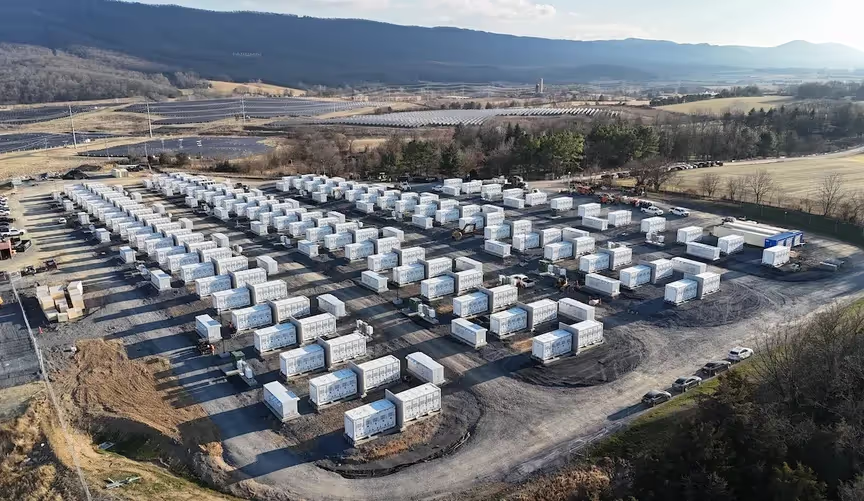
The mid-Atlantic grid operator PJM Interconnection faces a capacity crunch of titanic proportions as AI computing investment rushes headlong into its 13-state region, home to more than 67 million people. The most recent PJM capacity auctions — where the grid operator pays in advance for power plants to be available to serve the grid — hit record-high clearing prices in December, portending more expensive electricity for the region.
The developer Elevate Renewables is tackling that dire need by accomplishing something unheard of in the PJM region: building a really big battery. The company, launched by private equity firm ArcLight in 2022, announced today that it had acquired a 150-megawatt/600-megawatt-hour battery project in northern Virginia and will complete construction by mid-2026. Called Prospect Power, the project could be bolstering the grid near the state’s famed “Data Center Alley” just in time for the summer spike in electricity use.
“The states want capacity, they want affordability, they want in-state resources,” Elevate CEO Joshua Rogol told Canary Media. “Storage can clearly be part of the solution to that problem. It is one of the few resources that can come online quickly, given how long it takes to develop and build a project given the supply chain as it exists today.”
Fossil gas still generates more power across the U.S. than any other resource, but battery storage has become the top source of on-demand power being built today (solar, as an intermittent producer, does not meet that definition).
However, almost all the storage action, and its resulting benefits, has happened in California and Texas. Data firm Modo Energy drew the comparison in a report last year: “In the past five years, PJM has added just 200 MW of grid-scale battery capacity — while Texas and California have cumulatively built more than 20 GW of [battery energy storage systems] over the same period.” It’s as if a major swath of the country saw a few states adopting smartphones and said, “No, thanks, we’re happy with flip phones.”
PJM’s failure to keep up with this particular grid technology is particularly surprising because PJM actually created the modern storage market back in 2012, by letting batteries compete for the rapid-fire grid service known as frequency regulation. Those rules spurred a buildout of 181 megawatts by 2016, according to Modo — heady stuff at the time, and well before storage in California and Texas took off. But these batteries tended to have just 15 minutes of duration, because that’s all that was needed to perform that role for the grid.
“The economic strategy was always to build a very short-duration battery, just participate in regulation services and make really substantial returns that way,” said Julia Hoos, head of USA East at Aurora Energy Research.
Frequency regulation has stayed lucrative for battery owners, Hoos noted, in part due to quirks in PJM’s rules that reserved some of the market for thermal generators like gas plants, which set a higher clearing price than batteries do. But rule changes now underway will likely reduce the payoff in future years.
In any case, the amount of regulation PJM needs for the grid isn’t enough to support a larger battery buildout on its own. Currently, PJM has more than 400 megawatts of batteries operating, meaning individual projects elsewhere in the country contain more battery capacity than is in the entirety of the nation’s largest wholesale market.
Beyond the limited regulation market, PJM’s rules and market dynamics make it hard for developers to finance storage projects. In California and Texas, battery owners can profit by charging up at times when solar generation makes grid power very cheap and selling back to the grid when prices are high. But PJM doesn’t experience that level of daily swing from cheap to expensive power, Hoos said.
Battery developers could try to make money instead by committing their batteries in the capacity auction. However, PJM awards capacity contracts on a one-year basis, which prevents developers from locking down long-term revenue certainty, like they can in California.
Aurora modeled a hypothetical four-hour duration battery in Virginia and found that half its revenue would come from capacity payments and half from energy arbitrage. But, Hoos added, “the revenue from both of those is still not enough for an investor to build a merchant battery.”
Prospect Power could be the project that breaks the dry spell, and it’s taken many hands to make that possible.
Storage specialist Eolian Energy, known for its pioneering battery construction in Texas, started developing the project back around 2017 in a joint venture with Open Road Renewable Energy. Eolian CEO Aaron Zubaty wanted to place a project “anywhere we could within a 100-mile radius of northern Virginia to feed the data center load growth.” But Data Center Alley is ringed by rolling Virginia horse country, where landowners were not enthusiastic about power plant construction.
The joint venture ended up securing a parcel farther west, over the Blue Ridge Mountains, that could ship power directly to northern Virginia. In 2023, the joint venture sold the project to Swift Current Energy, which secured a 15-year contract from utility Dominion Energy. That dependable revenue stream helped Swift Current lock down a $242 million financing package last September to build the project.
Now, Elevate has emerged as the long-term owner, which will operate the finished battery just in time to navigate the choppy waters of PJM amid the AI boom.
The Prospect battery broke through the PJM logjam because state policy created an opening.
PJM governs the energy markets for the whole region, but individual states can layer on their own policies, and Virginia passed a comprehensive clean energy law in 2020. This law sets a 100% renewable electricity target and requires Dominion, the largest utility in the state, to procure 2.7 gigawatts of energy storage by 2035, some of which must be owned by third parties.
Virginia also has long been home to the densest cluster of data centers in the world, stemming from Cold War defense investments that kick-started a dense fiber-optic network there. That has naturally evolved into ground zero for AI computing investment, which is putting utilities in a bind as they try to figure out how to deliver enough power for the new computing behemoths.
“There is a need for capacity, and the states are stepping up to incent that battery capacity to come online, to drive affordability and reliability,” Elevate’s Rogol said.
Prospect checks off part of Dominion’s energy storage obligation under state law, and it delivers a powerful tool for meeting Data Center Alley’s needs during peak hours, when the grid might struggle.
As for what the battery will do exactly, the short answer is, whatever Dominion asks for. Under the contract, known as a tolling agreement, Elevate will own the battery and keep it in fine working condition, Rogol said, while Dominion will dispatch it to monetize regulation, energy arbitrage, and capacity as it sees fit.
The conditions that made Prospect possible, then, aren’t in place across most of PJM’s territory, though the PJM states of Illinois, New Jersey, and Maryland have enacted policies that support storage build-out, too. Prospect may be a lonely giant for a few more years, but the sheer need for more capacity should change that sooner or later.
“With limited availability of gas turbines; constraints on gas fuel supply; challenges siting, permitting, and building new gas plants; and a limited number of gas plants in advanced development, it is difficult to see how growing demand in PJM will be met anytime soon without a lot of storage filling the gap,” said Brent Nelson, managing director of markets and strategy at the research firm Ascend Analytics. “But mechanisms to provide stable revenues will be critical for getting projects financed and built.”
When the PJM region figures out those mechanisms, Zubaty expects the situation to improve.
“It’s evolving very quickly,” he said of the storage market in PJM. “I think people are going to be surprised. It’s going to go from being totally dead to seeing a huge amount of build.”
Originally published in Canary Media, January 15, 2026 by Julian Spector
The mid-Atlantic grid operator PJM Interconnection faces a capacity crunch of titanic proportions as AI computing investment rushes headlong into its 13-state region, home to more than 67 million people. The most recent PJM capacity auctions — where the grid operator pays in advance for power plants to be available to serve the grid — hit record-high clearing prices in December, portending more expensive electricity for the region.
The developer Elevate Renewables is tackling that dire need by accomplishing something unheard of in the PJM region: building a really big battery. The company, launched by private equity firm ArcLight in 2022, announced today that it had acquired a 150-megawatt/600-megawatt-hour battery project in northern Virginia and will complete construction by mid-2026. Called Prospect Power, the project could be bolstering the grid near the state’s famed “Data Center Alley” just in time for the summer spike in electricity use.
“The states want capacity, they want affordability, they want in-state resources,” Elevate CEO Joshua Rogol told Canary Media. “Storage can clearly be part of the solution to that problem. It is one of the few resources that can come online quickly, given how long it takes to develop and build a project given the supply chain as it exists today.”
Fossil gas still generates more power across the U.S. than any other resource, but battery storage has become the top source of on-demand power being built today (solar, as an intermittent producer, does not meet that definition).
However, almost all the storage action, and its resulting benefits, has happened in California and Texas. Data firm Modo Energy drew the comparison in a report last year: “In the past five years, PJM has added just 200 MW of grid-scale battery capacity — while Texas and California have cumulatively built more than 20 GW of [battery energy storage systems] over the same period.” It’s as if a major swath of the country saw a few states adopting smartphones and said, “No, thanks, we’re happy with flip phones.”
PJM’s failure to keep up with this particular grid technology is particularly surprising because PJM actually created the modern storage market back in 2012, by letting batteries compete for the rapid-fire grid service known as frequency regulation. Those rules spurred a buildout of 181 megawatts by 2016, according to Modo — heady stuff at the time, and well before storage in California and Texas took off. But these batteries tended to have just 15 minutes of duration, because that’s all that was needed to perform that role for the grid.
“The economic strategy was always to build a very short-duration battery, just participate in regulation services and make really substantial returns that way,” said Julia Hoos, head of USA East at Aurora Energy Research.
Frequency regulation has stayed lucrative for battery owners, Hoos noted, in part due to quirks in PJM’s rules that reserved some of the market for thermal generators like gas plants, which set a higher clearing price than batteries do. But rule changes now underway will likely reduce the payoff in future years.
In any case, the amount of regulation PJM needs for the grid isn’t enough to support a larger battery buildout on its own. Currently, PJM has more than 400 megawatts of batteries operating, meaning individual projects elsewhere in the country contain more battery capacity than is in the entirety of the nation’s largest wholesale market.
Beyond the limited regulation market, PJM’s rules and market dynamics make it hard for developers to finance storage projects. In California and Texas, battery owners can profit by charging up at times when solar generation makes grid power very cheap and selling back to the grid when prices are high. But PJM doesn’t experience that level of daily swing from cheap to expensive power, Hoos said.
Battery developers could try to make money instead by committing their batteries in the capacity auction. However, PJM awards capacity contracts on a one-year basis, which prevents developers from locking down long-term revenue certainty, like they can in California.
Aurora modeled a hypothetical four-hour duration battery in Virginia and found that half its revenue would come from capacity payments and half from energy arbitrage. But, Hoos added, “the revenue from both of those is still not enough for an investor to build a merchant battery.”
Prospect Power could be the project that breaks the dry spell, and it’s taken many hands to make that possible.
Storage specialist Eolian Energy, known for its pioneering battery construction in Texas, started developing the project back around 2017 in a joint venture with Open Road Renewable Energy. Eolian CEO Aaron Zubaty wanted to place a project “anywhere we could within a 100-mile radius of northern Virginia to feed the data center load growth.” But Data Center Alley is ringed by rolling Virginia horse country, where landowners were not enthusiastic about power plant construction.
The joint venture ended up securing a parcel farther west, over the Blue Ridge Mountains, that could ship power directly to northern Virginia. In 2023, the joint venture sold the project to Swift Current Energy, which secured a 15-year contract from utility Dominion Energy. That dependable revenue stream helped Swift Current lock down a $242 million financing package last September to build the project.
Now, Elevate has emerged as the long-term owner, which will operate the finished battery just in time to navigate the choppy waters of PJM amid the AI boom.
The Prospect battery broke through the PJM logjam because state policy created an opening.
PJM governs the energy markets for the whole region, but individual states can layer on their own policies, and Virginia passed a comprehensive clean energy law in 2020. This law sets a 100% renewable electricity target and requires Dominion, the largest utility in the state, to procure 2.7 gigawatts of energy storage by 2035, some of which must be owned by third parties.
Virginia also has long been home to the densest cluster of data centers in the world, stemming from Cold War defense investments that kick-started a dense fiber-optic network there. That has naturally evolved into ground zero for AI computing investment, which is putting utilities in a bind as they try to figure out how to deliver enough power for the new computing behemoths.
“There is a need for capacity, and the states are stepping up to incent that battery capacity to come online, to drive affordability and reliability,” Elevate’s Rogol said.
Prospect checks off part of Dominion’s energy storage obligation under state law, and it delivers a powerful tool for meeting Data Center Alley’s needs during peak hours, when the grid might struggle.
As for what the battery will do exactly, the short answer is, whatever Dominion asks for. Under the contract, known as a tolling agreement, Elevate will own the battery and keep it in fine working condition, Rogol said, while Dominion will dispatch it to monetize regulation, energy arbitrage, and capacity as it sees fit.
The conditions that made Prospect possible, then, aren’t in place across most of PJM’s territory, though the PJM states of Illinois, New Jersey, and Maryland have enacted policies that support storage build-out, too. Prospect may be a lonely giant for a few more years, but the sheer need for more capacity should change that sooner or later.
“With limited availability of gas turbines; constraints on gas fuel supply; challenges siting, permitting, and building new gas plants; and a limited number of gas plants in advanced development, it is difficult to see how growing demand in PJM will be met anytime soon without a lot of storage filling the gap,” said Brent Nelson, managing director of markets and strategy at the research firm Ascend Analytics. “But mechanisms to provide stable revenues will be critical for getting projects financed and built.”
When the PJM region figures out those mechanisms, Zubaty expects the situation to improve.
“It’s evolving very quickly,” he said of the storage market in PJM. “I think people are going to be surprised. It’s going to go from being totally dead to seeing a huge amount of build.”
Ascend Analytics is the leading provider of market intelligence and analytics solutions for the power industry.
The company’s offerings enable decision makers in power supply, procurement, and investment markets to plan, operate, monetize, and manage risk across any energy asset portfolio. From real-time to 30-year horizons, their forecasts and insights are at the foundation of over $50 billion in project financing assessments.
Ascend provides energy market stakeholders with the clarity and confidence to successfully navigate the rapidly shifting energy landscape.


.png)
.avif)
.png)

