Let's Connect
Contact us
Thank you for reaching out, we will be in touch shortly!
Oops! Something went wrong while submitting the form.

.avif)
As one of the largest public power utilities in the United States and the second largest municipally owned utility within the Electric Reliability Council of Texas (ERCOT) footprint, Austin Energy delivers electricity and other utility services to more than 550,000 customers within the City of Austin and its surrounding community.
Faced with rapid population growth, evolving customer demands, a changing policy environment and increasing expectations for reliability, affordability, and decarbonization, Austin Energy found itself at a pivotal moment. Its previous resource plans were coming up against new stresses: retired generation assets, increasing peak loads (including summer peaks and growing winter exposure), transmission import constraints, extreme weather risks, and accelerating goals for clean energy.
In response, Austin Energy embarked on the creation of a Resource, Generation & Climate Protection Plan to 2035 (the '2035 Plan') to generate a flexible, actionable road map that would identify achievable pathways to meet clean energy targets amid tradeoffs between emissions, costs, and reliability across resource portfolios.
Ascend Analytics was engaged to conduct a comprehensive resource planning study using its PowerSIMM™ stochastic modeling solution, which is leveraged by utilities, community choice aggregators, independent power producers, and developers for both short- and long-term portfolio management, project optimization, and planning purposes. Ascend's advanced modeling served to explore scenarios, evaluate trade-offs among Austin Energy’s priorities, and serve as a refinement resource to Austin Energy’s existing production cost modeling and power system simulation tool. Ascend's modeling enabled Austin Energy to evaluate resource portfolios under multiple assumptions related to load growth, transmission/ import constraints, asset retirements, extreme weather events, technological change, and cost trajectories.
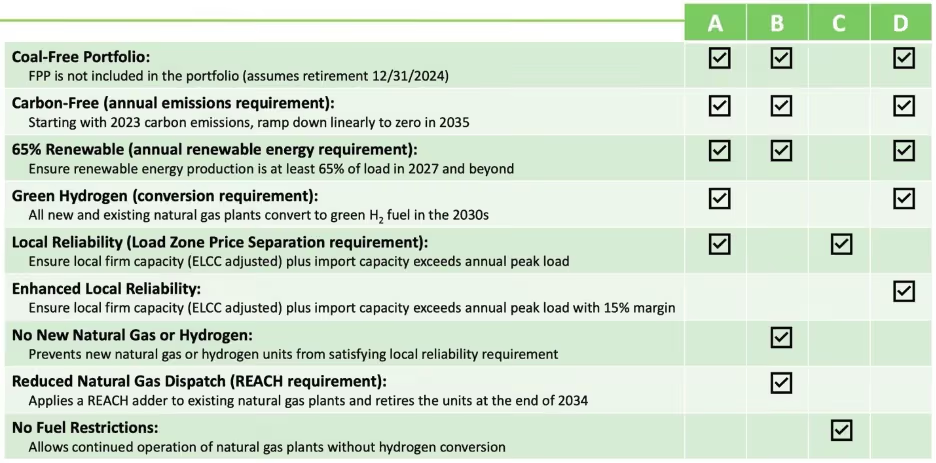
To start its modeling and evaluation work, the Ascend team analyzed the existing system and determined a group of feasible candidate resources for inclusion within the analysis. Following an initial round of modeling, in which PowerSIMM deployed a stochastic capacity expansion model to identify a range of portfolios, the Ascend team worked with Austin Energy to further study the following four options:
These four scenarios were designed to highlight the tradeoffs between cost, emissions, and reliability, providing key insights into the resource planning analysis. As shown in Figure 1, Austin Energy also required that the portfolios meet a variety of other criteria related to resource type, local reliability, and annual emissions/energy requirements.
These scenarios were then put through high-fidelity production cost models that leveraged Ascend's Opportunity Cost Forecasting Framework to reveal a detailed breakdown of costs, emissions, and reliability, complete with both averages and uncertainty ranges.
Ascend's analyses equipped key stakeholders, including Austin Energy's leadership team, the Austin Electric Utility Commission, and the Austin City Council, with insights needed to make informed decisions regarding the creation of the 2035 Plan. In addition, Ascend's modeling work also provided a complementary lens that allowed Austin Energy to evaluate the outcomes from their own in-house modeling processes.
Ultimately, as illustrated in Figure 2, the scenario analyses allowed Austin Energy to appropriately consider the following factors:
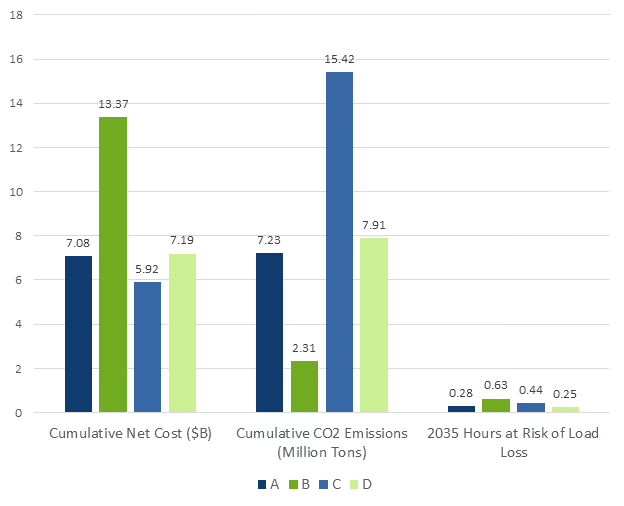
Ascend’s modeling confirmed the importance of ensuring reliability by building local resources, including solar, batteries, and natural gas peakers. While a clear 'winner' did not emerge from the test portfolios, the results of Ascend's analysis provided the clarity needed for Austin Energy to recommend a final plan that included the resources and strategies needed to ensure reliability while providing clean, affordable energy.
Ultimately, Austin Energy landed on a flexible approach that prioritized customer energy solutions such as energy efficiency measures, demand response, rooftop solar and customer-sited batteries, while also committing to local resource solutions that included utility-scale solar, utility-scale batteries, and more efficient natural gas peaker units with emissions guardrails. At the same time, Austin Energy reaffirmed its commitment to reaching 100% carbon-free generation as a percentage of load by 2035 while recognizing the need for technology evolution as an enabling factor. Two months after Ascend delivered its final modeling results, the Austin City Council unanimously voted to adopt Austin Energy’s plan.
"Another advantage with Ascend is the ability to generate a range of expected outcomes instead of a single data point. They do this by running their portfolios through 100 future situations to generate a range of outcomes," Austin Energy noted in the final version of the Resource, Generation and Climate Protection Plan to 2035. "This range includes the average outcome as well as the 5th and 95th percentiles to represent the outer edge possibilities. This is helpful in understanding uncertainty and the significance of variability in events."
PowerSIMM™ Suite is Ascend’s energy analytics solution for resource planning, valuation, and portfolio management. PowerSIMM incorporates variability in physical and market conditions, ensuring that decisions weight and properly value future events. Utilities, public power entities, renewable developers, and community choice aggregators utilize PowerSIMM for optimal energy portfolio management, resource planning, and project optimization.
As one of the largest public power utilities in the United States and the second largest municipally owned utility within the Electric Reliability Council of Texas (ERCOT) footprint, Austin Energy delivers electricity and other utility services to more than 550,000 customers within the City of Austin and its surrounding community.
Faced with rapid population growth, evolving customer demands, a changing policy environment and increasing expectations for reliability, affordability, and decarbonization, Austin Energy found itself at a pivotal moment. Its previous resource plans were coming up against new stresses: retired generation assets, increasing peak loads (including summer peaks and growing winter exposure), transmission import constraints, extreme weather risks, and accelerating goals for clean energy.
In response, Austin Energy embarked on the creation of a Resource, Generation & Climate Protection Plan to 2035 (the '2035 Plan') to generate a flexible, actionable road map that would identify achievable pathways to meet clean energy targets amid tradeoffs between emissions, costs, and reliability across resource portfolios.
Ascend Analytics was engaged to conduct a comprehensive resource planning study using its PowerSIMM™ stochastic modeling solution, which is leveraged by utilities, community choice aggregators, independent power producers, and developers for both short- and long-term portfolio management, project optimization, and planning purposes. Ascend's advanced modeling served to explore scenarios, evaluate trade-offs among Austin Energy’s priorities, and serve as a refinement resource to Austin Energy’s existing production cost modeling and power system simulation tool. Ascend's modeling enabled Austin Energy to evaluate resource portfolios under multiple assumptions related to load growth, transmission/ import constraints, asset retirements, extreme weather events, technological change, and cost trajectories.
To start its modeling and evaluation work, the Ascend team analyzed the existing system and determined a group of feasible candidate resources for inclusion within the analysis. Following an initial round of modeling, in which PowerSIMM deployed a stochastic capacity expansion model to identify a range of portfolios, the Ascend team worked with Austin Energy to further study the following four options:
These four scenarios were designed to highlight the tradeoffs between cost, emissions, and reliability, providing key insights into the resource planning analysis. As shown in Figure 1, Austin Energy also required that the portfolios meet a variety of other criteria related to resource type, local reliability, and annual emissions/energy requirements.
These scenarios were then put through high-fidelity production cost models that leveraged Ascend's Opportunity Cost Forecasting Framework to reveal a detailed breakdown of costs, emissions, and reliability, complete with both averages and uncertainty ranges.
Ascend's analyses equipped key stakeholders, including Austin Energy's leadership team, the Austin Electric Utility Commission, and the Austin City Council, with insights needed to make informed decisions regarding the creation of the 2035 Plan. In addition, Ascend's modeling work also provided a complementary lens that allowed Austin Energy to evaluate the outcomes from their own in-house modeling processes.
Ultimately, as illustrated in Figure 2, the scenario analyses allowed Austin Energy to appropriately consider the following factors:
Ascend’s modeling confirmed the importance of ensuring reliability by building local resources, including solar, batteries, and natural gas peakers. While a clear 'winner' did not emerge from the test portfolios, the results of Ascend's analysis provided the clarity needed for Austin Energy to recommend a final plan that included the resources and strategies needed to ensure reliability while providing clean, affordable energy.
Ultimately, Austin Energy landed on a flexible approach that prioritized customer energy solutions such as energy efficiency measures, demand response, rooftop solar and customer-sited batteries, while also committing to local resource solutions that included utility-scale solar, utility-scale batteries, and more efficient natural gas peaker units with emissions guardrails. At the same time, Austin Energy reaffirmed its commitment to reaching 100% carbon-free generation as a percentage of load by 2035 while recognizing the need for technology evolution as an enabling factor. Two months after Ascend delivered its final modeling results, the Austin City Council unanimously voted to adopt Austin Energy’s plan.
"Another advantage with Ascend is the ability to generate a range of expected outcomes instead of a single data point. They do this by running their portfolios through 100 future situations to generate a range of outcomes," Austin Energy noted in the final version of the Resource, Generation and Climate Protection Plan to 2035. "This range includes the average outcome as well as the 5th and 95th percentiles to represent the outer edge possibilities. This is helpful in understanding uncertainty and the significance of variability in events."
PowerSIMM™ Suite is Ascend’s energy analytics solution for resource planning, valuation, and portfolio management. PowerSIMM incorporates variability in physical and market conditions, ensuring that decisions weight and properly value future events. Utilities, public power entities, renewable developers, and community choice aggregators utilize PowerSIMM for optimal energy portfolio management, resource planning, and project optimization.
Ascend Analytics is the leading provider of market intelligence and analytics solutions for the power industry.
The company’s offerings enable decision makers in power development and supply procurement to maximize the value of planning, operating, and managing risk for renewable, storage, and other assets. From real-time to 30-year horizons, their forecasts and insights are at the foundation of over $50 billion in project financing assessments.
Ascend provides energy market stakeholders with the clarity and confidence to successfully navigate the rapidly shifting energy landscape.


.avif)

.avif)