Let's Connect
Contact us
Thank you for reaching out, we will be in touch shortly!
Oops! Something went wrong while submitting the form.


By Dr. Brent Nelson, Senior Managing Director of Market Intelligence, and Robert LaFaso, Director of Market Intelligence, Ascend Analytics®
Natural gas generation is generally considered the practical, and even optimal, solution for meeting growing electricity demand and reliability requirements. However, that assumption is increasingly being challenged by rising construction costs, equipment and labor shortages, fuel infrastructure constraints, and performance challenges during severe winter weather events.
At the same time, changing power market fundamentals and improving storage economics are shifting the competitiveness alternative resources relative to gas. While natural gas will continue to play an important role in meeting extended reliability needs in many US power markets, utilities and large-load developers have a stronger economic case for evaluating storage, flexible interconnections, and diversified resource portfolios as an alternative to new gas generation.
Supply chain shortages and EPC constraints are extending natural gas project development timelines while sharply increasing gas generation costs. Gas infrastructure considerations create another bottleneck: new plants may require pipeline expansion or firm transportation capacity that may have its own development timeline. Even completed facilities can face operating restrictions if sufficient fuel cannot be delivered during peak conditions.
Gas turbine capital costs have also roughly tripled in recent years, with some estimates approaching four times earlier levels. These cost increases create investment risk if turbine supply eventually normalizes. Projects developed at today's elevated equipment prices could become less competitive than subsequent facilities constructed at lower costs. Combined with uncertainty related to timing, this makes new gas investments considerably more difficult to justify under conventional cost and schedule assumptions.
Severe winter weather is increasingly becoming the binding reliability constraint on the grid through much of the US, with simultaneously elevated electricity demand and reduced gas generation availability.
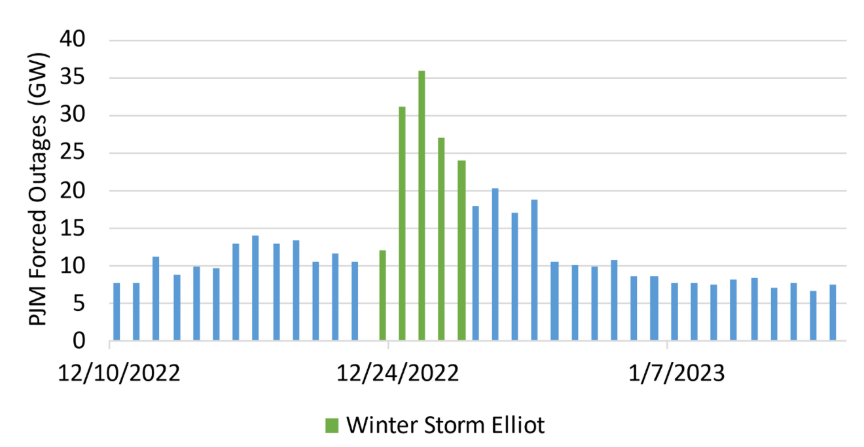
Severe cold can disrupt natural gas production and transportation, restrict fuel availability, and cause elevated generating equipment failures. As shown in Figure 1, for example, PJM systemwide outages during Winter Storm Elliott totaled 24% of capacity, driven primarily by natural gas. As a result, most thermal generators are now being accredited significantly below their nameplate capacity due to their outage risk during severe weather.
Additionally, facilities dependent on interruptible gas transportation can be exposed when heating demand competes for pipeline capacity. BTM gas generation may face similar vulnerabilities during the same conditions that trigger grid curtailments.
Storage faces a different limitation. Extended winter peaks, compounded by heightened thermal outages during severe cold, can deplete storage resources precisely when system reserves are most constrained. As a result, storage also receives particularly low capacity accreditation in markets with significant winter reliability risks. In PJM, for example, effective load carrying capability (ELCC) accreditations are 55%, 65%, and 68% for four-hour, six-hour, and eight-hour storage, respectively. Thus both gas and storage experience reduced accreditation as winter conditions become the primary reliability constraint, although for different operational reasons.
The relative economics of gas and storage have shifted as gas capital costs have escalated, storage has benefited from investment incentives, and changing market fundamentals have weakened gas generation revenues. Driven primarily by gas turbine supply shortages and rising EPC costs, new gas generation now costs an estimated $2,500–$3,000/kW, with more recent reports closer to $3,500/kW, compared with approximately $1,400/kW for four-hour storage, or $700/kW assuming a 30% investment tax credit (ITC), 10% bonus adder for being in an energy community, and ~10% of additional value from a step-up transaction.
The revenue comparison has also changed substantially. Increasing renewable generation reduces wholesale electricity prices across many hours, compressing gas spark spreads and limiting margins. Additional low-marginal-cost generation can also put downward pressure on market heat rates, even as demand increases. At the same time, storage buildout erodes most of the value in ancillary services markets. Storage benefits from some of these same price dynamics. Although ancillary services value declines, greater renewable penetration can increase price differences between periods of abundant generation and periods when renewable output declines, creating arbitrage opportunities even as average power prices stay low.
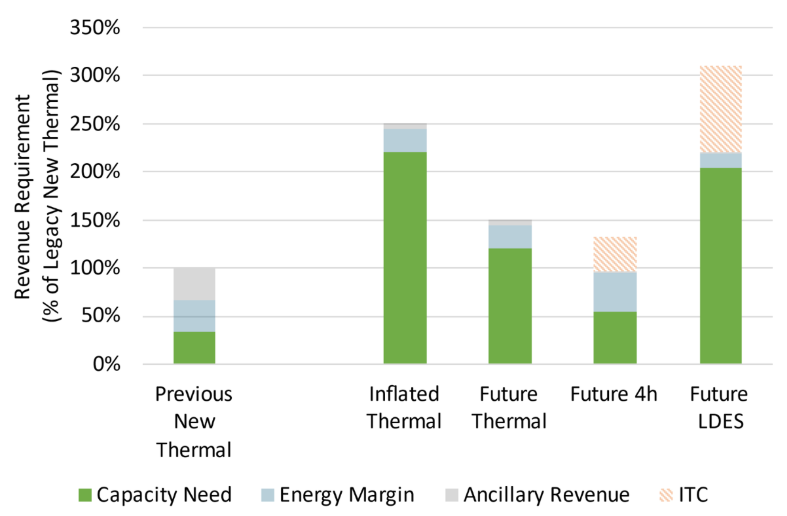
For gas generation, rising capital costs and declining merchant revenues increase the fixed-cost recovery required from capacity payments or long-term contracts, known as the Net Cost of New Entry (Net CONE). Storage, by contrast, reduces its Net CONE with revenue from energy arbitrage. Both suffer from increased Net CONE due to low accreditation during severe winter conditions. As Figure 2 illustrates, these differences, together with capital costs and tax incentives yield different Net CONEs by asset type.
Beyond current capacity accreditation, storage accreditation declines as shaved demand peaks lengthen with storage buildout. Gas, in contrast, has no such decline with resource buildout. In PJM, for example, combined-cycle gas generation becomes the clear lowest-cost new entry capacity resource by the mid-2030s in some locations. Differences among gas technologies also matter. Natural gas combined cycles have significantly higher energy margins and capacity accreditation than simple cycle turbines while exhibiting a more modest price premium than several years ago. Reciprocating internal combustion engines (RICE) offer flexible operation, with capital costs that have not risen as much as combustion turbines.
Gas generation remains valuable for extended-duration reliability, particularly in markets where dependable fuel supply is available. However, the shifting economics outlined above mean that appropriate resource selection increasingly depends on matching the technology, or combination of technologies, to the duration and conditions of the reliability need.
For utilities, resource selection should account for fuel security, storage duration, and correlated outage risks. A diversified portfolio can provide greater reliability value than the sum of individual resource contributions, particularly when technologies respond differently to extreme weather. Capacity planning should reflect those interactions rather than rely on technology-specific accreditation in isolation.
Large load developers may find that taking a flexible approach to resource selection increases speed to power with minimal reduction in reliability, especially in markets where severe grid shortages occur infrequently and the cost of providing uninterrupted power is disproportionately high. For instance, pairing a curtailable grid interconnection with BTM storage could provide a faster, less expensive alternative to building dedicated generation for data centers.
Long-term gas investments may also face political and regulatory uncertainty. Changes in state or federal energy policy, permitting requirements, and emissions regulations could alter project economics even within a plant’s development timeline, let alone its operating life, increasing the risk of committing capital under today's assumptions. Project siting and power decisions must be robust against a range of potential political outcomes.
AscendMI™ (Ascend Market Intelligence) delivers proprietary power market forecasts that have been trusted in hundreds of projects and resource planning activities, supporting over $50 billion in project financing assessments. Contact us to learn more.
By Dr. Brent Nelson, Senior Managing Director of Market Intelligence, and Robert LaFaso, Director of Market Intelligence, Ascend Analytics®
Natural gas generation is generally considered the practical, and even optimal, solution for meeting growing electricity demand and reliability requirements. However, that assumption is increasingly being challenged by rising construction costs, equipment and labor shortages, fuel infrastructure constraints, and performance challenges during severe winter weather events.
At the same time, changing power market fundamentals and improving storage economics are shifting the competitiveness alternative resources relative to gas. While natural gas will continue to play an important role in meeting extended reliability needs in many US power markets, utilities and large-load developers have a stronger economic case for evaluating storage, flexible interconnections, and diversified resource portfolios as an alternative to new gas generation.
Supply chain shortages and EPC constraints are extending natural gas project development timelines while sharply increasing gas generation costs. Gas infrastructure considerations create another bottleneck: new plants may require pipeline expansion or firm transportation capacity that may have its own development timeline. Even completed facilities can face operating restrictions if sufficient fuel cannot be delivered during peak conditions.
Gas turbine capital costs have also roughly tripled in recent years, with some estimates approaching four times earlier levels. These cost increases create investment risk if turbine supply eventually normalizes. Projects developed at today's elevated equipment prices could become less competitive than subsequent facilities constructed at lower costs. Combined with uncertainty related to timing, this makes new gas investments considerably more difficult to justify under conventional cost and schedule assumptions.
Severe winter weather is increasingly becoming the binding reliability constraint on the grid through much of the US, with simultaneously elevated electricity demand and reduced gas generation availability.
Severe cold can disrupt natural gas production and transportation, restrict fuel availability, and cause elevated generating equipment failures. As shown in Figure 1, for example, PJM systemwide outages during Winter Storm Elliott totaled 24% of capacity, driven primarily by natural gas. As a result, most thermal generators are now being accredited significantly below their nameplate capacity due to their outage risk during severe weather.
Additionally, facilities dependent on interruptible gas transportation can be exposed when heating demand competes for pipeline capacity. BTM gas generation may face similar vulnerabilities during the same conditions that trigger grid curtailments.
Storage faces a different limitation. Extended winter peaks, compounded by heightened thermal outages during severe cold, can deplete storage resources precisely when system reserves are most constrained. As a result, storage also receives particularly low capacity accreditation in markets with significant winter reliability risks. In PJM, for example, effective load carrying capability (ELCC) accreditations are 55%, 65%, and 68% for four-hour, six-hour, and eight-hour storage, respectively. Thus both gas and storage experience reduced accreditation as winter conditions become the primary reliability constraint, although for different operational reasons.
The relative economics of gas and storage have shifted as gas capital costs have escalated, storage has benefited from investment incentives, and changing market fundamentals have weakened gas generation revenues. Driven primarily by gas turbine supply shortages and rising EPC costs, new gas generation now costs an estimated $2,500–$3,000/kW, with more recent reports closer to $3,500/kW, compared with approximately $1,400/kW for four-hour storage, or $700/kW assuming a 30% investment tax credit (ITC), 10% bonus adder for being in an energy community, and ~10% of additional value from a step-up transaction.
The revenue comparison has also changed substantially. Increasing renewable generation reduces wholesale electricity prices across many hours, compressing gas spark spreads and limiting margins. Additional low-marginal-cost generation can also put downward pressure on market heat rates, even as demand increases. At the same time, storage buildout erodes most of the value in ancillary services markets. Storage benefits from some of these same price dynamics. Although ancillary services value declines, greater renewable penetration can increase price differences between periods of abundant generation and periods when renewable output declines, creating arbitrage opportunities even as average power prices stay low.
For gas generation, rising capital costs and declining merchant revenues increase the fixed-cost recovery required from capacity payments or long-term contracts, known as the Net Cost of New Entry (Net CONE). Storage, by contrast, reduces its Net CONE with revenue from energy arbitrage. Both suffer from increased Net CONE due to low accreditation during severe winter conditions. As Figure 2 illustrates, these differences, together with capital costs and tax incentives yield different Net CONEs by asset type.
Beyond current capacity accreditation, storage accreditation declines as shaved demand peaks lengthen with storage buildout. Gas, in contrast, has no such decline with resource buildout. In PJM, for example, combined-cycle gas generation becomes the clear lowest-cost new entry capacity resource by the mid-2030s in some locations. Differences among gas technologies also matter. Natural gas combined cycles have significantly higher energy margins and capacity accreditation than simple cycle turbines while exhibiting a more modest price premium than several years ago. Reciprocating internal combustion engines (RICE) offer flexible operation, with capital costs that have not risen as much as combustion turbines.
Gas generation remains valuable for extended-duration reliability, particularly in markets where dependable fuel supply is available. However, the shifting economics outlined above mean that appropriate resource selection increasingly depends on matching the technology, or combination of technologies, to the duration and conditions of the reliability need.
For utilities, resource selection should account for fuel security, storage duration, and correlated outage risks. A diversified portfolio can provide greater reliability value than the sum of individual resource contributions, particularly when technologies respond differently to extreme weather. Capacity planning should reflect those interactions rather than rely on technology-specific accreditation in isolation.
Large load developers may find that taking a flexible approach to resource selection increases speed to power with minimal reduction in reliability, especially in markets where severe grid shortages occur infrequently and the cost of providing uninterrupted power is disproportionately high. For instance, pairing a curtailable grid interconnection with BTM storage could provide a faster, less expensive alternative to building dedicated generation for data centers.
Long-term gas investments may also face political and regulatory uncertainty. Changes in state or federal energy policy, permitting requirements, and emissions regulations could alter project economics even within a plant’s development timeline, let alone its operating life, increasing the risk of committing capital under today's assumptions. Project siting and power decisions must be robust against a range of potential political outcomes.
AscendMI™ (Ascend Market Intelligence) delivers proprietary power market forecasts that have been trusted in hundreds of projects and resource planning activities, supporting over $50 billion in project financing assessments. Contact us to learn more.
Ascend Analytics is the leading provider of market intelligence and analytics solutions for the power industry.
The company’s offerings enable decision makers in power supply, procurement, and investment markets to plan, operate, monetize, and manage risk across any energy asset portfolio. From real-time to 30-year horizons, their forecasts and insights are at the foundation of over $50 billion in project financing assessments.
Ascend provides energy market stakeholders with the clarity and confidence to successfully navigate the rapidly shifting energy landscape.