Let's Connect
Contact us
Thank you for reaching out, we will be in touch shortly!
Oops! Something went wrong while submitting the form.


Power markets are increasingly shaped by unprecedented levels of data center-driven load growth, uncertainty in utility-scale renewable production, the complexity of battery storage operational dynamics, and skyrocketing capacity prices. Prices and price formation mechanisms are fundamentally different than even a few years ago. As power markets become increasingly supply-constrained, prices are being set under conditions where small changes in demand or available generation can produce disproportionately large price movements.
In these environments, accurately representing system stress, and not just average operating conditions, becomes critical. Forecasts must capture the frequency and severity of scarcity conditions, the growing importance of demand flexibility, and the variability introduced by weather and other extreme events. Forecasting approaches that worked well in eras dominated by thermal generation, and even during the last half-decade of increasing renewable penetration, are no longer adequate.
As US energy markets enter an era in which large, concentrated, and responsive loads will push demand against the limits of supply, selecting the right forecast has never been more critical. Model-driven fundamental forecasts underpin nearly every aspect of energy planning processes and drive important decisions related to optimal dispatch, capacity expansion, resource adequacy, reliability planning, project/portfolio valuation, and investment.
Energy market forecasts serve as foundations for developers, utilities, independent power producers, energy project investors, asset owners and operators, and electric retailers. The right forecasts help minimize costs and risks, maximize returns, and optimize project siting, sizing, valuation, origination, and operation. As the grid becomes increasingly complex, choosing the right forecast can be the difference between profit and loss.
Forecasting methodologies are necessarily reflective of the markets they were designed to model. As energy markets evolve, forecasting methodologies must evolve, too.
Today’s high load growth energy markets are characterized by immense demand appetite constrained by the ability to rapidly add supply, as exemplified in Figure 1, in which ERCOT's large load interconnection queue has grown to approximately 450 GW, even though only about 40 GW of new generation can realistically be added by 2030. As markets move closer to the supply edge, forecasting errors become increasingly asymmetric.
.png)
The impact of this change cannot be understated: in surplus markets, small modeling errors have limited consequences because the system has ample supply. In supply-constrained markets, however, those same errors can lead to dramatically different forecasts because prices are determined by a relatively small number of high-stress, inelastic hours. As a result, the value of a forecasting methodology increasingly depends on how well it captures these extreme conditions in addition to how well it reproduces average market behavior.
This represents a significant shift from the dynamics of the past several decades. Thermal-era market forecasts leveraged simple production cost models, which worked well when large, weather-insensitive thermal generators could set prices while experiencing minimal net load misses in a mostly static energy policy environment. Forecasting renewable- and storage-era markets, in which weather increasingly became a key driver of both supply and demand, and thus price formation, required the inclusion of opportunity cost and storage economics modeling. The emerging data center era demands a framework that combines operational reality, inelastic system behavior, flexible and curtailable loads, and long-run economic equilibrium in a single methodology.
Three broad categories of methodologies exist for energy price forecasting. Each carries a distinct set of trade-offs, and none are optimal for accurately capturing the dynamics of modern power markets.
Econometric, statistical, and machine learning/AI models estimate prices based on correlations and patterns observed in historical data.
In a period of rapid grid transformation, backward-looking models face inherent structural challenges that no amount of calibration can fully overcome.
Production cost models (PCMs) remain the most commonly-used methodology in power market forecasting, as they simulate the hourly dispatch of every generator and transmission constraint on the grid, producing price estimates from least-cost optimization that are designed to reflect power market price formation.
Ascend developed its Opportunity Cost Forecasting Framework (OCFF) to address the limitations of both statistical and production cost models. At its core, the OCFF treats price as a function of opportunity cost determined by rational market participants bidding competitively, with long-run market equilibrium as the binding constraint.
Large data centers are geographically concentrated, highly responsive, and capable of both generating and suppressing volatility in ways that no prior modeling era was designed to capture. Addressing this limitation required an enhancement of the OCFF.
To accurately capture the new dynamics of the data center era, Ascend is enhancing its existing forecasting framework. The Enhanced Opportunity Cost Forecasting Framework (EOCFF) incorporates production cost modeling in the near term, where nodal precision matters most and system information is well known, then progressively transitions toward opportunity cost forecasting as input uncertainty grows over longer time horizons. This proprietary approach allows Ascend to holistically address the key challenges inherent in forecasting both today’s and tomorrow’s energy markets, as shown in Figure 2.
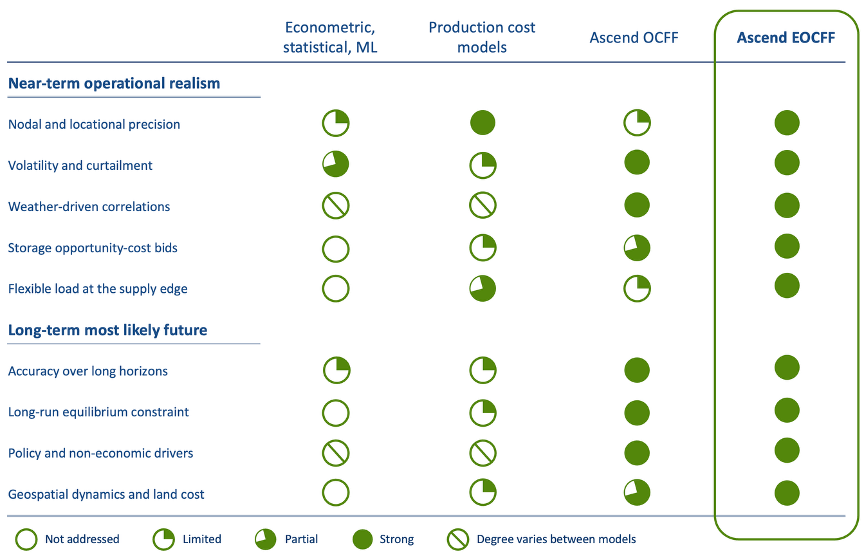
Today's markets operate simultaneously on two very different timescales. Near-term prices are determined by operational realities such as weather, outages, transmission constraints, storage dispatch, renewable variability, bidding behavior, and curtailment. However, long-term investment decisions depend on accounting realistically for decades of market evolution, generation additions, retirements, and policy changes, all while adhering to long-run economic equilibrium.
No single traditional modeling paradigm was designed to solve both problems equally well. As discussed in the previous section, a methodology that excels at one often sacrifices accuracy in the other. Thus, modern markets require forecasts that are operationally realistic in the short term while remaining economically consistent and defendable over the long term.
The EOCFF resolves this by weighting the two paradigms differently across the forecast horizon. To model near-term power market dynamics and prices, the EOCFF integrates production cost modeling, with an emphasis on the front where nodal precision is most valuable. As time horizons extend and input uncertainty increases, the framework still utilizes production cost modeling but progressively views the model outputs through an opportunity cost forecasting lens.
As illustrated in Figure 3, PCM carries the highest relative modeling importance in the near term, when interconnection queues, transmission plans, and load locations are relatively well known. As that information degrades, Ascend’s OCFF equilibrium-based framework becomes the dominant modeling lens.
Price formation has never been more complex in US energy markets. Electricity prices emerge from the interaction of weather, demand, renewable generation, transmission constraints, curtailment, outages, and market participant behavior, among other factors.
Accurately accounting for weather is especially important. For example, a hot summer afternoon may cause significant demand spikes while simultaneously reducing wind generation and creating localized transmission congestion. Together, these conditions can produce scarcity pricing that would never be predicted by modeling each variable independently.
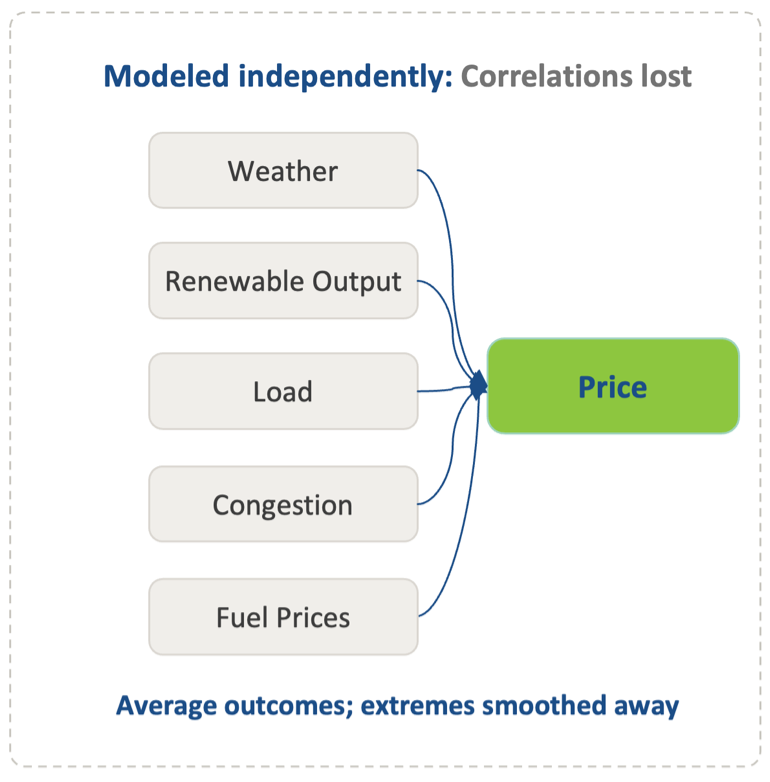
Many forecasting approaches accurately model individual market drivers but simplify the relationships between them, as illustrated in Figure 4. Some rely on representative weather years, average renewable generation profiles, independently modeled load forecasts, or simplified assumptions about transmission and operational conditions. These simplifications can produce reasonable average outcomes while failing to accurately reproduce the combinations of conditions that increasingly determine market outcomes.
Ascend, however, models the power system as an interconnected whole, preserving the physical relationships that exist across the power system rather than modeling each driver in isolation, as illustrated in Figure 5. Using PowerSIMM™, Ascend maintains realistic correlations between temperature, wind conditions, solar output, electricity demand, renewable generation, fuel prices, and transmission utilization while producing representative weather scenarios. These correlated inputs feed directly into detailed production cost simulations that capture how system conditions evolve hour by hour across the grid.
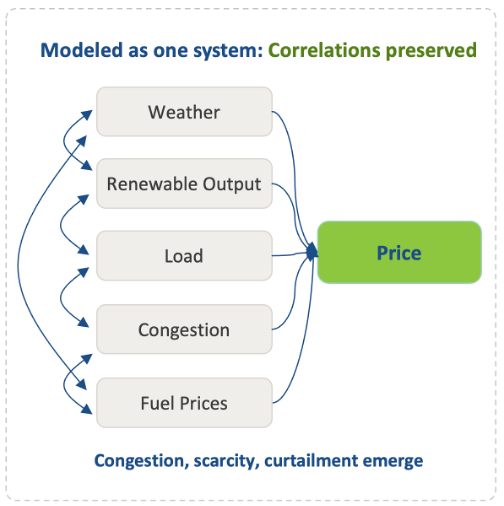
By using this approach, the EOCFF reproduces the operational conditions under which prices actually form, including the complex interactions that drive congestion, scarcity, renewable curtailment, and storage dispatch. This enables the framework to more accurately represent both everyday market behavior and the high-stress conditions that increasingly drive asset value.
Accurately reflecting the price formation dynamics of today’s and tomorrow’s energy markets requires accurately representing the operational realities that increasingly determine market outcomes. Data center-era markets will be fundamentally different than past ones, in which market conditions often looked similar from year to year.
That consistency no longer exists. Increasingly, a relatively small number of high-stress hours determine annual merchant revenues, generator economics, capacity values, congestion, and project valuations. Those hours cannot be approximated with average weather, average renewable profiles, simplified storage behavior, representative days, or single historical weather years, all of which can smooth away exactly the conditions that matter most for critical decisions related to planning, investment, and operations. Thus, as markets spend more time operating near the supply edge, accurately representing price formation during extreme conditions grows in importance.
Ascend's Enhanced Opportunity Cost Forecasting Framework addresses this challenge through distinct and complementary capabilities. These capabilities include typical meteorological year (TMY) weather modeling with appropriately correlated driving forces, detailed modeling of flexible and curtailable loads, granular storage simulation, and opportunity cost bidding. Together, these capabilities enable the EOCFF to accurately capture the system conditions under which energy markets increasingly set prices, in a way that is fundamentally different from other PCM-based forecasts.
As markets become increasingly dependent on weather-sensitive resources and operate closer to supply limits, accurately representing the relationships between temperature, renewable output, and load becomes essential. Simplified weather assumptions or reliance on a single historical year can understate system stress and distort price formation, particularly during the extreme conditions that disproportionately drive merchant revenue.
Many forecasting approaches either use a single historical weather year as a proxy for ‘typical’ conditions, making forecasts highly dependent on whichever year was selected, or simplify renewable production using average hourly or seasonal generation profiles that smooth away the variability responsible for many scarcity events.
Ascend avoids both limitations by producing weather inputs that are statistically representative of long-term conditions while retaining the hourly variability and correlations necessary for realistic market simulation. Leveraging the proprietary PowerSIMM simulation engine, Ascend constructs composite Typical Meteorological Years (TMYs), rather than relying on a single historical weather year, as illustrated in Figure 6.
.png)
This approach preserves the physical relationships between weather variables and electricity demand by maintaining temperature-to-load and renewable-to-temperature correlations while stitching together representative months from across multiple historical years. The result is a synthetic weather year that reflects long-term climatological conditions while preserving realistic daily load shapes and renewable generation profiles, including the natural variability and intermittency that characterize real-world system operations.
As electricity demand approaches available supply, markets become increasingly sensitive to relatively small changes in system conditions. Flexible demand, demand response, and curtailable loads, particularly from emerging large industrial and data center customers, can materially influence prices by reducing stress during critical hours. Capturing these dynamics is increasingly important as the market spends more time operating near the supply edge.
Many production cost model-based forecasting approaches continue to treat demand as largely static or represent demand response using simplified assumptions that fail to capture when and how flexible loads actually participate in markets.
Ascend instead explicitly models flexible demand resources, including curtailable load, price-responsive demand, and customer-specific flexibility thresholds. Rather than assuming demand is fixed regardless of market conditions, the framework allows loads to respond dynamically when prices exceed predefined economic thresholds. This enables Ascend to capture how flexible demand moderates scarcity events, influences dispatch decisions, shapes system reliability, and increasingly participates in price formation.
Battery energy storage systems (BESS) have evolved from a price taker into an active participant in price formation in multiple US energy markets. Storage simultaneously competes across energy and ancillary service markets while influencing investment decisions, generation dispatch, and future resource deployment.
Thus, accurately forecasting future markets requires capturing both how storage operates today, as well as how increasing storage penetration changes the market itself. Many forecasting methodologies, however, simplify storage as either a fixed dispatch resource or an arbitrage asset operating under static assumptions. As storage penetration increases, accurately representing these decisions becomes essential for forecasting market-clearing prices. Traditional production cost models often dispatch storage based primarily on short-term production cost optimization or deterministic arbitrage logic. These approaches can reasonably reproduce dispatch but frequently fail to capture the strategic bidding behavior that increasingly determines market-clearing prices.
Unlike thermal generators, storage decisions depend on the value of preserving energy for future opportunities. A battery's willingness to charge, discharge, or remain idle changes continuously based on expected future market conditions, making opportunity cost a central driver of bidding behavior.
Ascend models how storage actually participates in markets, with storage bidding based on the economic value of future operating opportunities rather than immediate production costs alone, as illustrated in Figure 7. The EOCFF models storage bidding dynamically according to multiple operational factors, including SoC, time of day, seasonal conditions, expected reserve margins, and anticipated future price opportunities.
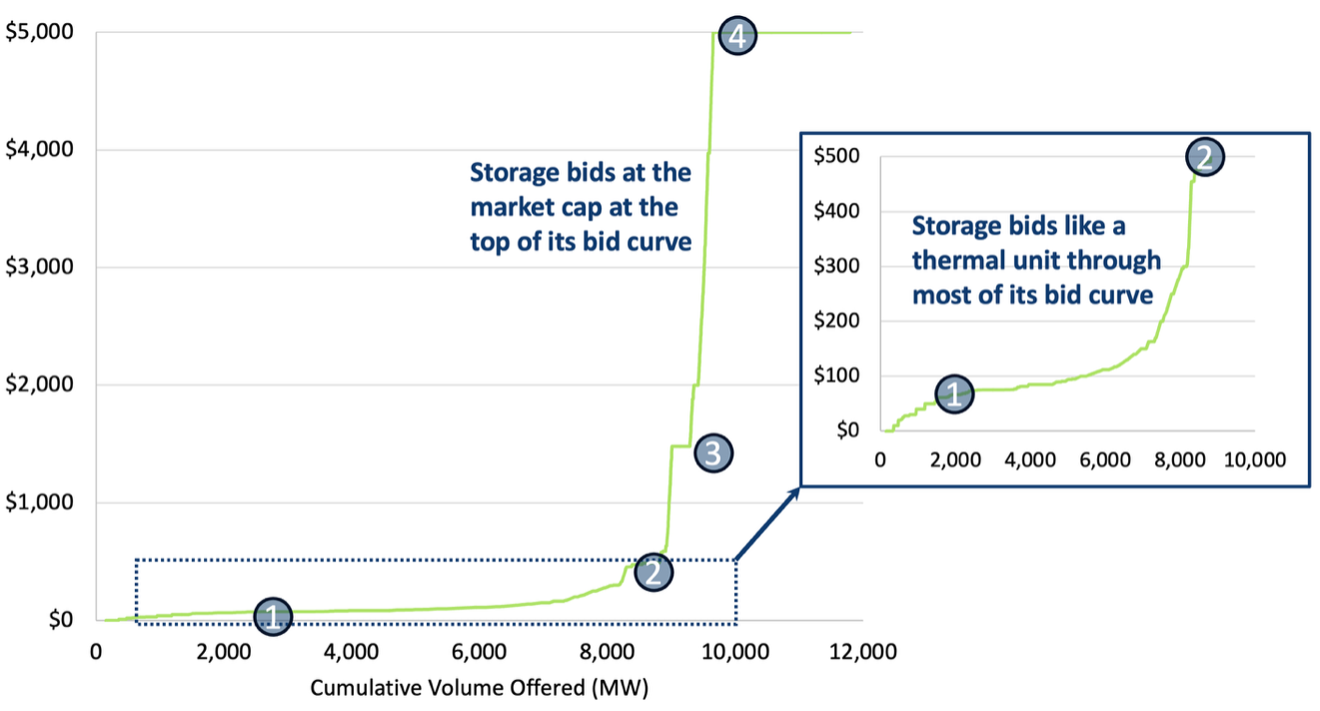
By explicitly representing these opportunity costs, Ascend captures how storage strategically withholds or deploys energy, producing bidding behavior that closely reflects observed market operations.
In addition to accurately capturing near-term dynamics, credible forecasts must also reflect how energy markets evolve in response to persistent economic signals at both the system and nodal levels. Long-term prices are determined not only by today's conditions but by how market participants respond to changing economics, policy, technology, and demand over time. For instance, high prices encourage new generation, storage buildout, transmission buildout, demand response, flexible load, and increased efficiency measures. Similarly, consistently low prices drive retirements, increase curtailment, and disincentivize new build in some markets. Over long horizons, these dynamics fundamentally reshape markets.
The data center era introduces uncertainties into US power markets at a scale the industry has never before experienced. Perhaps the most significant unknown is the actual amount of load growth that will be produced by the vast demand appetite currently exhibited by data center developers and hyperscalers. Other key uncertainties include where load will appear, when it will appear, transmission availability, technology costs, policy changes, stakeholder responses, storage deployment, AI demand, and flexible load adoption.
Rather than treating the future as a static extension of the present, Ascend combines detailed operational data with long-run market equilibrium to model the feedback loops that drive investment, development, retirement, dispatch, and price formation as markets evolve. In order to capture the most likely future, Ascend’s EOCFF enforces long-run economic equilibrium, accounts for evolving policy and stakeholder demand, and takes a granular approach to geospatial dynamics and their evolution over time.
As load growth surges and numerous project developers compete to provide supply to meet demand, rational investments will converge markets towards an equilibrium between the locational cost of new entry and locational project value. Premium locations will not stay premium. The cost of new entry creates a cap on the value of energy and capacity. Thus, all forecasting aspects must align to a world constrained by long-run equilibrium.
Forecasts that fail to account for long-run equilibrium lead to undefendable valuations that are incompatible with the competitive markets that arise from the abundance of project development activity that exists today.
As illustrated in Figure 8, Ascend's forecasts adhere to long-run equilibrium, which ensures that resources can only earn normal returns in the long run, since supernormal returns would drive market entry and subnormal returns would drive retirement or deter entry.
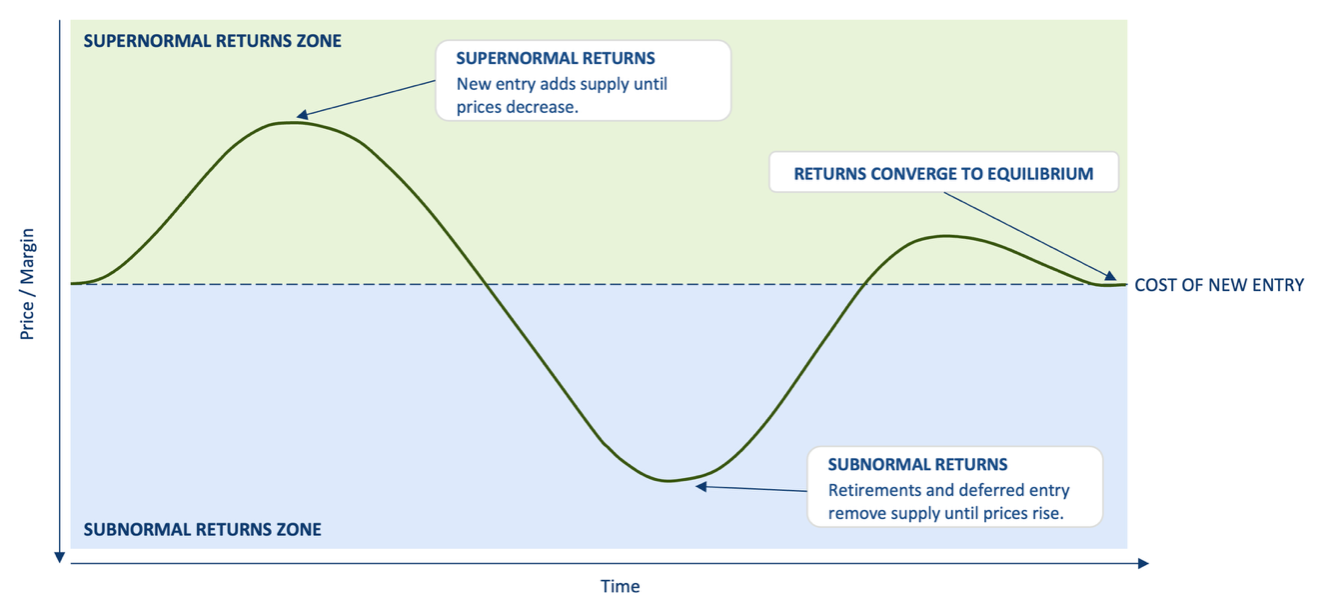
In the long run, the EOCFF ensures that revenue stacks do not exceed normal returns, with equilibration timing that varies according to the conditions in each market. Consequently, Ascend's forecasts ensure that total projected revenue stacks reflect capital expenditures (CapEx) and operating costs for each asset class, including forecasted changes over time.
In power markets across the world, clean energy policy and corporate offtake demand have emerged as significant driving forces for clean energy deployment. Yet many forecasts rely on 'status quo policy' assumptions and purely economic models that fail to account for policy evolution and voluntary offtake demand for clean energy, leading to underprediction of some asset types, overprediction of others, and unrealistic price dynamics as a result.
Rather than relying on ‘status quo policies,’ which are certain to be incorrect, the Ascend EOCFF incorporates assumptions about anticipated state- and federal-level energy policy evolution in base case forecasts. Ascend also adds a select amount of non-economic renewable generation into forecasts to reflect anticipated offtake demand and willingness to pay for renewable resources, since corporate offtake demand and ESG factors drive clean energy deployment beyond what an economic model alone would predict. In doing so, Ascend effectively assumes that RECs have a value above zero, reflecting the desire for offtakers to contract with clean energy.
In today’s grid, resource siting decisions and subsequent locational price patterns are driven by variation in renewable resource quality as well as land cost. Permanent differences in climate and geography create permanent differences in renewable resource potential, population density, and cost of land, which affect the ability to develop projects and the resultant cost of energy. This dynamic is exemplified in Figure 9, in which continued deployment of solar projects in Southern California has resulted in negative solar-hour electricity prices, which has created rising curtailment levels, narrowed the basis price gap between inland and coastal regions, and shifted the relative solar economics between northern and southern California.
.png)
While the alignment between population density and price is not perfect due to differences in solar resource and transmission constraints, more dense and higher-cost areas with worse renewable resource potential generally show higher prices relative to less populated areas with higher resource potential. New transmission build will only incentivize more project development in lower-cost areas until the price differentials once again reflect the underlying differences in cost of production. High population density and high cost of land create perpetual barriers to new development.
Many forecasts that rely solely on production cost models fail to account for locational cost of production, ignoring rational and realistic siting behavior for developers of new projects. This approach leads to underestimates of basis risk and irrational patterns in locational premiums.
Ascend analyzes each market regionally based on geospatial barriers in order to produce granular views of locational price patterns. The EOCFF enforces compression within self-similar regions over time, as well as maintaining differentiation over time between regions with geospatial barriers between them.
In searching for the right forecast, good and prudent investors should seek out what they don’t want to hear. Not every investment will be a good one, not everyone can be above average, and high prices and returns incentivize exactly the buildout that reduces prices and returns.
Investors should have a clear understanding of the realities of today's energy markets. Prices can’t keep climbing when renewables can be deployed to set an upper limit. Projects can’t earn supernormal returns indefinitely when participants respond to incentives and drive equilibrium. Valuations for renewables and storage will often be in opposition: the generation surpluses that drive value for storage suppress value for renewable generation.
While no forecast is perfectly accurate, Ascend’s Enhanced Opportunity Cost Forecasting Framework combines the best aspects of multiple modeling approaches to holistically capture both the near-term market dynamics and the critical long-term driving forces that are crucial for making sound investment and procurement decisions in rapidly changing power markets.
Power markets are increasingly shaped by unprecedented levels of data center-driven load growth, uncertainty in utility-scale renewable production, the complexity of battery storage operational dynamics, and skyrocketing capacity prices. Prices and price formation mechanisms are fundamentally different than even a few years ago. As power markets become increasingly supply-constrained, prices are being set under conditions where small changes in demand or available generation can produce disproportionately large price movements.
In these environments, accurately representing system stress, and not just average operating conditions, becomes critical. Forecasts must capture the frequency and severity of scarcity conditions, the growing importance of demand flexibility, and the variability introduced by weather and other extreme events. Forecasting approaches that worked well in eras dominated by thermal generation, and even during the last half-decade of increasing renewable penetration, are no longer adequate.
As US energy markets enter an era in which large, concentrated, and responsive loads will push demand against the limits of supply, selecting the right forecast has never been more critical. Model-driven fundamental forecasts underpin nearly every aspect of energy planning processes and drive important decisions related to optimal dispatch, capacity expansion, resource adequacy, reliability planning, project/portfolio valuation, and investment.
Energy market forecasts serve as foundations for developers, utilities, independent power producers, energy project investors, asset owners and operators, and electric retailers. The right forecasts help minimize costs and risks, maximize returns, and optimize project siting, sizing, valuation, origination, and operation. As the grid becomes increasingly complex, choosing the right forecast can be the difference between profit and loss.
Forecasting methodologies are necessarily reflective of the markets they were designed to model. As energy markets evolve, forecasting methodologies must evolve, too.
Today’s high load growth energy markets are characterized by immense demand appetite constrained by the ability to rapidly add supply, as exemplified in Figure 1, in which ERCOT's large load interconnection queue has grown to approximately 450 GW, even though only about 40 GW of new generation can realistically be added by 2030. As markets move closer to the supply edge, forecasting errors become increasingly asymmetric.
The impact of this change cannot be understated: in surplus markets, small modeling errors have limited consequences because the system has ample supply. In supply-constrained markets, however, those same errors can lead to dramatically different forecasts because prices are determined by a relatively small number of high-stress, inelastic hours. As a result, the value of a forecasting methodology increasingly depends on how well it captures these extreme conditions in addition to how well it reproduces average market behavior.
This represents a significant shift from the dynamics of the past several decades. Thermal-era market forecasts leveraged simple production cost models, which worked well when large, weather-insensitive thermal generators could set prices while experiencing minimal net load misses in a mostly static energy policy environment. Forecasting renewable- and storage-era markets, in which weather increasingly became a key driver of both supply and demand, and thus price formation, required the inclusion of opportunity cost and storage economics modeling. The emerging data center era demands a framework that combines operational reality, inelastic system behavior, flexible and curtailable loads, and long-run economic equilibrium in a single methodology.
Three broad categories of methodologies exist for energy price forecasting. Each carries a distinct set of trade-offs, and none are optimal for accurately capturing the dynamics of modern power markets.
Econometric, statistical, and machine learning/AI models estimate prices based on correlations and patterns observed in historical data.
In a period of rapid grid transformation, backward-looking models face inherent structural challenges that no amount of calibration can fully overcome.
Production cost models (PCMs) remain the most commonly-used methodology in power market forecasting, as they simulate the hourly dispatch of every generator and transmission constraint on the grid, producing price estimates from least-cost optimization that are designed to reflect power market price formation.
Ascend developed its Opportunity Cost Forecasting Framework (OCFF) to address the limitations of both statistical and production cost models. At its core, the OCFF treats price as a function of opportunity cost determined by rational market participants bidding competitively, with long-run market equilibrium as the binding constraint.
Large data centers are geographically concentrated, highly responsive, and capable of both generating and suppressing volatility in ways that no prior modeling era was designed to capture. Addressing this limitation required an enhancement of the OCFF.
To accurately capture the new dynamics of the data center era, Ascend is enhancing its existing forecasting framework. The Enhanced Opportunity Cost Forecasting Framework (EOCFF) incorporates production cost modeling in the near term, where nodal precision matters most and system information is well known, then progressively transitions toward opportunity cost forecasting as input uncertainty grows over longer time horizons. This proprietary approach allows Ascend to holistically address the key challenges inherent in forecasting both today’s and tomorrow’s energy markets, as shown in Figure 2.
Today's markets operate simultaneously on two very different timescales. Near-term prices are determined by operational realities such as weather, outages, transmission constraints, storage dispatch, renewable variability, bidding behavior, and curtailment. However, long-term investment decisions depend on accounting realistically for decades of market evolution, generation additions, retirements, and policy changes, all while adhering to long-run economic equilibrium.
No single traditional modeling paradigm was designed to solve both problems equally well. As discussed in the previous section, a methodology that excels at one often sacrifices accuracy in the other. Thus, modern markets require forecasts that are operationally realistic in the short term while remaining economically consistent and defendable over the long term.
The EOCFF resolves this by weighting the two paradigms differently across the forecast horizon. To model near-term power market dynamics and prices, the EOCFF integrates production cost modeling, with an emphasis on the front where nodal precision is most valuable. As time horizons extend and input uncertainty increases, the framework still utilizes production cost modeling but progressively views the model outputs through an opportunity cost forecasting lens.
As illustrated in Figure 3, PCM carries the highest relative modeling importance in the near term, when interconnection queues, transmission plans, and load locations are relatively well known. As that information degrades, Ascend’s OCFF equilibrium-based framework becomes the dominant modeling lens.
Price formation has never been more complex in US energy markets. Electricity prices emerge from the interaction of weather, demand, renewable generation, transmission constraints, curtailment, outages, and market participant behavior, among other factors.
Accurately accounting for weather is especially important. For example, a hot summer afternoon may cause significant demand spikes while simultaneously reducing wind generation and creating localized transmission congestion. Together, these conditions can produce scarcity pricing that would never be predicted by modeling each variable independently.
Many forecasting approaches accurately model individual market drivers but simplify the relationships between them, as illustrated in Figure 4. Some rely on representative weather years, average renewable generation profiles, independently modeled load forecasts, or simplified assumptions about transmission and operational conditions. These simplifications can produce reasonable average outcomes while failing to accurately reproduce the combinations of conditions that increasingly determine market outcomes.
Ascend, however, models the power system as an interconnected whole, preserving the physical relationships that exist across the power system rather than modeling each driver in isolation, as illustrated in Figure 5. Using PowerSIMM™, Ascend maintains realistic correlations between temperature, wind conditions, solar output, electricity demand, renewable generation, fuel prices, and transmission utilization while producing representative weather scenarios. These correlated inputs feed directly into detailed production cost simulations that capture how system conditions evolve hour by hour across the grid.
By using this approach, the EOCFF reproduces the operational conditions under which prices actually form, including the complex interactions that drive congestion, scarcity, renewable curtailment, and storage dispatch. This enables the framework to more accurately represent both everyday market behavior and the high-stress conditions that increasingly drive asset value.
Accurately reflecting the price formation dynamics of today’s and tomorrow’s energy markets requires accurately representing the operational realities that increasingly determine market outcomes. Data center-era markets will be fundamentally different than past ones, in which market conditions often looked similar from year to year.
That consistency no longer exists. Increasingly, a relatively small number of high-stress hours determine annual merchant revenues, generator economics, capacity values, congestion, and project valuations. Those hours cannot be approximated with average weather, average renewable profiles, simplified storage behavior, representative days, or single historical weather years, all of which can smooth away exactly the conditions that matter most for critical decisions related to planning, investment, and operations. Thus, as markets spend more time operating near the supply edge, accurately representing price formation during extreme conditions grows in importance.
Ascend's Enhanced Opportunity Cost Forecasting Framework addresses this challenge through distinct and complementary capabilities. These capabilities include typical meteorological year (TMY) weather modeling with appropriately correlated driving forces, detailed modeling of flexible and curtailable loads, granular storage simulation, and opportunity cost bidding. Together, these capabilities enable the EOCFF to accurately capture the system conditions under which energy markets increasingly set prices, in a way that is fundamentally different from other PCM-based forecasts.
As markets become increasingly dependent on weather-sensitive resources and operate closer to supply limits, accurately representing the relationships between temperature, renewable output, and load becomes essential. Simplified weather assumptions or reliance on a single historical year can understate system stress and distort price formation, particularly during the extreme conditions that disproportionately drive merchant revenue.
Many forecasting approaches either use a single historical weather year as a proxy for ‘typical’ conditions, making forecasts highly dependent on whichever year was selected, or simplify renewable production using average hourly or seasonal generation profiles that smooth away the variability responsible for many scarcity events.
Ascend avoids both limitations by producing weather inputs that are statistically representative of long-term conditions while retaining the hourly variability and correlations necessary for realistic market simulation. Leveraging the proprietary PowerSIMM simulation engine, Ascend constructs composite Typical Meteorological Years (TMYs), rather than relying on a single historical weather year, as illustrated in Figure 6.
This approach preserves the physical relationships between weather variables and electricity demand by maintaining temperature-to-load and renewable-to-temperature correlations while stitching together representative months from across multiple historical years. The result is a synthetic weather year that reflects long-term climatological conditions while preserving realistic daily load shapes and renewable generation profiles, including the natural variability and intermittency that characterize real-world system operations.
As electricity demand approaches available supply, markets become increasingly sensitive to relatively small changes in system conditions. Flexible demand, demand response, and curtailable loads, particularly from emerging large industrial and data center customers, can materially influence prices by reducing stress during critical hours. Capturing these dynamics is increasingly important as the market spends more time operating near the supply edge.
Many production cost model-based forecasting approaches continue to treat demand as largely static or represent demand response using simplified assumptions that fail to capture when and how flexible loads actually participate in markets.
Ascend instead explicitly models flexible demand resources, including curtailable load, price-responsive demand, and customer-specific flexibility thresholds. Rather than assuming demand is fixed regardless of market conditions, the framework allows loads to respond dynamically when prices exceed predefined economic thresholds. This enables Ascend to capture how flexible demand moderates scarcity events, influences dispatch decisions, shapes system reliability, and increasingly participates in price formation.
Battery energy storage systems (BESS) have evolved from a price taker into an active participant in price formation in multiple US energy markets. Storage simultaneously competes across energy and ancillary service markets while influencing investment decisions, generation dispatch, and future resource deployment.
Thus, accurately forecasting future markets requires capturing both how storage operates today, as well as how increasing storage penetration changes the market itself. Many forecasting methodologies, however, simplify storage as either a fixed dispatch resource or an arbitrage asset operating under static assumptions. As storage penetration increases, accurately representing these decisions becomes essential for forecasting market-clearing prices. Traditional production cost models often dispatch storage based primarily on short-term production cost optimization or deterministic arbitrage logic. These approaches can reasonably reproduce dispatch but frequently fail to capture the strategic bidding behavior that increasingly determines market-clearing prices.
Unlike thermal generators, storage decisions depend on the value of preserving energy for future opportunities. A battery's willingness to charge, discharge, or remain idle changes continuously based on expected future market conditions, making opportunity cost a central driver of bidding behavior.
Ascend models how storage actually participates in markets, with storage bidding based on the economic value of future operating opportunities rather than immediate production costs alone, as illustrated in Figure 7. The EOCFF models storage bidding dynamically according to multiple operational factors, including SoC, time of day, seasonal conditions, expected reserve margins, and anticipated future price opportunities.
By explicitly representing these opportunity costs, Ascend captures how storage strategically withholds or deploys energy, producing bidding behavior that closely reflects observed market operations.
In addition to accurately capturing near-term dynamics, credible forecasts must also reflect how energy markets evolve in response to persistent economic signals at both the system and nodal levels. Long-term prices are determined not only by today's conditions but by how market participants respond to changing economics, policy, technology, and demand over time. For instance, high prices encourage new generation, storage buildout, transmission buildout, demand response, flexible load, and increased efficiency measures. Similarly, consistently low prices drive retirements, increase curtailment, and disincentivize new build in some markets. Over long horizons, these dynamics fundamentally reshape markets.
The data center era introduces uncertainties into US power markets at a scale the industry has never before experienced. Perhaps the most significant unknown is the actual amount of load growth that will be produced by the vast demand appetite currently exhibited by data center developers and hyperscalers. Other key uncertainties include where load will appear, when it will appear, transmission availability, technology costs, policy changes, stakeholder responses, storage deployment, AI demand, and flexible load adoption.
Rather than treating the future as a static extension of the present, Ascend combines detailed operational data with long-run market equilibrium to model the feedback loops that drive investment, development, retirement, dispatch, and price formation as markets evolve. In order to capture the most likely future, Ascend’s EOCFF enforces long-run economic equilibrium, accounts for evolving policy and stakeholder demand, and takes a granular approach to geospatial dynamics and their evolution over time.
As load growth surges and numerous project developers compete to provide supply to meet demand, rational investments will converge markets towards an equilibrium between the locational cost of new entry and locational project value. Premium locations will not stay premium. The cost of new entry creates a cap on the value of energy and capacity. Thus, all forecasting aspects must align to a world constrained by long-run equilibrium.
Forecasts that fail to account for long-run equilibrium lead to undefendable valuations that are incompatible with the competitive markets that arise from the abundance of project development activity that exists today.
As illustrated in Figure 8, Ascend's forecasts adhere to long-run equilibrium, which ensures that resources can only earn normal returns in the long run, since supernormal returns would drive market entry and subnormal returns would drive retirement or deter entry.
In the long run, the EOCFF ensures that revenue stacks do not exceed normal returns, with equilibration timing that varies according to the conditions in each market. Consequently, Ascend's forecasts ensure that total projected revenue stacks reflect capital expenditures (CapEx) and operating costs for each asset class, including forecasted changes over time.
In power markets across the world, clean energy policy and corporate offtake demand have emerged as significant driving forces for clean energy deployment. Yet many forecasts rely on 'status quo policy' assumptions and purely economic models that fail to account for policy evolution and voluntary offtake demand for clean energy, leading to underprediction of some asset types, overprediction of others, and unrealistic price dynamics as a result.
Rather than relying on ‘status quo policies,’ which are certain to be incorrect, the Ascend EOCFF incorporates assumptions about anticipated state- and federal-level energy policy evolution in base case forecasts. Ascend also adds a select amount of non-economic renewable generation into forecasts to reflect anticipated offtake demand and willingness to pay for renewable resources, since corporate offtake demand and ESG factors drive clean energy deployment beyond what an economic model alone would predict. In doing so, Ascend effectively assumes that RECs have a value above zero, reflecting the desire for offtakers to contract with clean energy.
In today’s grid, resource siting decisions and subsequent locational price patterns are driven by variation in renewable resource quality as well as land cost. Permanent differences in climate and geography create permanent differences in renewable resource potential, population density, and cost of land, which affect the ability to develop projects and the resultant cost of energy. This dynamic is exemplified in Figure 9, in which continued deployment of solar projects in Southern California has resulted in negative solar-hour electricity prices, which has created rising curtailment levels, narrowed the basis price gap between inland and coastal regions, and shifted the relative solar economics between northern and southern California.
While the alignment between population density and price is not perfect due to differences in solar resource and transmission constraints, more dense and higher-cost areas with worse renewable resource potential generally show higher prices relative to less populated areas with higher resource potential. New transmission build will only incentivize more project development in lower-cost areas until the price differentials once again reflect the underlying differences in cost of production. High population density and high cost of land create perpetual barriers to new development.
Many forecasts that rely solely on production cost models fail to account for locational cost of production, ignoring rational and realistic siting behavior for developers of new projects. This approach leads to underestimates of basis risk and irrational patterns in locational premiums.
Ascend analyzes each market regionally based on geospatial barriers in order to produce granular views of locational price patterns. The EOCFF enforces compression within self-similar regions over time, as well as maintaining differentiation over time between regions with geospatial barriers between them.
In searching for the right forecast, good and prudent investors should seek out what they don’t want to hear. Not every investment will be a good one, not everyone can be above average, and high prices and returns incentivize exactly the buildout that reduces prices and returns.
Investors should have a clear understanding of the realities of today's energy markets. Prices can’t keep climbing when renewables can be deployed to set an upper limit. Projects can’t earn supernormal returns indefinitely when participants respond to incentives and drive equilibrium. Valuations for renewables and storage will often be in opposition: the generation surpluses that drive value for storage suppress value for renewable generation.
While no forecast is perfectly accurate, Ascend’s Enhanced Opportunity Cost Forecasting Framework combines the best aspects of multiple modeling approaches to holistically capture both the near-term market dynamics and the critical long-term driving forces that are crucial for making sound investment and procurement decisions in rapidly changing power markets.
Ascend Analytics is the leading provider of market intelligence and analytics solutions for the power industry.
The company’s offerings enable decision makers in power development and supply procurement to maximize the value of planning, operating, and managing risk for renewable, storage, and other assets. From real-time to 30-year horizons, their forecasts and insights are at the foundation of over $50 billion in project financing assessments.
Ascend provides energy market stakeholders with the clarity and confidence to successfully navigate the rapidly shifting energy landscape.





.avif)


.avif)
-1-ercot%20image.avif)


