Let's Connect
Contact us
Thank you for reaching out, we will be in touch shortly!
Oops! Something went wrong while submitting the form.


By Dr. Brent Nelson, Senior Managing Director of Market Intelligence, Ascend Analytics®
Load growth forecasts, driven significantly by projected data center demand, are skyrocketing in nearly every US power market. However, many data center projects in current interconnection queues will never get built: the projected capacity is far beyond what can realistically be built or supplied by energy markets. Data center developers also face increasing financial viability requirements, mounting energy affordability concerns, infrastructure, equipment and, labor constraints, and growing scrutiny of how data centers secure power.
For utilities, developers, hyperscalers, and investors, five trends will be particularly important to watch as data center demand and power markets evolve in 2027.
Current data center development pipelines are inflated by a combination of speculation and duplication. Developers routinely pursue multiple opportunities to hedge against the myriad of interconnection, permitting, financing, and other risks that can derail projects. However, the current AI infrastructure boom has also attracted speculative developers seeking to capitalize on anticipated demand, further amplifying large-load interconnection queues across US power markets.
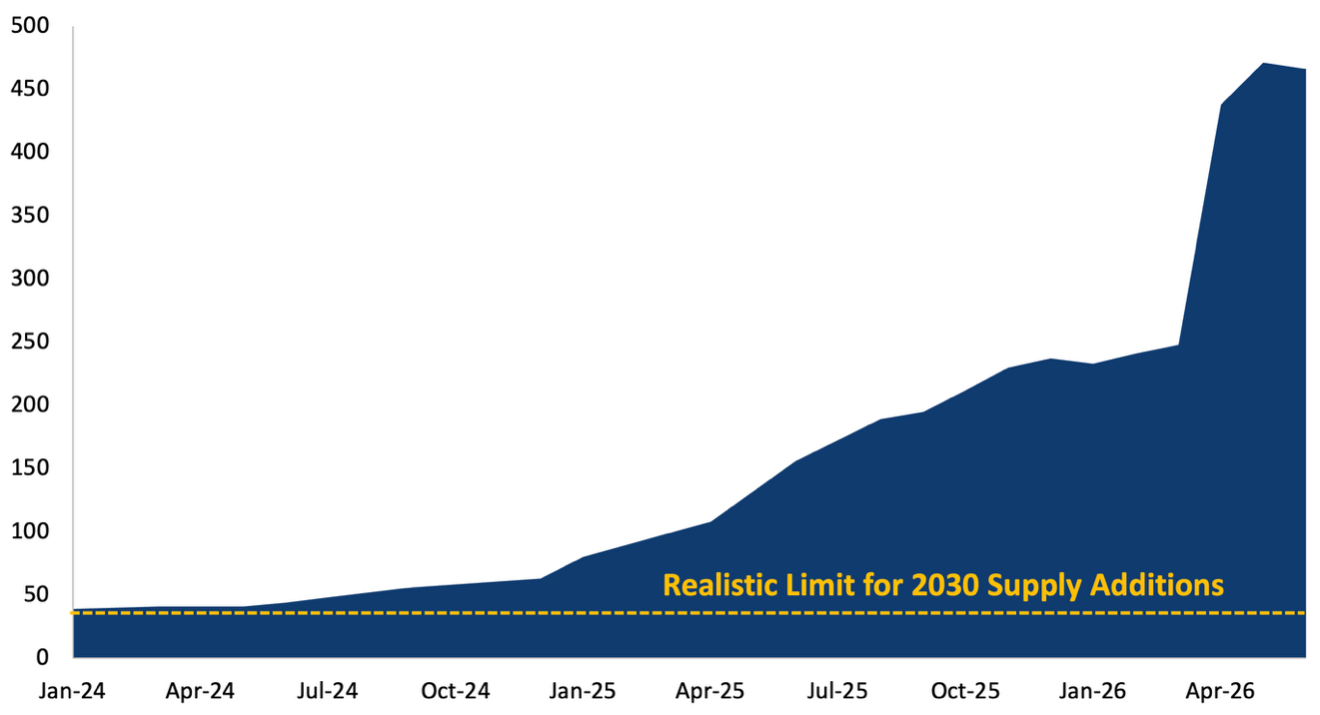
The reality is that many projects in large-load queues have little chance of securing the infrastructure or financing needed for construction. In ERCOT, for example, peak electricity demand is approximately 90 GW. Yet, as illustrated in Figure 1, the large-load interconnection queue has approached 500 GW. That demand growth would far outpace the amount of new supply that can be deployed, especially given supply, infrastructure, labor, permitting, and other constraints.
For utilities, then, it becomes critical to avoid treating speculative interconnection requests as committed demand, which risks overstating future capacity needs and thus triggering unnecessary infrastructure investment. For developers and investors, inflated load forecasts can distort expectations for future power prices, generation requirements, and market opportunities. More realistic forecasts must account for project attrition and the practical limits on bringing new load and generation online.
For developers, the ability to demonstrate a credible path to revenue will become an increasingly important determinant of how much proposed data center load actually materializes. Securing financing will require signed leases with tenants capable of meeting long-term financial obligations: a facility backed by a major hyperscaler, for instance, presents a substantially different credit profile than one dependent on attracting undefined future tenants or a portfolio of venture-backed AI startups.
The coming year will also see a continuation of practices designed to discourage speculation. Grid operators will require higher security deposits and more stringent financial commitments before proceeding with interconnection. Lenders will require more secure offtake and lease agreements before green-lighting financing. States will continue to tighten policies related to data center tax agreements, cost protections, and water usage. These dynamics, and the resulting development delays, will also accelerate project attrition.
For utilities, power producers, and investors, forecasts that accurately capture these factors will be critical to understanding how much proposed demand will actually materialize, when it will materialize, and what implications are for power market dynamics.
At both federal and state levels, growing opposition to large-load projects is increasing pressure on policymakers and utilities to ensure existing customers do not bear the costs of serving new data centers. Results from the recent US midterm elections may lead to further barriers to data center development; in the coming year, policymakers in multiple US states may potentially extend data center moratoriums or increase regulatory requirements.
Increasingly, the expectation that data centers pay for the infrastructure needed to serve them is becoming a prerequisite for regulatory and political acceptance. New substations, transmission upgrades, and the generation capacity needed to serve large load can require enormous investment, and regulators face increasing pressure to ensure these expenditures are assigned directly to the customers creating the need for upgrades.
Even then, credible cost protections may prove insufficient for ensuring a data center project moves forward. Water consumption, noise concerns, air emissions, and broader community opposition to AI infrastructure can create substantial obstacles independent of affordability concerns. Developers must also contend with permitting processes that expose energy infrastructure investments to changing political priorities over multiyear construction schedules.
In the coming year, then, securing community and regulatory acceptance will become as consequential as securing a technically viable interconnection.
Dedicated natural gas generation has become a preferred option for data centers seeking reliable power without waiting for traditional grid interconnection. However, the assumption that gas offers a fast, dependable solution is questionable.
New gas generation faces significant equipment and labor supply constraints, lengthy development timelines, and potentially substantial pipeline infrastructure commitments. Projects dependent on new pipelines or other federally permitted facilities also carry political risk, particularly when construction schedules extend beyond future changes in presidential administrations.
More fundamentally, gas generation has reliability limitations that are frequently underappreciated. Across much of the country, the most significant grid reliability risks are shifting toward extended severe winter weather events. Unlike relatively short summer peaks, winter scarcity conditions can persist overnight for long periods when solar generation is unavailable, wind production may be limited, and short-duration storage cannot sustain output throughout the event.
Natural gas appears attractive under these conditions because it can provide generation over extended periods. However, severe winter storms are also associated with gas supply disruptions and correlated thermal plant outages. A dedicated gas plant dependent on constrained pipeline infrastructure may therefore face fuel delivery problems and elevated outage risk precisely when reliable power from the grid may not be available.
These risks have substantial implications for data center power procurement. Developers and hyperscalers evaluating dedicated gas generation must account for equipment availability, fuel deliverability, and regulatory exposure alongside construction costs. Simply installing enough nameplate generation capacity does not guarantee that a facility can operate during the conditions that matter most.
Pairing a curtailable grid interconnection with behind-the-meter (BTM) battery storage could offer a faster, less expensive alternative to building dedicated generation for data centers. This approach can be especially attractive in markets where severe grid shortages occur infrequently and the cost of providing uninterrupted power is disproportionately high.
Power systems have ample generation capacity during the vast majority of hours. Reliability problems become acute during infrequent periods of extreme system stress, which may only occur once every several years in some markets, particularly when winter reliability risks are binding. Building new generation and transmission infrastructure to serve additional load during those rare conditions requires substantial capital investment that must ultimately be recovered from ratepayers.
A curtailable interconnection, then, allows a data center to receive grid power under normal conditions while agreeing to reduce consumption during defined periods of scarcity. BTM storage can provide additional flexibility, allowing facilities to maintain operations during curtailment events, though the economics of any given configuration depend on the duration and frequency of curtailment, storage costs, and the facility's tolerance for interruptions.
Taking this approach can also produce affordability benefits and potentially strengthen community support for data center developers. Accommodating additional electricity consumption without proportionately increasing system peak demand allows utilities to spread fixed generation, transmission, and distribution costs across more megawatt-hours, improving grid utilization and potentially lowering rates.
AscendMI™ (Ascend Market Intelligence) delivers proprietary power market forecasts that have been trusted in hundreds of projects and resource planning activities, supporting over $50 billion in project financing assessments. Contact us to learn more.
By Dr. Brent Nelson, Senior Managing Director of Market Intelligence, Ascend Analytics®
Load growth forecasts, driven significantly by projected data center demand, are skyrocketing in nearly every US power market. However, many data center projects in current interconnection queues will never get built: the projected capacity is far beyond what can realistically be built or supplied by energy markets. Data center developers also face increasing financial viability requirements, mounting energy affordability concerns, infrastructure, equipment and, labor constraints, and growing scrutiny of how data centers secure power.
For utilities, developers, hyperscalers, and investors, five trends will be particularly important to watch as data center demand and power markets evolve in 2027.
Current data center development pipelines are inflated by a combination of speculation and duplication. Developers routinely pursue multiple opportunities to hedge against the myriad of interconnection, permitting, financing, and other risks that can derail projects. However, the current AI infrastructure boom has also attracted speculative developers seeking to capitalize on anticipated demand, further amplifying large-load interconnection queues across US power markets.
The reality is that many projects in large-load queues have little chance of securing the infrastructure or financing needed for construction. In ERCOT, for example, peak electricity demand is approximately 90 GW. Yet, as illustrated in Figure 1, the large-load interconnection queue has approached 500 GW. That demand growth would far outpace the amount of new supply that can be deployed, especially given supply, infrastructure, labor, permitting, and other constraints.
For utilities, then, it becomes critical to avoid treating speculative interconnection requests as committed demand, which risks overstating future capacity needs and thus triggering unnecessary infrastructure investment. For developers and investors, inflated load forecasts can distort expectations for future power prices, generation requirements, and market opportunities. More realistic forecasts must account for project attrition and the practical limits on bringing new load and generation online.
For developers, the ability to demonstrate a credible path to revenue will become an increasingly important determinant of how much proposed data center load actually materializes. Securing financing will require signed leases with tenants capable of meeting long-term financial obligations: a facility backed by a major hyperscaler, for instance, presents a substantially different credit profile than one dependent on attracting undefined future tenants or a portfolio of venture-backed AI startups.
The coming year will also see a continuation of practices designed to discourage speculation. Grid operators will require higher security deposits and more stringent financial commitments before proceeding with interconnection. Lenders will require more secure offtake and lease agreements before green-lighting financing. States will continue to tighten policies related to data center tax agreements, cost protections, and water usage. These dynamics, and the resulting development delays, will also accelerate project attrition.
For utilities, power producers, and investors, forecasts that accurately capture these factors will be critical to understanding how much proposed demand will actually materialize, when it will materialize, and what implications are for power market dynamics.
At both federal and state levels, growing opposition to large-load projects is increasing pressure on policymakers and utilities to ensure existing customers do not bear the costs of serving new data centers. Results from the recent US midterm elections may lead to further barriers to data center development; in the coming year, policymakers in multiple US states may potentially extend data center moratoriums or increase regulatory requirements.
Increasingly, the expectation that data centers pay for the infrastructure needed to serve them is becoming a prerequisite for regulatory and political acceptance. New substations, transmission upgrades, and the generation capacity needed to serve large load can require enormous investment, and regulators face increasing pressure to ensure these expenditures are assigned directly to the customers creating the need for upgrades.
Even then, credible cost protections may prove insufficient for ensuring a data center project moves forward. Water consumption, noise concerns, air emissions, and broader community opposition to AI infrastructure can create substantial obstacles independent of affordability concerns. Developers must also contend with permitting processes that expose energy infrastructure investments to changing political priorities over multiyear construction schedules.
In the coming year, then, securing community and regulatory acceptance will become as consequential as securing a technically viable interconnection.
Dedicated natural gas generation has become a preferred option for data centers seeking reliable power without waiting for traditional grid interconnection. However, the assumption that gas offers a fast, dependable solution is questionable.
New gas generation faces significant equipment and labor supply constraints, lengthy development timelines, and potentially substantial pipeline infrastructure commitments. Projects dependent on new pipelines or other federally permitted facilities also carry political risk, particularly when construction schedules extend beyond future changes in presidential administrations.
More fundamentally, gas generation has reliability limitations that are frequently underappreciated. Across much of the country, the most significant grid reliability risks are shifting toward extended severe winter weather events. Unlike relatively short summer peaks, winter scarcity conditions can persist overnight for long periods when solar generation is unavailable, wind production may be limited, and short-duration storage cannot sustain output throughout the event.
Natural gas appears attractive under these conditions because it can provide generation over extended periods. However, severe winter storms are also associated with gas supply disruptions and correlated thermal plant outages. A dedicated gas plant dependent on constrained pipeline infrastructure may therefore face fuel delivery problems and elevated outage risk precisely when reliable power from the grid may not be available.
These risks have substantial implications for data center power procurement. Developers and hyperscalers evaluating dedicated gas generation must account for equipment availability, fuel deliverability, and regulatory exposure alongside construction costs. Simply installing enough nameplate generation capacity does not guarantee that a facility can operate during the conditions that matter most.
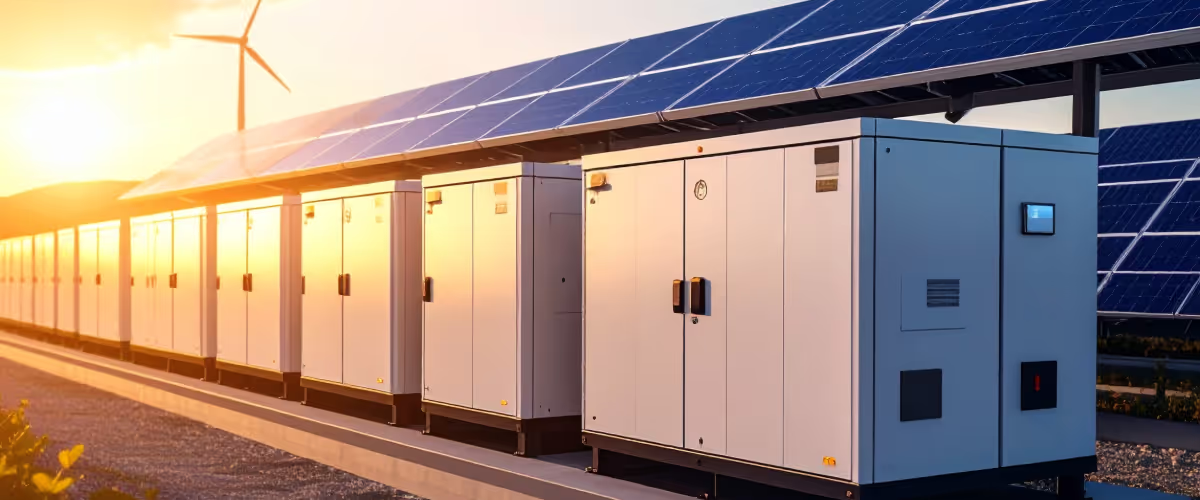
Pairing a curtailable grid interconnection with behind-the-meter (BTM) battery storage could offer a faster, less expensive alternative to building dedicated generation for data centers. This approach can be especially attractive in markets where severe grid shortages occur infrequently and the cost of providing uninterrupted power is disproportionately high.
Power systems have ample generation capacity during the vast majority of hours. Reliability problems become acute during infrequent periods of extreme system stress, which may only occur once every several years in some markets, particularly when winter reliability risks are binding. Building new generation and transmission infrastructure to serve additional load during those rare conditions requires substantial capital investment that must ultimately be recovered from ratepayers.
A curtailable interconnection, then, allows a data center to receive grid power under normal conditions while agreeing to reduce consumption during defined periods of scarcity. BTM storage can provide additional flexibility, allowing facilities to maintain operations during curtailment events, though the economics of any given configuration depend on the duration and frequency of curtailment, storage costs, and the facility's tolerance for interruptions.
Taking this approach can also produce affordability benefits and potentially strengthen community support for data center developers. Accommodating additional electricity consumption without proportionately increasing system peak demand allows utilities to spread fixed generation, transmission, and distribution costs across more megawatt-hours, improving grid utilization and potentially lowering rates.
AscendMI™ (Ascend Market Intelligence) delivers proprietary power market forecasts that have been trusted in hundreds of projects and resource planning activities, supporting over $50 billion in project financing assessments. Contact us to learn more.
Ascend Analytics is the leading provider of market intelligence and analytics solutions for the power industry.
The company’s offerings enable decision makers in power supply, procurement, and investment markets to plan, operate, monetize, and manage risk across any energy asset portfolio. From real-time to 30-year horizons, their forecasts and insights are at the foundation of over $50 billion in project financing assessments.
Ascend provides energy market stakeholders with the clarity and confidence to successfully navigate the rapidly shifting energy landscape.