Let's Connect
Contact us
Thank you for reaching out, we will be in touch shortly!
Oops! Something went wrong while submitting the form.

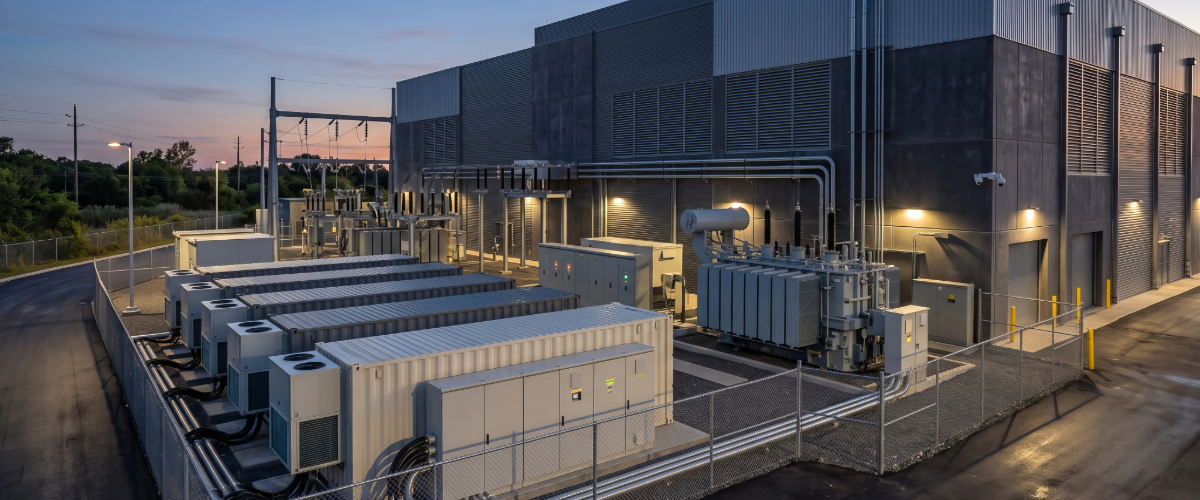
For commercial and industrial (C&I) customers in US power markets, behind-the-meter (BTM) battery storage is becoming increasingly attractive as rising charges for peak demand, transmission service, and generation capacity create new opportunities to reduce electricity costs. In some locations, a battery that reliably reduces consumption during peak periods can avoid substantial charges while capturing greater effective capacity value than an equivalent front-of-the-meter (FTM) resource. However, realizing value from BTM storage depends on specific utility territories, as well as when different peak charges are assessed and how effectively storage can mitigate them.
In a recent webinar, Dr. Michael Fisher, Senior Managing Director of PowerVAL™ at Ascend Analytics®, and Nate Rybin, Senior Energy Market Analytics Engineer, discussed the forces driving BTM storage adoption, the economics of demand, transmission, and capacity charge avoidance, how differences in peak timing and geography shape storage value, and how Ascend’s BTM Asset Valuation solution can help value coincident peak mitigation, demand charge avoidance, and retail rate arbitrage.
Several developments are improving the economics of BTM storage in US power markets. FERC Order 2222 creates opportunities for aggregations of distributed energy resources to participate in organized wholesale markets, although implementation remains uneven across ISOs. Accelerating load growth has put immense pressure on capacity markets and contributes to higher prices for reliable generation.
At the same time, rising utility distribution investment creates additional retail cost pressures, while congested wholesale interconnection queues make FTM development increasingly difficult. BTM projects can help large energy users avoid lengthy wholesale interconnection queues by connecting directly to a utility's distribution system, potentially bringing projects online faster.
Beyond potential interconnection advantages, BTM storage can also reduce a customer's peak billing determinants directly. C&I customers typically face three major categories of peak-power charges:
Because these charges are determined by different peak periods, a battery's discharge may reduce one charge without affecting the others. Maximizing combined savings therefore requires coordinating dispatch across potentially competing peak windows.
BTM storage can also avoid capacity accreditation discounts applied to FTM resources. For example, a 1 MW battery discharging throughout a correctly anticipated coincident peak window can reduce a customer's capacity or transmission billing determinant by the full 1 MW, though this advantage also depends on maintaining sufficient discharge duration. In contrast, a comparable FTM battery receives credit only for its accredited capacity: in PJM, four-hour storage currently receives roughly half its nameplate capacity.
Mean maximum commercial demand charges have more than doubled since 2008, creating stronger incentives for C&I customers to reduce their monthly peak demand. As noted above, these charges are typically determined by a customer's highest 15-, 30-, or 60-minute demand interval, meaning that a relatively brief period of elevated consumption can materially increase a monthly electricity bill. BTM storage can reduce these costs by discharging during peak periods, allowing customers to lower billed demand without requiring operational changes.
However, the value of demand charge mitigation varies considerably by location. While most C&I tariffs have relatively modest demand charges, some utility territories impose rates several times higher than those of neighboring utilities, as shown in Figure 1. For developers, this creates substantial differences in project economics even for batteries serving otherwise comparable facilities.

Thus, identifying where high demand charges coincide with load profiles that storage can effectively mitigate is central to determining which BTM projects offer the strongest economics. Facilities with pronounced, short-duration demand peaks are better positioned to benefit from battery discharge than those with sustained periods of high consumption, which may require longer-duration storage to achieve comparable reductions.
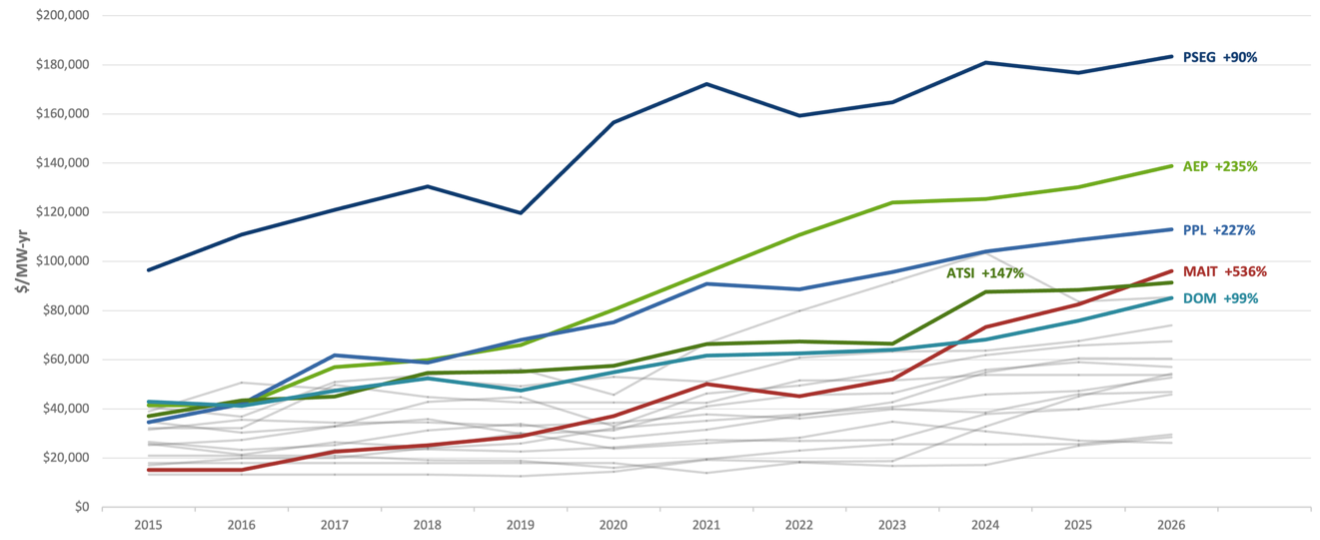
Aging infrastructure, load growth, and changing generation patterns are driving major transmission expansion projects in US power markets, with overall transmission investment nearly doubling since 2015. In PJM, for example, annual transmission revenue requirements increased 33% between 2023 and 2026, while median peak load grew just 2%, pushing transmission costs higher relative to the demand being served.
For BTM storage, the opportunity to avoid these costs depends significantly on location and peak timing. Transmission charges vary widely across PJM zones, as shown in Figure 2, making peak mitigation far more valuable in some territories than others. However, capturing those savings can be difficult since transmission billing determinants are tied to a limited number of zone-wide peak events rather than to a customer's own peak consumption.
The challenge becomes particularly pronounced in winter-peaking zones. Unlike summer peaks, which typically occur during relatively concentrated afternoon periods, winter storms can produce sustained high demand across many hours, including overnight. As shown in Figure 3, the extended load profile during 2022’s Winter Storm Elliott contrasts with the sharper summer peak during the June 2025 heat wave, shown in Figure 4. This makes it harder to predict which hours will determine transmission charges and increases the risk that a battery will exhaust its stored energy before the relevant peak occurs.


Consequently, the highest transmission charges do not necessarily translate into the greatest achievable storage savings. Developers must consider both the value of avoided charges and the likelihood that a battery can capture the relevant peaks, factoring in local demand patterns, seasonal peak timing, and battery duration.
In PJM, BTM storage is better positioned to reduce capacity charges than transmission charges because capacity peaks have historically occurred within relatively narrow, predictable summer afternoon windows. Unlike transmission peaks, which vary by zone and may occur during prolonged winter events, capacity charges are determined by five RTO-wide summer peak hours, making them easier to anticipate and target with battery discharge.
The economic incentive to capture these peaks has grown considerably as PJM's capacity market has tightened and auction prices have increased. For C&I customers, reducing consumption during these critical hours can translate into substantial avoided capacity costs, with the value of mitigation rising alongside capacity prices.
As shown in Figure 5, approximately 86% of PJM's coincident peak events between 2016 and 2025 occurred between 4 and 6 p.m., with a particularly strong concentration in July. This relatively predictable pattern allows batteries with sufficient discharge duration to target likely peak periods without requiring extended operation across many hours.

However, realizing these savings still requires operators to identify the correct peak days and maintain sufficient battery state of charge (SOC) to cover the relevant hours. The distinction between predictable summer capacity peaks and more uncertain transmission peaks makes it essential to evaluate the two cost-avoidance opportunities separately, even when a single battery is designed to capture both.
Trusted across hundreds of deals and more than $50 billion in project financing assessments, PowerVAL provides bankable revenue forecasts and nodal-specific valuations for storage, renewables, and hybrid projects under multiple operating strategies across all ISOs. Contact us to learn more.
For commercial and industrial (C&I) customers in US power markets, behind-the-meter (BTM) battery storage is becoming increasingly attractive as rising charges for peak demand, transmission service, and generation capacity create new opportunities to reduce electricity costs. In some locations, a battery that reliably reduces consumption during peak periods can avoid substantial charges while capturing greater effective capacity value than an equivalent front-of-the-meter (FTM) resource. However, realizing value from BTM storage depends on specific utility territories, as well as when different peak charges are assessed and how effectively storage can mitigate them.
In a recent webinar, Dr. Michael Fisher, Senior Managing Director of PowerVAL™ at Ascend Analytics®, and Nate Rybin, Senior Energy Market Analytics Engineer, discussed the forces driving BTM storage adoption, the economics of demand, transmission, and capacity charge avoidance, how differences in peak timing and geography shape storage value, and how Ascend’s BTM Asset Valuation solution can help value coincident peak mitigation, demand charge avoidance, and retail rate arbitrage.
Several developments are improving the economics of BTM storage in US power markets. FERC Order 2222 creates opportunities for aggregations of distributed energy resources to participate in organized wholesale markets, although implementation remains uneven across ISOs. Accelerating load growth has put immense pressure on capacity markets and contributes to higher prices for reliable generation.
At the same time, rising utility distribution investment creates additional retail cost pressures, while congested wholesale interconnection queues make FTM development increasingly difficult. BTM projects can help large energy users avoid lengthy wholesale interconnection queues by connecting directly to a utility's distribution system, potentially bringing projects online faster.
Beyond potential interconnection advantages, BTM storage can also reduce a customer's peak billing determinants directly. C&I customers typically face three major categories of peak-power charges:
Because these charges are determined by different peak periods, a battery's discharge may reduce one charge without affecting the others. Maximizing combined savings therefore requires coordinating dispatch across potentially competing peak windows.
BTM storage can also avoid capacity accreditation discounts applied to FTM resources. For example, a 1 MW battery discharging throughout a correctly anticipated coincident peak window can reduce a customer's capacity or transmission billing determinant by the full 1 MW, though this advantage also depends on maintaining sufficient discharge duration. In contrast, a comparable FTM battery receives credit only for its accredited capacity: in PJM, four-hour storage currently receives roughly half its nameplate capacity.
Mean maximum commercial demand charges have more than doubled since 2008, creating stronger incentives for C&I customers to reduce their monthly peak demand. As noted above, these charges are typically determined by a customer's highest 15-, 30-, or 60-minute demand interval, meaning that a relatively brief period of elevated consumption can materially increase a monthly electricity bill. BTM storage can reduce these costs by discharging during peak periods, allowing customers to lower billed demand without requiring operational changes.
However, the value of demand charge mitigation varies considerably by location. While most C&I tariffs have relatively modest demand charges, some utility territories impose rates several times higher than those of neighboring utilities, as shown in Figure 1. For developers, this creates substantial differences in project economics even for batteries serving otherwise comparable facilities.
Thus, identifying where high demand charges coincide with load profiles that storage can effectively mitigate is central to determining which BTM projects offer the strongest economics. Facilities with pronounced, short-duration demand peaks are better positioned to benefit from battery discharge than those with sustained periods of high consumption, which may require longer-duration storage to achieve comparable reductions.
Aging infrastructure, load growth, and changing generation patterns are driving major transmission expansion projects in US power markets, with overall transmission investment nearly doubling since 2015. In PJM, for example, annual transmission revenue requirements increased 33% between 2023 and 2026, while median peak load grew just 2%, pushing transmission costs higher relative to the demand being served.
For BTM storage, the opportunity to avoid these costs depends significantly on location and peak timing. Transmission charges vary widely across PJM zones, as shown in Figure 2, making peak mitigation far more valuable in some territories than others. However, capturing those savings can be difficult since transmission billing determinants are tied to a limited number of zone-wide peak events rather than to a customer's own peak consumption.
The challenge becomes particularly pronounced in winter-peaking zones. Unlike summer peaks, which typically occur during relatively concentrated afternoon periods, winter storms can produce sustained high demand across many hours, including overnight. As shown in Figure 3, the extended load profile during 2022’s Winter Storm Elliott contrasts with the sharper summer peak during the June 2025 heat wave, shown in Figure 4. This makes it harder to predict which hours will determine transmission charges and increases the risk that a battery will exhaust its stored energy before the relevant peak occurs.
Consequently, the highest transmission charges do not necessarily translate into the greatest achievable storage savings. Developers must consider both the value of avoided charges and the likelihood that a battery can capture the relevant peaks, factoring in local demand patterns, seasonal peak timing, and battery duration.
In PJM, BTM storage is better positioned to reduce capacity charges than transmission charges because capacity peaks have historically occurred within relatively narrow, predictable summer afternoon windows. Unlike transmission peaks, which vary by zone and may occur during prolonged winter events, capacity charges are determined by five RTO-wide summer peak hours, making them easier to anticipate and target with battery discharge.
The economic incentive to capture these peaks has grown considerably as PJM's capacity market has tightened and auction prices have increased. For C&I customers, reducing consumption during these critical hours can translate into substantial avoided capacity costs, with the value of mitigation rising alongside capacity prices.
As shown in Figure 5, approximately 86% of PJM's coincident peak events between 2016 and 2025 occurred between 4 and 6 p.m., with a particularly strong concentration in July. This relatively predictable pattern allows batteries with sufficient discharge duration to target likely peak periods without requiring extended operation across many hours.
However, realizing these savings still requires operators to identify the correct peak days and maintain sufficient battery state of charge (SOC) to cover the relevant hours. The distinction between predictable summer capacity peaks and more uncertain transmission peaks makes it essential to evaluate the two cost-avoidance opportunities separately, even when a single battery is designed to capture both.
Trusted across hundreds of deals and more than $50 billion in project financing assessments, PowerVAL provides bankable revenue forecasts and nodal-specific valuations for storage, renewables, and hybrid projects under multiple operating strategies across all ISOs. Contact us to learn more.
Ascend Analytics is the leading provider of market intelligence and analytics solutions for the power industry.
The company’s offerings enable decision makers in power supply, procurement, and investment markets to plan, operate, monetize, and manage risk across any energy asset portfolio. From real-time to 30-year horizons, their forecasts and insights are at the foundation of over $50 billion in project financing assessments.
Ascend provides energy market stakeholders with the clarity and confidence to successfully navigate the rapidly shifting energy landscape.