Is Load Growth Exposing the Limits of U.S. Capacity Markets?

Is Load Growth Exposing the Limits of U.S. Capacity Markets?

After more than two decades of relatively flat electricity demand, rapid load growth is fundamentally reshaping capacity markets in the US. Data centers, manufacturing, electrification, and other large loads are driving skyrocketing electricity demand just as aging thermal generators, interconnection constraints, and long development timelines limit how quickly new supply can come online.  

These dynamics create an immense challenge for existing capacity markets: capacity prices must be high enough to incentivize new entry, but applying the cost of new entry across the entire existing supply stack can drive costs sharply higher for ratepayers, provide large windfalls for existing generators, and trigger significant political backlash.

In a recent podcast hosted by Norton Rose Fulbright, a global law firm specializing in energy and infrastructure, Brent Nelson, Senior Managing Director of Market Intelligence at Ascend Analytics, discussed how rapid load growth is exposing structural challenges in U.S. energy markets, and why the next generation of capacity market reforms may look very different from the markets that exist today.

Key Takeaways

  • Even though load growth is soaring in US power markets, an energy shortage is not the problem. The primary issue involves having the capacity resources needed to serve load during the specific and infrequent instances when power systems are critically stressed. Adding generation in aggregate does not necessarily solve that problem.
  • Reliability is increasingly determined by the specific hours when supply is most constrained, making resource duration, availability, weather correlation, and technology increasingly important. Winter reliability risks can be particularly challenging for short-duration storage and thermal resources exposed to correlated weather-driven outages.
  • Capacity markets may have little choice but to bifurcate how they compensate new and existing generation. Using the cost of new entry as a single clearing price creates a politically untenable affordability problem when that price is paid across the entire existing generation fleet. US energy markets are now pursuing a multitude of approaches to addressing this challenge.
  • While data center-driven demand presents the primary source of near-term load growth, transportation, heating, and industrial electrification were already poised to create the same structural shortage that would require paying for new generation.
  • Large loads may increasingly need to bring or contract their own supply to secure grid access. Curtailable interconnections, behind-the-meter storage, and firm generation contracts could give data centers and other large loads a path to connect without imposing the full cost of new generation on existing ratepayers. If bring-your-own-new-generation (BYONG) requirements proliferate, however, significant new generation could be built outside of energy markets, potentially reshaping price formation dynamics for existing generators.
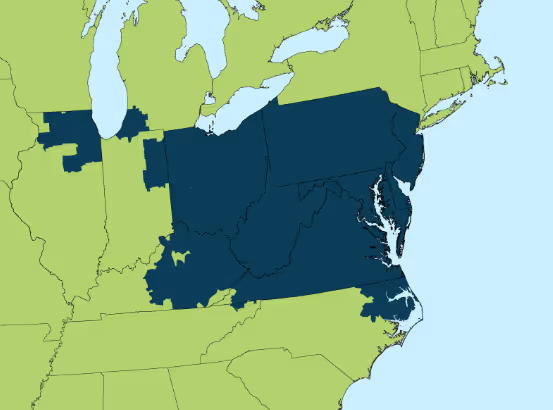
  • Higher capacity prices are likely to create political pressure for market redesign. Recent capacity-price increases in PJM, for instance, have already triggered a variety of market reforms designed to address pushback from utilities, ratepayers, regulators, and policymakers.
  • Forecasting approaches must evolve as markets evolve and should contain the best aspects of near-term and long-term modeling to accurately capture the dynamics of the data center era. Accurately evaluating future capacity value requires an integrated view of load growth, resource economics, accreditation, weather, market design, potential policy, and the timing of new supply.

Listen to the full podcast for additional insights into how different US power markets are responding to unprecedented load growth, evolving approaches to capacity procurement, and large-load development. The discussion also examines how market design, uncertainty surrounding the scale of load growth, and future hyperscaler cost considerations could reshape investment opportunities.

Speakers

No items found.

Is Load Growth Exposing the Limits of U.S. Capacity Markets?

September 9, 2026

 | 

Articles

After more than two decades of relatively flat electricity demand, rapid load growth is fundamentally reshaping capacity markets in the US. Data centers, manufacturing, electrification, and other large loads are driving skyrocketing electricity demand just as aging thermal generators, interconnection constraints, and long development timelines limit how quickly new supply can come online.  

These dynamics create an immense challenge for existing capacity markets: capacity prices must be high enough to incentivize new entry, but applying the cost of new entry across the entire existing supply stack can drive costs sharply higher for ratepayers, provide large windfalls for existing generators, and trigger significant political backlash.

In a recent podcast hosted by Norton Rose Fulbright, a global law firm specializing in energy and infrastructure, Brent Nelson, Senior Managing Director of Market Intelligence at Ascend Analytics, discussed how rapid load growth is exposing structural challenges in U.S. energy markets, and why the next generation of capacity market reforms may look very different from the markets that exist today.

Key Takeaways

  • Even though load growth is soaring in US power markets, an energy shortage is not the problem. The primary issue involves having the capacity resources needed to serve load during the specific and infrequent instances when power systems are critically stressed. Adding generation in aggregate does not necessarily solve that problem.
  • Reliability is increasingly determined by the specific hours when supply is most constrained, making resource duration, availability, weather correlation, and technology increasingly important. Winter reliability risks can be particularly challenging for short-duration storage and thermal resources exposed to correlated weather-driven outages.
  • Capacity markets may have little choice but to bifurcate how they compensate new and existing generation. Using the cost of new entry as a single clearing price creates a politically untenable affordability problem when that price is paid across the entire existing generation fleet. US energy markets are now pursuing a multitude of approaches to addressing this challenge.
  • While data center-driven demand presents the primary source of near-term load growth, transportation, heating, and industrial electrification were already poised to create the same structural shortage that would require paying for new generation.
  • Large loads may increasingly need to bring or contract their own supply to secure grid access. Curtailable interconnections, behind-the-meter storage, and firm generation contracts could give data centers and other large loads a path to connect without imposing the full cost of new generation on existing ratepayers. If bring-your-own-new-generation (BYONG) requirements proliferate, however, significant new generation could be built outside of energy markets, potentially reshaping price formation dynamics for existing generators.
  • Higher capacity prices are likely to create political pressure for market redesign. Recent capacity-price increases in PJM, for instance, have already triggered a variety of market reforms designed to address pushback from utilities, ratepayers, regulators, and policymakers.
  • Forecasting approaches must evolve as markets evolve and should contain the best aspects of near-term and long-term modeling to accurately capture the dynamics of the data center era. Accurately evaluating future capacity value requires an integrated view of load growth, resource economics, accreditation, weather, market design, potential policy, and the timing of new supply.

Listen to the full podcast for additional insights into how different US power markets are responding to unprecedented load growth, evolving approaches to capacity procurement, and large-load development. The discussion also examines how market design, uncertainty surrounding the scale of load growth, and future hyperscaler cost considerations could reshape investment opportunities.

About Ascend Analytics

Ascend Analytics is the leading provider of market intelligence and analytics solutions for the power industry.

The company’s offerings enable decision makers in power development and supply procurement to maximize the value of planning, operating, and managing risk for renewable, storage, and other assets. From real-time to 30-year horizons, their forecasts and insights are at the foundation of over $50 billion in project financing assessments.

Ascend provides energy market stakeholders with the clarity and confidence to successfully navigate the rapidly shifting energy landscape.

Latest

Articles