Let's Connect
Contact us
Thank you for reaching out, we will be in touch shortly!
Oops! Something went wrong while submitting the form.


New York's Value of Distributed Energy Resources (VDER) program has reliably generated revenue for solar developers for years. Optimizing revenue for standalone battery energy storage systems (BESS), however, presents a different challenge: unlike solar, a battery's revenue depends on when it discharges and charges, which involves navigating a maze of utility-specific costs. For solar developers considering storage in New York, understanding this distinction matters: the payoff for storage can exceed what solar earns today, though only for projects that get the dispatch strategy right.
In a recent webinar hosted by the New York Solar Energy Industries Association (NYSEIA), Caroline Zechter, Director of Community Solar and Peter Wise, Senior Energy Analyst at Ascend Analytics discuss how storage monetizes the VDER value stack differently than solar, why capacity revenue carries the most risk and the most reward, how variation in utility charging costs vary influence where projects get built, and what regulatory shifts could reshape the program in the years ahead.
Solar's VDER revenue is essentially locked in once a project is built: production times the value stack components determine the payout, and there's little else a developer can do to influence it.
On the contrary, a battery’s margin depends on sophisticated operation of the asset – knowing when to charge and discharge. The timing of charge and discharge decisions interacts with capture of energy prices, DRV, capacity payments, and the utility costs incurred to charge in the first place.
Getting the timing right can produce significant value for storage relative to solar. As illustrated in Figure 1, net revenue for the year 2030 reaches $2.4 million under current DRV rates and $2.6 million if proposed rates are finalized, compared with $1.7 million for an equivalent 5MW solar project versus a 5 MW, 4-hour battery in Consolidated Edison's (ConEd) Zone J. Higher revenues are driven by how storage can monetize its flexibility by ensuring greater discharge into the DRV window and by providing greater capacity services under capacity alternative 3.
%2C%20ConEd%20Zone%20J%20-2030.png)
Similar dynamics apply in upstate New York. In National Grid's Zone F, for example, storage revenue roughly matches solar today, at $1.1 million versus $1.2 million, and would climb well past it, to $1.9 million, under proposed DRV values.
Unlike solar and hybrid projects, which can choose among three capacity compensation alternatives, standalone storage is required to take Alternative 3, which produces a payment based on a project's output during a single system peak hour of the previous year.
That structure creates two distinct types of risk – pricing and performance risk. First, because ICAP compensation is based on wholesale capacity auction prices, projects face price risk in the value of payments. New York's capacity market prices are generally binary, clearing near the cost of keeping existing plants online when supply is adequate, or near the cost of building new generation when it is not. Programs such as the state's Index Storage Credit subsidize new battery entry, allowing subsidized capacity to act as a price taker that suppresses capacity prices. That dynamic is what makes pricing risk hard to pin down: subsidized entry could keep pace with load growth and hold prices near a floor (cost of keeping existing entry online), or lag behind it and push prices toward a ceiling (Net Cost of New Entry -- Net CONE). Ascend’s capacity forecast models the expected value of capacity prices within a band of uncertainty between floor and ceiling conditions.
Capture risk is the second piece: miss the single peak hour, and a project forfeits capacity revenue for the entire year. The good news is that this hour has fallen between 4 and 7 p.m. in the past decade, allowing for predictable capture of both capacity and DRV revenue components. In the future, the peak load hour is expected to fall later in the day, occurring near the end or after common DRV window hours. This misalignment will incent operators to discharge into likely peak hours outside the DRV window to ensure capacity capture. Doing so incurs a cost of missing incremental DRV revenue. To ensure peak hour capture, operators can inform discharge of their asset using NYISO’s day ahead load forecast on days with high forecasted loads. NYISO’s day-ahead load forecast has correctly identified the peak hour in eight of the last 10 years, missing by no more than two hours in the other two. That track record gives four-hour batteries a strong basis for confidently capturing ICAP Alt 3, even as the peak hour is expected to shift later and eventually move outside current DRV windows.
Storage projects pay for the power they use to charge in ways solar never has to consider. Three cost components dominate: supply prices tied to hourly zonal day-ahead energy prices, as-used demand charges triggered by charging during defined daytime windows, and contract demand charges based on a project's maximum charging and export capacity.
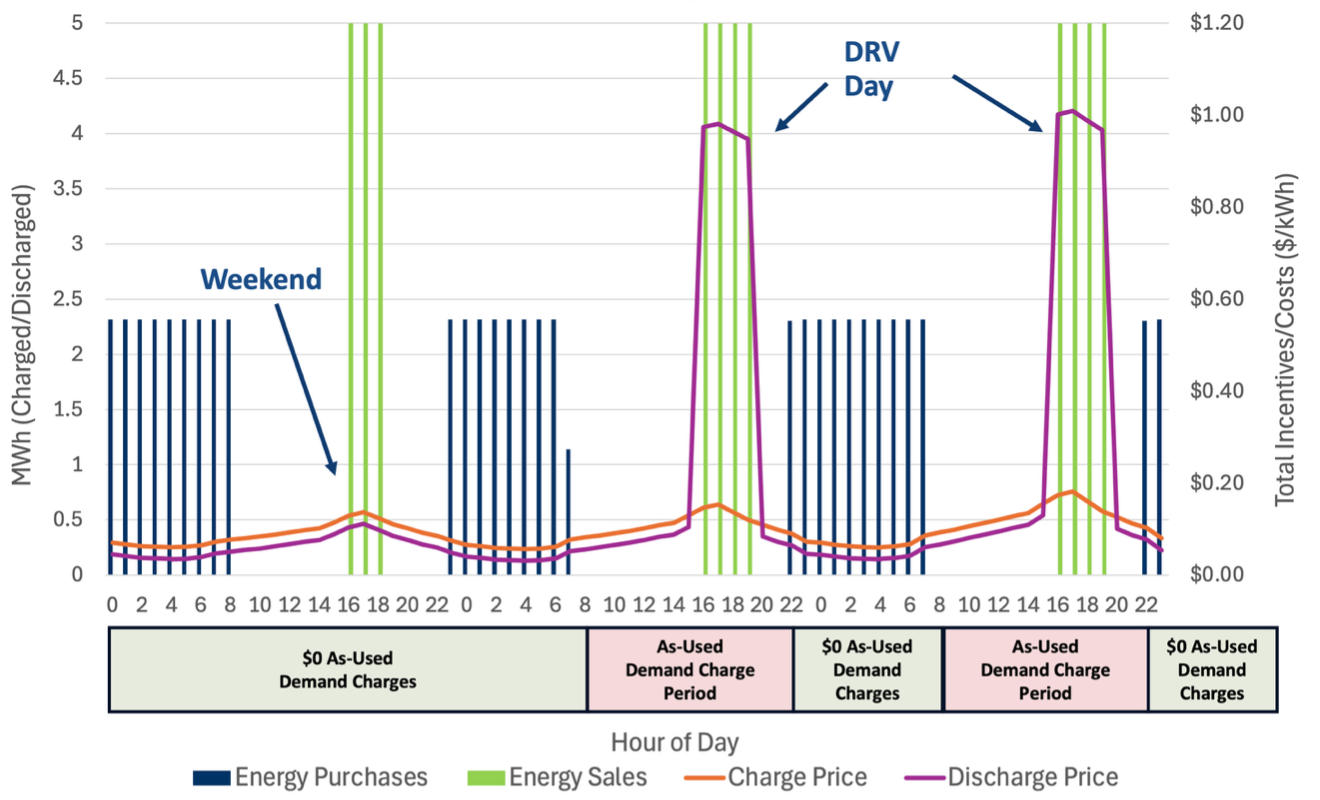
Together, these costs push most VDER storage projects toward an overnight trickle-charging strategy: reducing output below nameplate capacity and charging steadily overnight, when energy prices are typically lowest and as-used demand charges don't apply. Optimal overnight charging rates allow for the project to fully charge in order to preserve DRV and energy arbitrage, as illustrated in Figure 2.
Costs vary considerably depending on utility territory, with real consequences for project economics. For instance, National Grid's contract demand charge runs about $0.45 per kilowatt-month, while NYSEG's runs roughly $4.90, nearly 10 times higher. NYSEG's as-used demand charge window is also longer, forcing projects to charge at a higher rate, incurring more contract demand charges. That combination makes National Grid a friendlier upstate territory for storage.
As developers look where build, they must also be mindful of charging and discharging restrictions that may be imposed on projects. In interconnection studies, utilities may dictate when a project can charge and discharge and at what rates. Charging restrictions overnight that eat into a preferred trickle charging strategy or discharging restrictions that conflict with DRV or ICAP can greatly impact project economics.
In the near term, the DPS released proposed DRV values in December 2025 that would raise compensation for most utilities, with National Grid and NYSEG seeing especially large increases. Ascend expects these proposed values to be finalized largely as written by the end of 2026.
Longer term, tension is expected to grow between VDER's current structure, built around a summer-peaking system, and the grid NYISO is forecasted to become. NYISO projects a shift to winter peaking by 2040, and regulators will likely need to revisit several pieces of the program to keep incentives aligned with that shift: how the ICAP market peak hour is defined, whether winter DRV windows get added, whether DRV windows need to lengthen to reflect longer winter peaks, and whether those windows should shift later in the day.
Trusted across hundreds of deals and more than $50 billion in project finance assessments, PowerVAL provides specific 25-year outlooks for distributed energy compensation programs in New York and Illinois, incorporating dispatch optimization for all applicable value stack, cost, and program components. Contact us to learn more.
New York's Value of Distributed Energy Resources (VDER) program has reliably generated revenue for solar developers for years. Optimizing revenue for standalone battery energy storage systems (BESS), however, presents a different challenge: unlike solar, a battery's revenue depends on when it discharges and charges, which involves navigating a maze of utility-specific costs. For solar developers considering storage in New York, understanding this distinction matters: the payoff for storage can exceed what solar earns today, though only for projects that get the dispatch strategy right.
In a recent webinar hosted by the New York Solar Energy Industries Association (NYSEIA), Caroline Zechter, Director of Community Solar and Peter Wise, Senior Energy Analyst at Ascend Analytics discuss how storage monetizes the VDER value stack differently than solar, why capacity revenue carries the most risk and the most reward, how variation in utility charging costs vary influence where projects get built, and what regulatory shifts could reshape the program in the years ahead.
Solar's VDER revenue is essentially locked in once a project is built: production times the value stack components determine the payout, and there's little else a developer can do to influence it.
On the contrary, a battery’s margin depends on sophisticated operation of the asset – knowing when to charge and discharge. The timing of charge and discharge decisions interacts with capture of energy prices, DRV, capacity payments, and the utility costs incurred to charge in the first place.
Getting the timing right can produce significant value for storage relative to solar. As illustrated in Figure 1, net revenue for the year 2030 reaches $2.4 million under current DRV rates and $2.6 million if proposed rates are finalized, compared with $1.7 million for an equivalent 5MW solar project versus a 5 MW, 4-hour battery in Consolidated Edison's (ConEd) Zone J. Higher revenues are driven by how storage can monetize its flexibility by ensuring greater discharge into the DRV window and by providing greater capacity services under capacity alternative 3.
Similar dynamics apply in upstate New York. In National Grid's Zone F, for example, storage revenue roughly matches solar today, at $1.1 million versus $1.2 million, and would climb well past it, to $1.9 million, under proposed DRV values.
Unlike solar and hybrid projects, which can choose among three capacity compensation alternatives, standalone storage is required to take Alternative 3, which produces a payment based on a project's output during a single system peak hour of the previous year.
That structure creates two distinct types of risk – pricing and performance risk. First, because ICAP compensation is based on wholesale capacity auction prices, projects face price risk in the value of payments. New York's capacity market prices are generally binary, clearing near the cost of keeping existing plants online when supply is adequate, or near the cost of building new generation when it is not. Programs such as the state's Index Storage Credit subsidize new battery entry, allowing subsidized capacity to act as a price taker that suppresses capacity prices. That dynamic is what makes pricing risk hard to pin down: subsidized entry could keep pace with load growth and hold prices near a floor (cost of keeping existing entry online), or lag behind it and push prices toward a ceiling (Net Cost of New Entry -- Net CONE). Ascend’s capacity forecast models the expected value of capacity prices within a band of uncertainty between floor and ceiling conditions.
Capture risk is the second piece: miss the single peak hour, and a project forfeits capacity revenue for the entire year. The good news is that this hour has fallen between 4 and 7 p.m. in the past decade, allowing for predictable capture of both capacity and DRV revenue components. In the future, the peak load hour is expected to fall later in the day, occurring near the end or after common DRV window hours. This misalignment will incent operators to discharge into likely peak hours outside the DRV window to ensure capacity capture. Doing so incurs a cost of missing incremental DRV revenue. To ensure peak hour capture, operators can inform discharge of their asset using NYISO’s day ahead load forecast on days with high forecasted loads. NYISO’s day-ahead load forecast has correctly identified the peak hour in eight of the last 10 years, missing by no more than two hours in the other two. That track record gives four-hour batteries a strong basis for confidently capturing ICAP Alt 3, even as the peak hour is expected to shift later and eventually move outside current DRV windows.
Storage projects pay for the power they use to charge in ways solar never has to consider. Three cost components dominate: supply prices tied to hourly zonal day-ahead energy prices, as-used demand charges triggered by charging during defined daytime windows, and contract demand charges based on a project's maximum charging and export capacity.
Together, these costs push most VDER storage projects toward an overnight trickle-charging strategy: reducing output below nameplate capacity and charging steadily overnight, when energy prices are typically lowest and as-used demand charges don't apply. Optimal overnight charging rates allow for the project to fully charge in order to preserve DRV and energy arbitrage, as illustrated in Figure 2.
Costs vary considerably depending on utility territory, with real consequences for project economics. For instance, National Grid's contract demand charge runs about $0.45 per kilowatt-month, while NYSEG's runs roughly $4.90, nearly 10 times higher. NYSEG's as-used demand charge window is also longer, forcing projects to charge at a higher rate, incurring more contract demand charges. That combination makes National Grid a friendlier upstate territory for storage.
As developers look where build, they must also be mindful of charging and discharging restrictions that may be imposed on projects. In interconnection studies, utilities may dictate when a project can charge and discharge and at what rates. Charging restrictions overnight that eat into a preferred trickle charging strategy or discharging restrictions that conflict with DRV or ICAP can greatly impact project economics.
In the near term, the DPS released proposed DRV values in December 2025 that would raise compensation for most utilities, with National Grid and NYSEG seeing especially large increases. Ascend expects these proposed values to be finalized largely as written by the end of 2026.
Longer term, tension is expected to grow between VDER's current structure, built around a summer-peaking system, and the grid NYISO is forecasted to become. NYISO projects a shift to winter peaking by 2040, and regulators will likely need to revisit several pieces of the program to keep incentives aligned with that shift: how the ICAP market peak hour is defined, whether winter DRV windows get added, whether DRV windows need to lengthen to reflect longer winter peaks, and whether those windows should shift later in the day.
Trusted across hundreds of deals and more than $50 billion in project finance assessments, PowerVAL provides specific 25-year outlooks for distributed energy compensation programs in New York and Illinois, incorporating dispatch optimization for all applicable value stack, cost, and program components. Contact us to learn more.
Ascend Analytics is the leading provider of market intelligence and analytics solutions for the power industry.
The company’s offerings enable decision makers in power development and supply procurement to maximize the value of planning, operating, and managing risk for renewable, storage, and other assets. From real-time to 30-year horizons, their forecasts and insights are at the foundation of over $50 billion in project financing assessments.
Ascend provides energy market stakeholders with the clarity and confidence to successfully navigate the rapidly shifting energy landscape.


-3.avif)
.avif)