Let's Connect
Contact us
Thank you for reaching out, we will be in touch shortly!
Oops! Something went wrong while submitting the form.


For developers, independent power producers (IPPs), and asset owners who rely on long-term energy market intelligence forecasts to guide strategy, the gap between a semi-annual forecast release and shifting market realities can carry financial consequences. Forward prices can shift rapidly in response to supply-demand dynamics, fuel supply changes, and geopolitical events. In these cases, energy asset operators often need to make critical decisions about near- to mid-term strategies, while remaining aligned with a long-term fundamental approach.
Monthly forecast updates, such as those offered through Ascend Analytics' PowerVAL platform, are designed to give power market stakeholders a current, market-informed view of asset value without waiting for the next major forecast release.
Here are common questions about how monthly forecast updates work, why they matter, and how they can help maximize revenue while minimizing risk.
Rather than relying solely on a semi-annual fundamental forecast, a monthly update effectively provides a mark-to-market view of project value, offering a current view of forward market prices over the next 12–36 months, including updates for day-ahead and real-time prices.
Monthly forecast updates afford asset developers, owners, and operators a clearer view of near-term price signals that have incorporated new market information, thereby offering directional insights into pricing and value shifts that can inform medium-term operational and strategic decision making.
Forward markets continuously and simultaneously aggregate the views of multiple energy market participants, embedding expectations about supply and demand fundamentals as well as uncertainty and tail risk, which makes them the best available risk-adjusted view of near-term price outcomes.
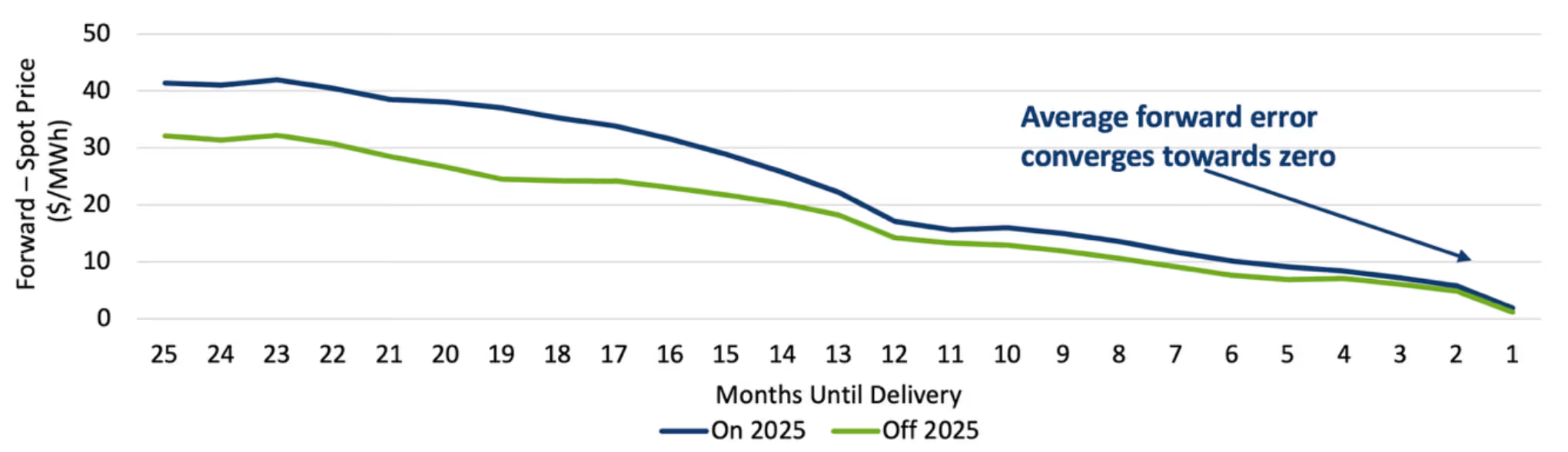
Even so, forward prices are not perfect predictors. They diverge from realized spot prices as market conditions evolve, and this divergence tends to narrow as the delivery month approaches. As shown in Figure 1, for example, average forward error is highest 18-24 months out and converges toward zero in the prompt month as uncertainty resolves. This means the most actionable forward market signals are in the near term, which is why monthly forecast updates can provide significant value, depending on where power market stakeholders are in a project timeline.
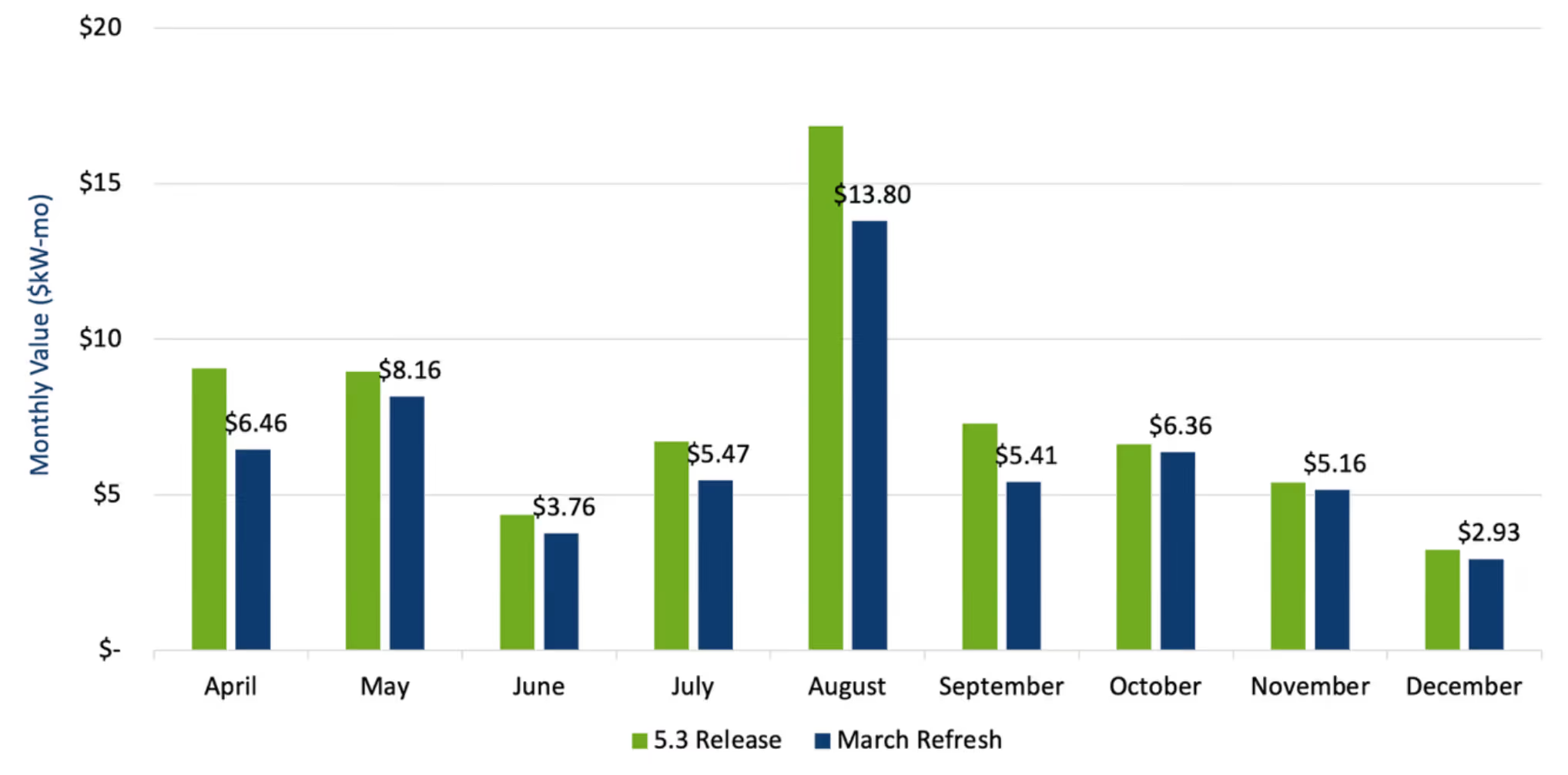
Forward markets can shift meaningfully and rapidly between forecast releases. As illustrated in Figure 2, forward prices in PJM shifted significantly between July 2025 and February 2026, reflecting a gas-driven winter price spike followed by declining shoulder-month pricing. These movements can redistribute expected revenue across months in ways that have direct implications for project budgeting, liquidity, and operational positioning.

Geopolitical events can materially impact (or not) near- to mid-term energy prices, as well. When Russia invaded Ukraine in early 2022, Henry Hub August delivery prices climbed steadily from roughly $4/MMBtu to nearly $9/MMBtu between January and July of that year. However, when recent U.S. strikes against Iran raised concerns about energy supply disruption, August 2026 Henry Hub forwards showed little movement compared to the 2022 period, likely due to US liquid natural gas (LNG) exports operating near maximum capacity, thus insulating the domestic market from trans-continental gas price increases. Monthly monitoring enables energy market stakeholders to account for these dynamics as they unfold.
Concretely, monthly updates can be utilized to fine-tune the following types of decisions:
Long-term project valuation relies on fundamental forecasts spanning 20 or more years. Day-ahead and real-time bidding decisions are driven by near-term operational optimization. Monthly forecast updates bridge the gap between those two horizons, covering the 12–36 month tactical window where forward markets are liquid enough to be informative and near enough to matter for operational and financial decisions.
For valuation purposes beyond 36 months, forwards become less useful due to declining liquidity and widening uncertainty, making fundamental forecasts the more appropriate basis for decision making. Ascend's monthly update is specifically designed to integrate both perspectives.
Monthly forecast updates are appropriate for power market stakeholders that own or operate energy assets, and that need to align near-term operational decisions with current market conditions. This includes:
Trusted across hundreds of deals and more than $1 billion in transaction value, PowerVAL provides bankable revenue forecasts and nodal-specific valuations for storage, renewables, and hybrid projects under multiple operating strategies across all ISOs. PowerVAL visualizations can be used to work with forward data, and can automatically adjust revenue expectations, and help reveal revenue opportunities associated with locking in inflated forward prices.
For Ascend's Monthly Forecast Update, new data is available during the first week of each month. All PowerVAL users can access the functionality under existing subscriptions. Please contact us to learn more.
For developers, independent power producers (IPPs), and asset owners who rely on long-term energy market intelligence forecasts to guide strategy, the gap between a semi-annual forecast release and shifting market realities can carry financial consequences. Forward prices can shift rapidly in response to supply-demand dynamics, fuel supply changes, and geopolitical events. In these cases, energy asset operators often need to make critical decisions about near- to mid-term strategies, while remaining aligned with a long-term fundamental approach.
Monthly forecast updates, such as those offered through Ascend Analytics' PowerVAL platform, are designed to give power market stakeholders a current, market-informed view of asset value without waiting for the next major forecast release.
Here are common questions about how monthly forecast updates work, why they matter, and how they can help maximize revenue while minimizing risk.
Rather than relying solely on a semi-annual fundamental forecast, a monthly update effectively provides a mark-to-market view of project value, offering a current view of forward market prices over the next 12–36 months, including updates for day-ahead and real-time prices.
Monthly forecast updates afford asset developers, owners, and operators a clearer view of near-term price signals that have incorporated new market information, thereby offering directional insights into pricing and value shifts that can inform medium-term operational and strategic decision making.
Forward markets continuously and simultaneously aggregate the views of multiple energy market participants, embedding expectations about supply and demand fundamentals as well as uncertainty and tail risk, which makes them the best available risk-adjusted view of near-term price outcomes.
Even so, forward prices are not perfect predictors. They diverge from realized spot prices as market conditions evolve, and this divergence tends to narrow as the delivery month approaches. As shown in Figure 1, for example, average forward error is highest 18-24 months out and converges toward zero in the prompt month as uncertainty resolves. This means the most actionable forward market signals are in the near term, which is why monthly forecast updates can provide significant value, depending on where power market stakeholders are in a project timeline.
Forward markets can shift meaningfully and rapidly between forecast releases. As illustrated in Figure 2, forward prices in PJM shifted significantly between July 2025 and February 2026, reflecting a gas-driven winter price spike followed by declining shoulder-month pricing. These movements can redistribute expected revenue across months in ways that have direct implications for project budgeting, liquidity, and operational positioning.
Geopolitical events can materially impact (or not) near- to mid-term energy prices, as well. When Russia invaded Ukraine in early 2022, Henry Hub August delivery prices climbed steadily from roughly $4/MMBtu to nearly $9/MMBtu between January and July of that year. However, when recent U.S. strikes against Iran raised concerns about energy supply disruption, August 2026 Henry Hub forwards showed little movement compared to the 2022 period, likely due to US liquid natural gas (LNG) exports operating near maximum capacity, thus insulating the domestic market from trans-continental gas price increases. Monthly monitoring enables energy market stakeholders to account for these dynamics as they unfold.
Concretely, monthly updates can be utilized to fine-tune the following types of decisions:
Long-term project valuation relies on fundamental forecasts spanning 20 or more years. Day-ahead and real-time bidding decisions are driven by near-term operational optimization. Monthly forecast updates bridge the gap between those two horizons, covering the 12–36 month tactical window where forward markets are liquid enough to be informative and near enough to matter for operational and financial decisions.
For valuation purposes beyond 36 months, forwards become less useful due to declining liquidity and widening uncertainty, making fundamental forecasts the more appropriate basis for decision making. Ascend's monthly update is specifically designed to integrate both perspectives.
Monthly forecast updates are appropriate for power market stakeholders that own or operate energy assets, and that need to align near-term operational decisions with current market conditions. This includes:
Trusted across hundreds of deals and more than $1 billion in transaction value, PowerVAL provides bankable revenue forecasts and nodal-specific valuations for storage, renewables, and hybrid projects under multiple operating strategies across all ISOs. PowerVAL visualizations can be used to work with forward data, and can automatically adjust revenue expectations, and help reveal revenue opportunities associated with locking in inflated forward prices.
For Ascend's Monthly Forecast Update, new data is available during the first week of each month. All PowerVAL users can access the functionality under existing subscriptions. Please contact us to learn more.
Ascend Analytics is the leading provider of market intelligence and analytics solutions for the power industry.
The company’s offerings enable decision makers in power development and supply procurement to maximize the value of planning, operating, and managing risk for renewable, storage, and other assets. From real-time to 30-year horizons, their forecasts and insights are at the foundation of over $50 billion in project financing assessments.
Ascend provides energy market stakeholders with the clarity and confidence to successfully navigate the rapidly shifting energy landscape.





-3.avif)


.avif)