Let's Connect
Contact us
Thank you for reaching out, we will be in touch shortly!
Oops! Something went wrong while submitting the form.

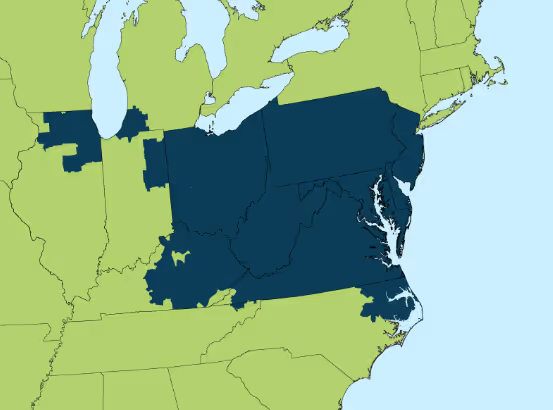
The proposals released by both the Trump administration and the PJM Board share a common theme, and the general agreement between the Trump Administration, a bipartisan group of 13 state Governors, and the PJM board demonstrates a rare alignment of interest and action. Both proposals consist of several main components:
The ‘Statement of Principles’ additionally proposes directly allocating the auction capacity costs through LSEs to datacenters that have not self-procured new capacity or agreed to curtailable service.
As Ascend has been writing about, high capacity prices are needed to support the new entry required to serve growing load, but high capacity prices lead to politically untenable costs that will drive market interventions that flow revenue to new generation without paying that same price to the rest of the supply. While the inherent instability of capacity revenues already created an investment challenge for financing new generation in PJM, the demonstrated unwillingness among politicians and key stakeholders to allow capacity prices to rise to the level needed to support new entry effectively ground the financing of new generation to a halt.
PJM already had a backstop reliability procurement mechanism within its tariff, which would get triggered after three consecutive shortages in the capacity market of greater than one percentage point below the approved reserve margin, which Ascend was expecting to get triggered after shortages in the next two capacity auctions. The proposed actions would accelerate this timeline, moving forward with a reliability backstop procurement now, and would target the costs onto new datacenter load rather than socializing across all the load in the system.
The immediate backstop procurement solves an acute need in a financially efficient manner by providing stable revenues to new generation while mitigating total capacity market costs. However, many long-term questions for how the market will operate on an ongoing basis remain unanswered.
The market outcomes of these proposals are generally consistent with what Ascend was already forecasting in PJM (and in other capacity markets). Ascend recognized that i) demand growth requires new generation; ii) new generation needs to get paid the cost of new entry to justify investment; iii) capacity prices at the cost of new entry are politically untenable; and iv) subsidizing new entry reduces capacity market costs by multiples of the subsidy cost.
In light of these considerations, Ascend was already forecasting that capacity markets would alternate between being long and being short, with the frequency of each determined by the rate at which out-of-market procurements/subsidies contract with new capacity relative to the rate of demand growth.
The degree of unity between the PJM Board of Managers, a bipartisan group of state governors, and a particularly divisive presidential administration combined with a mutually recognized need for holistic market reform is remarkable and points to a lower frequency of capacity shortages. As a result, Ascend will likely reduce its capacity price forecast in its next release, slated for Q2 2026, with the balance tilting toward more frequent long conditions than Ascend was previously anticipating.
While this reduction in capacity prices will reduce merchant revenue forecasts, Ascend was already warning that capacity market revenues cannot be relied on and would not be allowed to stay high indefinitely. Generation projects in PJM need some form of contracted capacity revenues to be safe investments.
Our market outlooks have emphasized the risk of capacity revenue instability and the need for some form of fixed capacity revenues in order to support new generation. The reliability backstop procurement provides exactly that mechanism, creating a clear and defined pathway for new generation to come online, supporting all economically competitive capacity resources (storage and NGCC in Ascend’s modeling).
While the firming of capacity revenues will greatly benefit the financeability of all units in the market, including storage, the biggest winners of the proposal are the prospective developers of new thermal resources. Efforts to fast-track projects through the interconnection queue and RRI process are more beneficial to new thermal than storage, with new thermal generation projects generally less mature than storage projects. Moreover, contracted revenues also protect new gas projects against the price correction risk in the 2030s if turbine prices decline, protecting new gas from being undercut by future gas at lower CapEx.
While storage will have its interconnection head start eroded by future rounds of fast-track studies, it is well positioned to compete with new gas solely on economics. In Ascend’s 5.3 PJM release, the economics of 40% ITC storage were highly competitive with new entry gas combined cycle generation, but storage with the standard ITC was generally undercut by combined cycles. This will place a heavy emphasis on siting of storage project in areas that have 10% ITC bonus adder eligibility, low interconnection costs, and durable volatility premiums.
As good as contracted revenues are for supporting new generation, the lower capacity prices that will result from creating surplus conditions with price-taking capacity will be detrimental to existing generation. Valuation of existing generation must be based on an expectation of market reforms that hold capacity prices well below that required for new entry.
Load in PJM can breathe a temporary sigh of relief, as this intervention demonstrates that PJM stakeholders are willing to take action to prevent perpetually high capacity prices. However, market reforms will likely require load-serving entities (LSEs) to be more proactive in contracting with new capacity, which will hedge against capacity price risk anyway. Additionally, if the principle of allocating costs of new supply onto the causes of new demand continues, the importance of accurate load forecasting will rise in order to prevent LSEs from having to pay for new capacity that they end up not needing.
While initiating an immediate reliability backstop procurement auction addresses a short-term, immediate need for capacity, many uncertainties remain for PJM.
Will FERC approve this structure?
Given the Trump administration support, unity among PJM state governors, unity between the ‘Statement of Principles’ and the proposal from the PJM Board of Managers, and FERC’s general deference to market participants, it seems unlikely that that the proposal for an immediate reliability backstop procurement would be rejected as a temporary measure.
An extension of the price collar is much less likely, as the initial price collar was approved as a temporary, one-off measure in response to previously delayed capacity auctions. IPPs in PJM will fight hard (but quietly) against an extension of the collar.
Will the reliability backstop procurement be a one-off solution, or is this the start of an ongoing capacity market bifurcation between new capacity and existing capacity?
PJM’s board proposal calls for this to be a temporary fix, though PJM has a history of various market interventions. A true bifurcation between new capacity and existing capacity is unlikely to be approved by FERC, but a permanent shortening of the backstop procurement auction timing from three shortages to one or two shortages seems likely.
If the backstop procurement effectively becomes a bifurcation in the capacity market between new and existing generation, expect bid mitigation of existing generation in the capacity market to become a very hot topic. If PJM is continuously short and procuring just enough to meet demand growth, then all existing generation will need to stay online as well with virtually guaranteed clearance in the capacity market, enabling aggressive bidding behavior.
Will backstop auctions procure just enough for a single auction, or overprocure in anticipation of ongoing load growth?
If reliability backstop procurements are just sufficient to meet anticipated load growth, then capacity markets are likely to swing wildly from long-to-short each year. In contrast, if the backstop procurements are allowed to pre-emptively contract with capacity in anticipation of additional future load growth, then the long-to-short cycle will be slower, with a greater proportion of years spent on the long side.
Will all resources be on equal footing in the reliability backstop procurement?
Political pressures may cause some generation asset types to be favored or disfavored in the backstop procurement auction, with disagreement among the powers-that-be about which asset types are favored. Blue states will want to see renewables and storage procurement, while the Trump administration and red states will want to tilt the playing field toward fossil fuel assets. Compromise to keep everyone in agreement will likely be necessary, with the backstop procurement playing by the same eligibility and accreditation rules as the capacity market. But the prioritization of ELCC and prevalence of new gas in the RRI process may be a harbinger of what could come in the backstop procurement.
What is the potential timing and structure of a holistic market reform?
Ascend expects a major market reform proposal for PJM by late 2026 or early 2027, with any major reform having to address the challenge of providing sufficient revenue to new entry without paying that price to the entire supply stack. Some possibilities include:
How will the costs of new generation be applied to load growth that is more organic?
While datacenters are the driving force for near-term capacity shortages, long-term capacity shortages were always going to arise in a world with finite practical lifetimes for aging generation infrastructure and load growth from electrification, re-industrialization, or other forms of organic load growth. If holistic market reforms sufficiently limit the amplification of capacity market costs, then cost-allocation for new generation will be less politically fraught and more likely to be socialized across the load in the system.
Want to learn more about Ascend’s market outlooks and our market intelligence practice? Contact us
The proposals released by both the Trump administration and the PJM Board share a common theme, and the general agreement between the Trump Administration, a bipartisan group of 13 state Governors, and the PJM board demonstrates a rare alignment of interest and action. Both proposals consist of several main components:
The ‘Statement of Principles’ additionally proposes directly allocating the auction capacity costs through LSEs to datacenters that have not self-procured new capacity or agreed to curtailable service.
As Ascend has been writing about, high capacity prices are needed to support the new entry required to serve growing load, but high capacity prices lead to politically untenable costs that will drive market interventions that flow revenue to new generation without paying that same price to the rest of the supply. While the inherent instability of capacity revenues already created an investment challenge for financing new generation in PJM, the demonstrated unwillingness among politicians and key stakeholders to allow capacity prices to rise to the level needed to support new entry effectively ground the financing of new generation to a halt.
PJM already had a backstop reliability procurement mechanism within its tariff, which would get triggered after three consecutive shortages in the capacity market of greater than one percentage point below the approved reserve margin, which Ascend was expecting to get triggered after shortages in the next two capacity auctions. The proposed actions would accelerate this timeline, moving forward with a reliability backstop procurement now, and would target the costs onto new datacenter load rather than socializing across all the load in the system.
The immediate backstop procurement solves an acute need in a financially efficient manner by providing stable revenues to new generation while mitigating total capacity market costs. However, many long-term questions for how the market will operate on an ongoing basis remain unanswered.
The market outcomes of these proposals are generally consistent with what Ascend was already forecasting in PJM (and in other capacity markets). Ascend recognized that i) demand growth requires new generation; ii) new generation needs to get paid the cost of new entry to justify investment; iii) capacity prices at the cost of new entry are politically untenable; and iv) subsidizing new entry reduces capacity market costs by multiples of the subsidy cost.
In light of these considerations, Ascend was already forecasting that capacity markets would alternate between being long and being short, with the frequency of each determined by the rate at which out-of-market procurements/subsidies contract with new capacity relative to the rate of demand growth.
The degree of unity between the PJM Board of Managers, a bipartisan group of state governors, and a particularly divisive presidential administration combined with a mutually recognized need for holistic market reform is remarkable and points to a lower frequency of capacity shortages. As a result, Ascend will likely reduce its capacity price forecast in its next release, slated for Q2 2026, with the balance tilting toward more frequent long conditions than Ascend was previously anticipating.
While this reduction in capacity prices will reduce merchant revenue forecasts, Ascend was already warning that capacity market revenues cannot be relied on and would not be allowed to stay high indefinitely. Generation projects in PJM need some form of contracted capacity revenues to be safe investments.
Our market outlooks have emphasized the risk of capacity revenue instability and the need for some form of fixed capacity revenues in order to support new generation. The reliability backstop procurement provides exactly that mechanism, creating a clear and defined pathway for new generation to come online, supporting all economically competitive capacity resources (storage and NGCC in Ascend’s modeling).
While the firming of capacity revenues will greatly benefit the financeability of all units in the market, including storage, the biggest winners of the proposal are the prospective developers of new thermal resources. Efforts to fast-track projects through the interconnection queue and RRI process are more beneficial to new thermal than storage, with new thermal generation projects generally less mature than storage projects. Moreover, contracted revenues also protect new gas projects against the price correction risk in the 2030s if turbine prices decline, protecting new gas from being undercut by future gas at lower CapEx.
While storage will have its interconnection head start eroded by future rounds of fast-track studies, it is well positioned to compete with new gas solely on economics. In Ascend’s 5.3 PJM release, the economics of 40% ITC storage were highly competitive with new entry gas combined cycle generation, but storage with the standard ITC was generally undercut by combined cycles. This will place a heavy emphasis on siting of storage project in areas that have 10% ITC bonus adder eligibility, low interconnection costs, and durable volatility premiums.
As good as contracted revenues are for supporting new generation, the lower capacity prices that will result from creating surplus conditions with price-taking capacity will be detrimental to existing generation. Valuation of existing generation must be based on an expectation of market reforms that hold capacity prices well below that required for new entry.
Load in PJM can breathe a temporary sigh of relief, as this intervention demonstrates that PJM stakeholders are willing to take action to prevent perpetually high capacity prices. However, market reforms will likely require load-serving entities (LSEs) to be more proactive in contracting with new capacity, which will hedge against capacity price risk anyway. Additionally, if the principle of allocating costs of new supply onto the causes of new demand continues, the importance of accurate load forecasting will rise in order to prevent LSEs from having to pay for new capacity that they end up not needing.
While initiating an immediate reliability backstop procurement auction addresses a short-term, immediate need for capacity, many uncertainties remain for PJM.
Will FERC approve this structure?
Given the Trump administration support, unity among PJM state governors, unity between the ‘Statement of Principles’ and the proposal from the PJM Board of Managers, and FERC’s general deference to market participants, it seems unlikely that that the proposal for an immediate reliability backstop procurement would be rejected as a temporary measure.
An extension of the price collar is much less likely, as the initial price collar was approved as a temporary, one-off measure in response to previously delayed capacity auctions. IPPs in PJM will fight hard (but quietly) against an extension of the collar.
Will the reliability backstop procurement be a one-off solution, or is this the start of an ongoing capacity market bifurcation between new capacity and existing capacity?
PJM’s board proposal calls for this to be a temporary fix, though PJM has a history of various market interventions. A true bifurcation between new capacity and existing capacity is unlikely to be approved by FERC, but a permanent shortening of the backstop procurement auction timing from three shortages to one or two shortages seems likely.
If the backstop procurement effectively becomes a bifurcation in the capacity market between new and existing generation, expect bid mitigation of existing generation in the capacity market to become a very hot topic. If PJM is continuously short and procuring just enough to meet demand growth, then all existing generation will need to stay online as well with virtually guaranteed clearance in the capacity market, enabling aggressive bidding behavior.
Will backstop auctions procure just enough for a single auction, or overprocure in anticipation of ongoing load growth?
If reliability backstop procurements are just sufficient to meet anticipated load growth, then capacity markets are likely to swing wildly from long-to-short each year. In contrast, if the backstop procurements are allowed to pre-emptively contract with capacity in anticipation of additional future load growth, then the long-to-short cycle will be slower, with a greater proportion of years spent on the long side.
Will all resources be on equal footing in the reliability backstop procurement?
Political pressures may cause some generation asset types to be favored or disfavored in the backstop procurement auction, with disagreement among the powers-that-be about which asset types are favored. Blue states will want to see renewables and storage procurement, while the Trump administration and red states will want to tilt the playing field toward fossil fuel assets. Compromise to keep everyone in agreement will likely be necessary, with the backstop procurement playing by the same eligibility and accreditation rules as the capacity market. But the prioritization of ELCC and prevalence of new gas in the RRI process may be a harbinger of what could come in the backstop procurement.
What is the potential timing and structure of a holistic market reform?
Ascend expects a major market reform proposal for PJM by late 2026 or early 2027, with any major reform having to address the challenge of providing sufficient revenue to new entry without paying that price to the entire supply stack. Some possibilities include:
How will the costs of new generation be applied to load growth that is more organic?
While datacenters are the driving force for near-term capacity shortages, long-term capacity shortages were always going to arise in a world with finite practical lifetimes for aging generation infrastructure and load growth from electrification, re-industrialization, or other forms of organic load growth. If holistic market reforms sufficiently limit the amplification of capacity market costs, then cost-allocation for new generation will be less politically fraught and more likely to be socialized across the load in the system.
Want to learn more about Ascend’s market outlooks and our market intelligence practice? Contact us
Ascend Analytics is the leading provider of market intelligence and analytics solutions for the power industry.
The company’s offerings enable decision makers in power development and supply procurement to maximize the value of planning, operating, and managing risk for renewable, storage, and other assets. From real-time to 30-year horizons, their forecasts and insights are at the foundation of over $50 billion in project financing assessments.
Ascend provides energy market stakeholders with the clarity and confidence to successfully navigate the rapidly shifting energy landscape.





-3.avif)

.avif)