Let's Connect
Contact us
Thank you for reaching out, we will be in touch shortly!
Oops! Something went wrong while submitting the form.

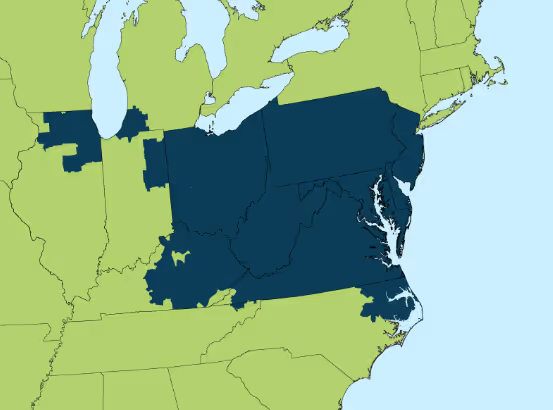
PJM is proposing a one-time emergency process to procure new resources, with no eligibility for measures related to existing generation, such as delayed retirements, license extensions, or Capacity Interconnection Rights (CIR)-only uprates.
The procurement will be composed of two phases. The first phase will involve bilateral contracting between load and new supply, with PJM acting as a confidential intermediary to facilitate contracting, particularly among multiple counterparties.
In the second phase, PJM would initiate a central procurement for any remaining capacity needs, with the Electric Distribution Companies (EDCs, i.e. the ‘poles and wires’ utilities) as offtakers. The central procurement would only provide capacity revenues and be pay-as-bid rather than providing a single clearing price. These projects would then bid into the capacity market as price-takers and receive a contract-for-differences on the capacity price. Accreditation and merchant revenue risk will be borne by the project owners, whose sell offers would include both the offered unforced capacity (UCAP) and offered price by year. Projects that underdeliver on UCAP (due to accreditation or performance) will not be compensated for the undelivered capacity and will additionally be assessed a 20% penalty if PJM is operating in a Connect and Manage Framework (i.e. capacity shortage). Network upgrade costs must be accounted for in a project’s offer price, creating additional risks for project owners without interconnection agreements.
The central procurement would also include a ‘gating’ stage, in which projects would have to pass a series of qualifications to demonstrate viability. These qualifications include historical success with project development, critical path construction schedule for COD viability, site control, financing and permitting plans, documentation on the acquisition of major equipment, and fuel delivery agreements for thermal projects. These viability qualifications strongly favor larger project developers with financial backing.
PJM’s initial estimate is for a total of 14.9 GW of UCAP to be procured, which would translate to over 20 GW of nameplate projects, depending on the resource mix. However, between direct bilateral contracts for load and direct cost assignments to EDCs from the central procurement based on load growth, load will be required to make financial commitments and obligations to new capacity. State regulators will be particularly keen to avoid over-procurement by EDCs, and data centers will not want to commit to capacity they do not need. Once these financial commitments carry real costs, load forecasts may become more conservative, and the total procured capacity may be substantially smaller than current estimates.
In parallel with the immediate procurement phases to support new generation, PJM’s proposal also notes that the backstop is not a long-term fix and PJM will be “undertaking a review of its markets.” Ascend has long asserted that holistic reform will be necessary because the instability of capacity markets will always render new projects unfinanceable without contracted revenues, and the high costs of supporting new entry through capacity markets is politically untenable.
The only solution to these challenges is to functionally bifurcate capacity markets between new and existing capacity, and Ascend expected PJM to achieve this by pursuing either an automatic backstop auction path or a mandatory generation ownership/bilateral contracting path for load. The emphasis on this backstop auction as a one-time event and the support for bilateral contracting in the new proposal indicates a greater likelihood for a mandatory contracting path in future market reforms.
If PJM pursues a mandatory contracting path, the end result would likely be a capacity market that is similar to MISO, with the cost of new entry being borne bilaterally and a merchant capacity market that is usually long and priced to keep existing generation online, but occasionally short. Such a market would result in balanced power between IPPs (who know that the load must contract with them) and retailers (who know the IPPs don’t want to live in the merchant capacity market).
As Ascend noted previously, the market outcomes of this proposal are generally consistent with what Ascend was already forecasting in PJM (and in other capacity markets). Ascend was already forecasting that capacity markets would alternate between being long and being short, with the frequency of each determined by the rate at which out-of-market procurements/subsidies contract with new capacity relative to the rate of demand growth.
The bipartisan alignment among state governors and discussion of holistic market reform in the proposal all point to a lower frequency of capacity shortages. As a result, Ascend will likely reduce its capacity price forecast in its next PJM release, with the balance tilting toward more frequent long conditions than previously anticipated. Regardless of the merchant capacity price outlook, Ascend was already warning that generation projects in PJM need some form of contracted capacity revenues to be safe investments.
Many of the implications for investment in PJM were already discussed in Ascend’s previous summary of the backstop auction. Importantly, PJM’s new proposal fixes a significant design problem in the original backstop procurement tariff, which would have been an all-in payment that ignored differences between resources in operating revenues, and eliminated incentives to maximize operational profitability.
In the proposed procurement design, resources would receive a capacity-only payment and be selected based on the lowest cost per MW of UCAP. This structure ensures a generally equal playing field among capacity resources, with each bidding in their Net Cost of New Entry (Net CONE) for capacity revenues needed to make the projects financially whole. The lowest cost capacity will likely be uprates on existing facilities, with Ascend’s modeling indicating that storage and NGCCs will be economically competitive among new entry. However, thermal generation carries substantially lower uncertainty on accreditation risks, which creates an advantage for thermal over storage with accreditation risk borne by the project. The competitiveness of potential demand response resources remains highly unclear, particularly if hyperscalers or data center developers explore mechanisms to pay other load to curtail during grid shortages.
For owners of existing generation in PJM, much depends on the structure of future market reforms. While the pay-as-bid structure in the centralized backstop procurement is intended to reduce procurement costs, lower cost capacity additions (such as uprates or Surplus Interconnection Service capacity) will likely hold out for contracts or bid prices that are only marginally lower than the costs of new entry. This presents a major upside for owners of generation assets that have uprate potential. Outside of this procurement, however, the lack of political support for capacity prices even at the current price cap (which is well below Net CONE for any new capacity resource) leads Ascend to consider a perpetually high capacity price future to be unlikely. Whatever the shape of holistic market reforms, the most probable outcome will likely be merchant capacity prices closer to the floor of the current price collar than the ceiling.
While the proposed backstop procurement approach addresses a short-term, immediate need for capacity, many uncertainties remain for PJM.
How much noise will IPPs make?
The PJM proposal is not final, and stakeholders now have the opportunity to provide feedback. Procurement of new capacity outside the capacity market is a negative for the revenue outlook of existing generation in PJM, so IPPs will likely want to oppose it while doing so quietly enough to avoid bad publicity.
Will FERC approve it?
Given the unity among the Trump Administration and PJM state governors, as well as FERC’s general deference to market participants, the proposed structure will likely receive FERC approval.
At the same time, an extension of the price collar is far less certain, as the initial price collar was approved as a temporary, one-off measure in response to previously delayed capacity auctions. IPPs in PJM will also fight hard (but quietly) against an extension of the collar.
What will holistic market reform look like?
PJM has shown that capacity markets cannot provide the needed incentives to support new entry, so meeting load growth requires supporting new entry via other mechanisms. PJM’s proposal indicates the backstop procurement as a one-time intervention, which points to bilateral procurements as PJM’s preferred mechanism to support new entry. While FERC narrowly rejected a minimum capacity obligation for MISO in 2022, several of the arguments do not apply to PJM and have not aged well.
Regardless of the structure of holistic market reform, if market participants acknowledge that the capacity market cannot provide new entry signals, then the demand curve may eventually be altered to no longer be pegged off of Net CONE, and may be revised to be pegged off of the cost to keep existing capacity online instead (which Ascend is calling Net Cost of Continued Operations or Net COCO).
How much load will actually come to PJM?
With data centers increasingly siting in locations where getting new supply online is more straightforward, such as MISO and ERCOT, the true outlook for demand growth is highly unclear. Moreover, the utilization of behind-the-meter generation can significantly mute demand growth from the perspective of the grid. Combined, there remains a high risk of demand growth falling significantly below current forecasts.
AscendMI™ (Ascend Market Intelligence) delivers proprietary power market forecasts that have been trusted in hundreds of projects and resource planning activities, supporting over 300 gigawatts and $25 billion in project assessments. Please contact us to learn more.
PJM is proposing a one-time emergency process to procure new resources, with no eligibility for measures related to existing generation, such as delayed retirements, license extensions, or Capacity Interconnection Rights (CIR)-only uprates.
The procurement will be composed of two phases. The first phase will involve bilateral contracting between load and new supply, with PJM acting as a confidential intermediary to facilitate contracting, particularly among multiple counterparties.
In the second phase, PJM would initiate a central procurement for any remaining capacity needs, with the Electric Distribution Companies (EDCs, i.e. the ‘poles and wires’ utilities) as offtakers. The central procurement would only provide capacity revenues and be pay-as-bid rather than providing a single clearing price. These projects would then bid into the capacity market as price-takers and receive a contract-for-differences on the capacity price. Accreditation and merchant revenue risk will be borne by the project owners, whose sell offers would include both the offered unforced capacity (UCAP) and offered price by year. Projects that underdeliver on UCAP (due to accreditation or performance) will not be compensated for the undelivered capacity and will additionally be assessed a 20% penalty if PJM is operating in a Connect and Manage Framework (i.e. capacity shortage). Network upgrade costs must be accounted for in a project’s offer price, creating additional risks for project owners without interconnection agreements.
The central procurement would also include a ‘gating’ stage, in which projects would have to pass a series of qualifications to demonstrate viability. These qualifications include historical success with project development, critical path construction schedule for COD viability, site control, financing and permitting plans, documentation on the acquisition of major equipment, and fuel delivery agreements for thermal projects. These viability qualifications strongly favor larger project developers with financial backing.
PJM’s initial estimate is for a total of 14.9 GW of UCAP to be procured, which would translate to over 20 GW of nameplate projects, depending on the resource mix. However, between direct bilateral contracts for load and direct cost assignments to EDCs from the central procurement based on load growth, load will be required to make financial commitments and obligations to new capacity. State regulators will be particularly keen to avoid over-procurement by EDCs, and data centers will not want to commit to capacity they do not need. Once these financial commitments carry real costs, load forecasts may become more conservative, and the total procured capacity may be substantially smaller than current estimates.
In parallel with the immediate procurement phases to support new generation, PJM’s proposal also notes that the backstop is not a long-term fix and PJM will be “undertaking a review of its markets.” Ascend has long asserted that holistic reform will be necessary because the instability of capacity markets will always render new projects unfinanceable without contracted revenues, and the high costs of supporting new entry through capacity markets is politically untenable.
The only solution to these challenges is to functionally bifurcate capacity markets between new and existing capacity, and Ascend expected PJM to achieve this by pursuing either an automatic backstop auction path or a mandatory generation ownership/bilateral contracting path for load. The emphasis on this backstop auction as a one-time event and the support for bilateral contracting in the new proposal indicates a greater likelihood for a mandatory contracting path in future market reforms.
If PJM pursues a mandatory contracting path, the end result would likely be a capacity market that is similar to MISO, with the cost of new entry being borne bilaterally and a merchant capacity market that is usually long and priced to keep existing generation online, but occasionally short. Such a market would result in balanced power between IPPs (who know that the load must contract with them) and retailers (who know the IPPs don’t want to live in the merchant capacity market).
As Ascend noted previously, the market outcomes of this proposal are generally consistent with what Ascend was already forecasting in PJM (and in other capacity markets). Ascend was already forecasting that capacity markets would alternate between being long and being short, with the frequency of each determined by the rate at which out-of-market procurements/subsidies contract with new capacity relative to the rate of demand growth.
The bipartisan alignment among state governors and discussion of holistic market reform in the proposal all point to a lower frequency of capacity shortages. As a result, Ascend will likely reduce its capacity price forecast in its next PJM release, with the balance tilting toward more frequent long conditions than previously anticipated. Regardless of the merchant capacity price outlook, Ascend was already warning that generation projects in PJM need some form of contracted capacity revenues to be safe investments.
Many of the implications for investment in PJM were already discussed in Ascend’s previous summary of the backstop auction. Importantly, PJM’s new proposal fixes a significant design problem in the original backstop procurement tariff, which would have been an all-in payment that ignored differences between resources in operating revenues, and eliminated incentives to maximize operational profitability.
In the proposed procurement design, resources would receive a capacity-only payment and be selected based on the lowest cost per MW of UCAP. This structure ensures a generally equal playing field among capacity resources, with each bidding in their Net Cost of New Entry (Net CONE) for capacity revenues needed to make the projects financially whole. The lowest cost capacity will likely be uprates on existing facilities, with Ascend’s modeling indicating that storage and NGCCs will be economically competitive among new entry. However, thermal generation carries substantially lower uncertainty on accreditation risks, which creates an advantage for thermal over storage with accreditation risk borne by the project. The competitiveness of potential demand response resources remains highly unclear, particularly if hyperscalers or data center developers explore mechanisms to pay other load to curtail during grid shortages.
For owners of existing generation in PJM, much depends on the structure of future market reforms. While the pay-as-bid structure in the centralized backstop procurement is intended to reduce procurement costs, lower cost capacity additions (such as uprates or Surplus Interconnection Service capacity) will likely hold out for contracts or bid prices that are only marginally lower than the costs of new entry. This presents a major upside for owners of generation assets that have uprate potential. Outside of this procurement, however, the lack of political support for capacity prices even at the current price cap (which is well below Net CONE for any new capacity resource) leads Ascend to consider a perpetually high capacity price future to be unlikely. Whatever the shape of holistic market reforms, the most probable outcome will likely be merchant capacity prices closer to the floor of the current price collar than the ceiling.
While the proposed backstop procurement approach addresses a short-term, immediate need for capacity, many uncertainties remain for PJM.
How much noise will IPPs make?
The PJM proposal is not final, and stakeholders now have the opportunity to provide feedback. Procurement of new capacity outside the capacity market is a negative for the revenue outlook of existing generation in PJM, so IPPs will likely want to oppose it while doing so quietly enough to avoid bad publicity.
Will FERC approve it?
Given the unity among the Trump Administration and PJM state governors, as well as FERC’s general deference to market participants, the proposed structure will likely receive FERC approval.
At the same time, an extension of the price collar is far less certain, as the initial price collar was approved as a temporary, one-off measure in response to previously delayed capacity auctions. IPPs in PJM will also fight hard (but quietly) against an extension of the collar.
What will holistic market reform look like?
PJM has shown that capacity markets cannot provide the needed incentives to support new entry, so meeting load growth requires supporting new entry via other mechanisms. PJM’s proposal indicates the backstop procurement as a one-time intervention, which points to bilateral procurements as PJM’s preferred mechanism to support new entry. While FERC narrowly rejected a minimum capacity obligation for MISO in 2022, several of the arguments do not apply to PJM and have not aged well.
Regardless of the structure of holistic market reform, if market participants acknowledge that the capacity market cannot provide new entry signals, then the demand curve may eventually be altered to no longer be pegged off of Net CONE, and may be revised to be pegged off of the cost to keep existing capacity online instead (which Ascend is calling Net Cost of Continued Operations or Net COCO).
How much load will actually come to PJM?
With data centers increasingly siting in locations where getting new supply online is more straightforward, such as MISO and ERCOT, the true outlook for demand growth is highly unclear. Moreover, the utilization of behind-the-meter generation can significantly mute demand growth from the perspective of the grid. Combined, there remains a high risk of demand growth falling significantly below current forecasts.
AscendMI™ (Ascend Market Intelligence) delivers proprietary power market forecasts that have been trusted in hundreds of projects and resource planning activities, supporting over 300 gigawatts and $25 billion in project assessments. Please contact us to learn more.
Ascend Analytics is the leading provider of market intelligence and analytics solutions for the power industry.
The company’s offerings enable decision makers in power development and supply procurement to maximize the value of planning, operating, and managing risk for renewable, storage, and other assets. From real-time to 30-year horizons, their forecasts and insights are at the foundation of over $50 billion in project financing assessments.
Ascend provides energy market stakeholders with the clarity and confidence to successfully navigate the rapidly shifting energy landscape.





-3.avif)

.avif)