Let's Connect
Contact us
Thank you for reaching out, we will be in touch shortly!
Oops! Something went wrong while submitting the form.

-3.avif)
Battery energy storage system (BESS) operators who leverage energy bid optimization software face a critical question: when should automated bid optimization strategies run without constraints, and when should a human step in? Successfully answering this question, and thus maximizing storage revenue, requires that operators trust the algorithmic optimization to do the heavy lifting during mild market conditions, which occur a majority of the time, but may realize additional risk-adjusted returns from human trader interventions when the grid is under stress and scarcity conditions emerge. Ultimately, finding the right balance requires a clear framework for identifying the rare occasions when human intervention can add value beyond automated bid strategies.
In a recent webinar on strategy configuration using Ascend’s SmartBidder™ bid optimization platform, Mike Huisenga, Managing Director of SmartBidder at Ascend Analytics, was joined by Senior Analyst Zander Kessler and Analyst Shiv Khanna to discuss Ascend’s trading philosophy, the mechanics of evaluating energy storage asset performance, when operators and trading teams should intervene to influence bidding behavior, and why combined automated bid optimization strategies and targeted human oversight separates top-performing BESS assets from the rest.
High-quality short term nodal price forecasts, such as those produced and used within SmartBidder, are trained on vast quantities of historical data and are continually refreshed as new prices clear the market. This consistent accuracy allows energy bid optimization solutions to pursue value freely in day-ahead and real-time markets, across energy and all ancillary service products, and across the full arc of the trading day without human direction.
This dynamic can be seen in Figure 1. On days when the day-ahead net load forecast fell below approximately 50 GW, representing roughly 90% of market days, price forecast error clustered tightly at the bottom of the distribution. In these conditions, in which abundant historical machine learning training data is available, expectations align closely with outcomes, and automated optimization reliably positions assets to capture available arbitrage value.
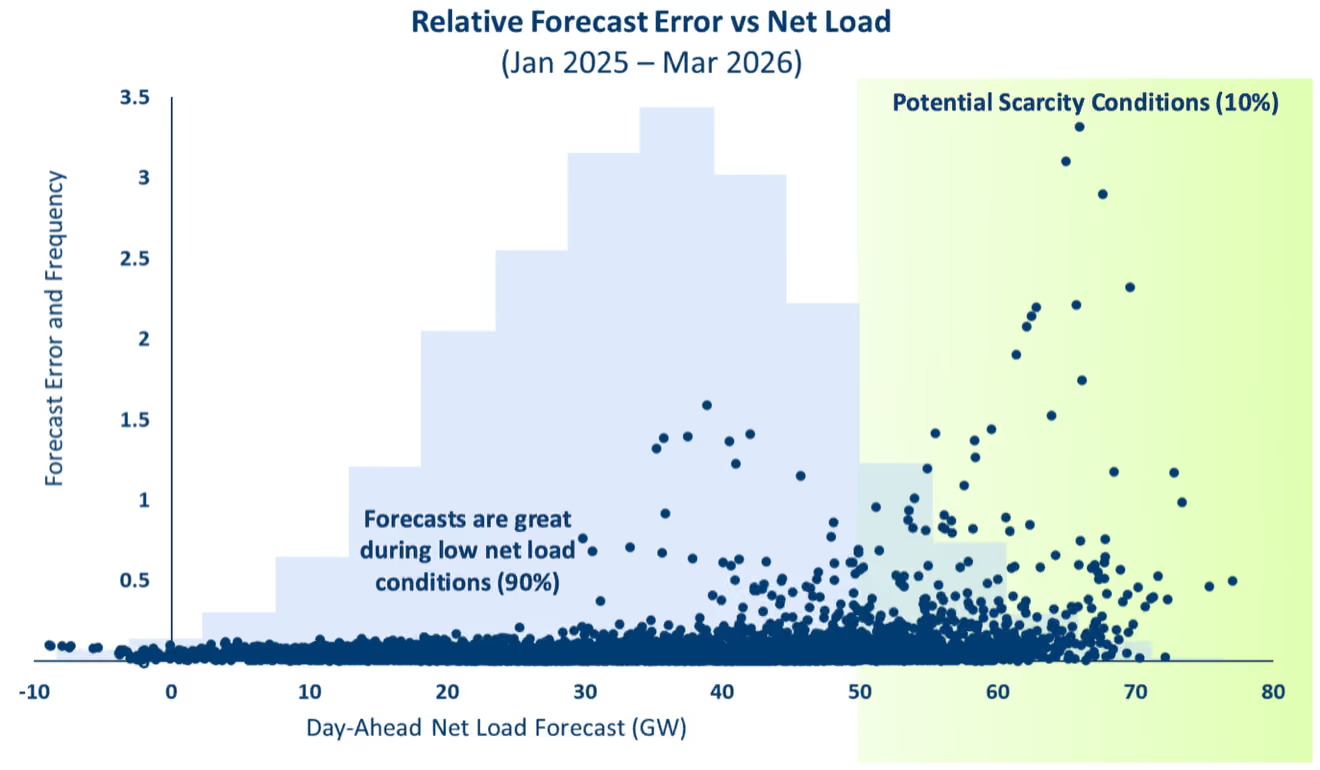
On the other 10% of market days, in which potential scarcity conditions are driven by high net load, weather events, or unexpected outages, bid optimization strategies must adapt. These are the days when machine learning models may not be optimal: training data for high-stress, tail-of-distribution events is limited, making price forecasts less reliable precisely when forecasting errors are most expensive.
Ascend’s recommended approach calls for building multiple strategies in advance to deal with distinct market conditions, and then switching between them as conditions warrant. For example, weather events such as winter storms or heat waves are usually foreseeable, which means that BESS operators usually have enough lead time for human intervention. This is the window in which switching to a pre-configured strategy can pay off. As seen in Figure 2, constrained strategies, such as raising minimum offer prices, increasing minimum arbitrage spreads, restricting ancillary service participation, or establishing state of charge (SOC) targets ahead of anticipated peak hours, outperformed unconstrained strategies by 12% during potential scarcity conditions from January and February 2024 through 2026.
When strategy switching is impractical and immediate intervention is needed, traders can re-configure RT market participation parameters or directly override the model generated bids for the next market hour. Although this approach is less optimal, these levers can be used to better capture value during unexpected RT price spikes.
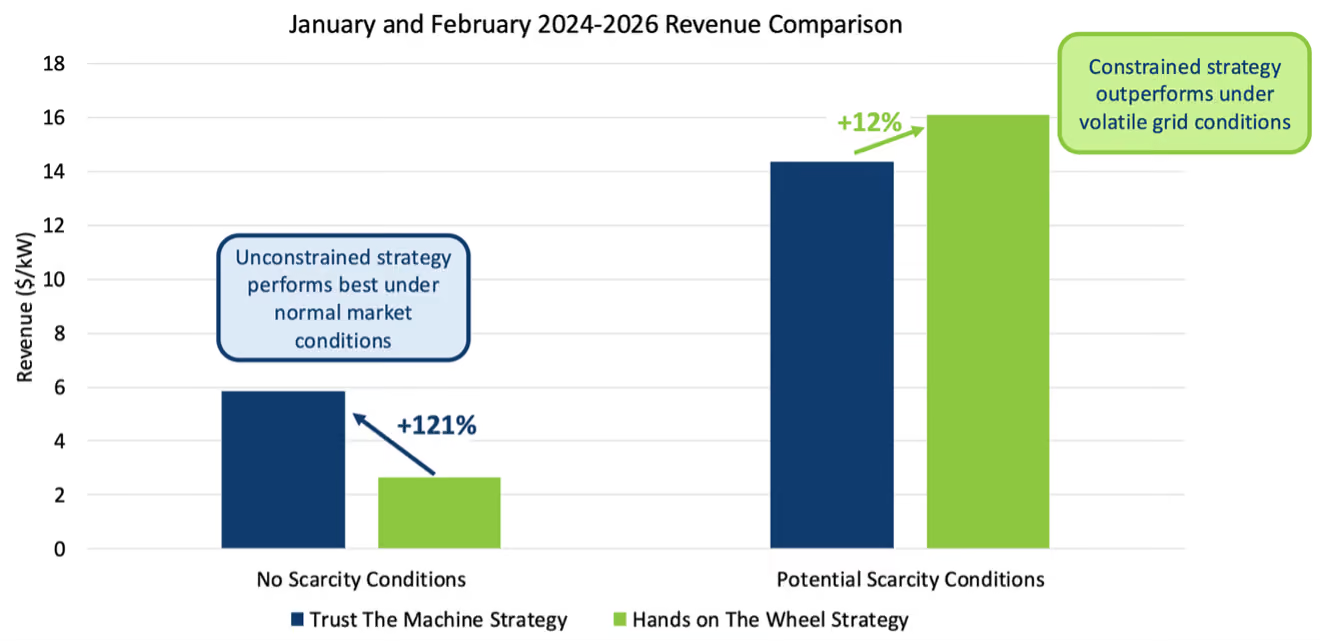
Figure 2 also shows that operators who add human-directed constraints during routine market conditions typically leave significant money on the table. For most days, the correct intervention is no intervention.
Energy storage asset performance can be evaluated using three distinct dimensions. These include:
Assessing the third dimension involves comparing realized revenue against two benchmarks: a perfect-foresight ceiling, which shows what the strategy would have earned with perfect knowledge of the most valuable product in every 5-minute interval, and a counterfactual low-side benchmark such as a day-ahead TBX strategy. If actual performance tracks closely to perfect foresight, the strategy is working. If it consistently falls short, that gap provides the signal to refine a strategy.
For example, a strategy configured with a minimum sell price set to 110% of the highest day-ahead price might prevent a storage asset from discharging in real time on any day when real-time prices fail to exceed that threshold, even when an arbitrage opportunity exists. Although this may not be a price forecasting miss, the constraint may limit revenue generation by holding daily cycling below target values. Testing different permutations of these parameters and constraints using backcast analysis for the target market conditions will illuminate where strategy parameters should be set to more optimally capture returns.
Knowing when to adjust requires regular monitoring of market conditions and asset performance. In this context, a solution such as SmartBidder – and the expert advisory service that comes with it – can be highly beneficial, allowing operators to proactively manage forward strategy positioning, conduct structured performance evaluations against industry benchmarks, and deploy a disciplined process for refining strategies.
SmartBidder™ is a fully automated bidding and dispatch optimization platform for North American storage owners and operators. It translates market price forecasts, system constraints, and operating requirements into optimized day-ahead and real-time offers, helping assets capture maximum revenue within defined risk limits. The platform integrates with scheduling and EMS providers to automate key market activities, including bid and COP submission, outage and award harvesting, and ingestion of live battery state-of-charge and power availability data. Contact us to learn more.
Battery energy storage system (BESS) operators who leverage energy bid optimization software face a critical question: when should automated bid optimization strategies run without constraints, and when should a human step in? Successfully answering this question, and thus maximizing storage revenue, requires that operators trust the algorithmic optimization to do the heavy lifting during mild market conditions, which occur a majority of the time, but may realize additional risk-adjusted returns from human trader interventions when the grid is under stress and scarcity conditions emerge. Ultimately, finding the right balance requires a clear framework for identifying the rare occasions when human intervention can add value beyond automated bid strategies.
In a recent webinar on strategy configuration using Ascend’s SmartBidder™ bid optimization platform, Mike Huisenga, Managing Director of SmartBidder at Ascend Analytics, was joined by Senior Analyst Zander Kessler and Analyst Shiv Khanna to discuss Ascend’s trading philosophy, the mechanics of evaluating energy storage asset performance, when operators and trading teams should intervene to influence bidding behavior, and why combined automated bid optimization strategies and targeted human oversight separates top-performing BESS assets from the rest.
High-quality short term nodal price forecasts, such as those produced and used within SmartBidder, are trained on vast quantities of historical data and are continually refreshed as new prices clear the market. This consistent accuracy allows energy bid optimization solutions to pursue value freely in day-ahead and real-time markets, across energy and all ancillary service products, and across the full arc of the trading day without human direction.
This dynamic can be seen in Figure 1. On days when the day-ahead net load forecast fell below approximately 50 GW, representing roughly 90% of market days, price forecast error clustered tightly at the bottom of the distribution. In these conditions, in which abundant historical machine learning training data is available, expectations align closely with outcomes, and automated optimization reliably positions assets to capture available arbitrage value.
On the other 10% of market days, in which potential scarcity conditions are driven by high net load, weather events, or unexpected outages, bid optimization strategies must adapt. These are the days when machine learning models may not be optimal: training data for high-stress, tail-of-distribution events is limited, making price forecasts less reliable precisely when forecasting errors are most expensive.
Ascend’s recommended approach calls for building multiple strategies in advance to deal with distinct market conditions, and then switching between them as conditions warrant. For example, weather events such as winter storms or heat waves are usually foreseeable, which means that BESS operators usually have enough lead time for human intervention. This is the window in which switching to a pre-configured strategy can pay off. As seen in Figure 2, constrained strategies, such as raising minimum offer prices, increasing minimum arbitrage spreads, restricting ancillary service participation, or establishing state of charge (SOC) targets ahead of anticipated peak hours, outperformed unconstrained strategies by 12% during potential scarcity conditions from January and February 2024 through 2026.
When strategy switching is impractical and immediate intervention is needed, traders can re-configure RT market participation parameters or directly override the model generated bids for the next market hour. Although this approach is less optimal, these levers can be used to better capture value during unexpected RT price spikes.
Figure 2 also shows that operators who add human-directed constraints during routine market conditions typically leave significant money on the table. For most days, the correct intervention is no intervention.
Energy storage asset performance can be evaluated using three distinct dimensions. These include:
Assessing the third dimension involves comparing realized revenue against two benchmarks: a perfect-foresight ceiling, which shows what the strategy would have earned with perfect knowledge of the most valuable product in every 5-minute interval, and a counterfactual low-side benchmark such as a day-ahead TBX strategy. If actual performance tracks closely to perfect foresight, the strategy is working. If it consistently falls short, that gap provides the signal to refine a strategy.
For example, a strategy configured with a minimum sell price set to 110% of the highest day-ahead price might prevent a storage asset from discharging in real time on any day when real-time prices fail to exceed that threshold, even when an arbitrage opportunity exists. Although this may not be a price forecasting miss, the constraint may limit revenue generation by holding daily cycling below target values. Testing different permutations of these parameters and constraints using backcast analysis for the target market conditions will illuminate where strategy parameters should be set to more optimally capture returns.
Knowing when to adjust requires regular monitoring of market conditions and asset performance. In this context, a solution such as SmartBidder – and the expert advisory service that comes with it – can be highly beneficial, allowing operators to proactively manage forward strategy positioning, conduct structured performance evaluations against industry benchmarks, and deploy a disciplined process for refining strategies.
SmartBidder™ is a fully automated bidding and dispatch optimization platform for North American storage owners and operators. It translates market price forecasts, system constraints, and operating requirements into optimized day-ahead and real-time offers, helping assets capture maximum revenue within defined risk limits. The platform integrates with scheduling and EMS providers to automate key market activities, including bid and COP submission, outage and award harvesting, and ingestion of live battery state-of-charge and power availability data. Contact us to learn more.
Ascend Analytics is the leading provider of market intelligence and analytics solutions for the power industry.
The company’s offerings enable decision makers in power development and supply procurement to maximize the value of planning, operating, and managing risk for renewable, storage, and other assets. From real-time to 30-year horizons, their forecasts and insights are at the foundation of over $50 billion in project financing assessments.
Ascend provides energy market stakeholders with the clarity and confidence to successfully navigate the rapidly shifting energy landscape.







.avif)