Let's Connect
Contact us
Thank you for reaching out, we will be in touch shortly!
Oops! Something went wrong while submitting the form.


PJM must attract new generation to serve growing demand, but paying the entire existing fleet the price needed to finance new entry creates an affordability problem that policymakers and consumers are demonstrably unwilling to accept. Resolving that tension will require market reforms that separate revenues supporting new investment from payments needed to keep existing resources online. For developers, asset owners, and electricity buyers, the consequences of this potential bifurcation are significant, since the mechanisms used to finance new supply would substantially reduce the capacity revenues available to existing resources.
In a recent webinar previewing the latest PJM market outlook from Ascend Analytics®, Dr. Brent Nelson, Senior Managing Director of Market Intelligence, and Robert LaFaso, Director of Market Intelligence, examined PJM’s competing stakeholder priorities, rising supply costs, and proposed capacity market reforms.
As Ascend has previously pointed out, paying the Net Cost of New Entry (Net CONE) across the entire PJM supply stack increases customer costs far beyond the amount needed to finance incremental capacity, and poses a politically untenable affordability issue. And while affordability concerns have created a rare bipartisan point of unity among PJM governors and the Federal government, significant obstacles still remain when it comes to tackling the issue.
Though they share an electricity market, PJM states have substantially different priorities for the power sector. Clean energy mandates are broadly concentrated in eastern PJM, while several western states favor thermal generation. Regulatory differences provide further complications. Some regions within PJM have utilities that can rate-base new generation, while generation in other regions is subject to merchant risk, creating heterogeneity in the ability to finance new generation.
These differences create persistent governance tensions among states, generators, utilities, and consumers. Generators seeking higher revenues and customers seeking lower costs have conflicting objectives. Rapid demand growth makes resolving those conflicts more consequential because new supply must be financed before shortages can be resolved.
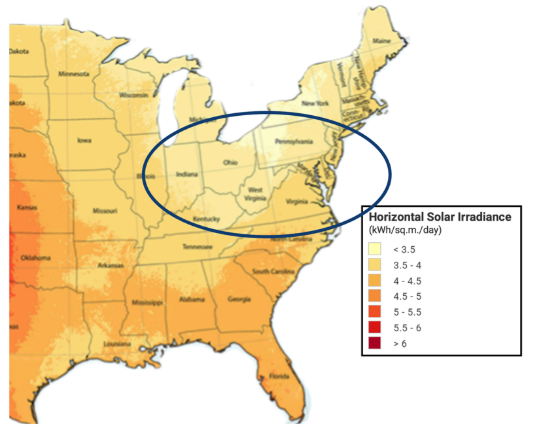
Renewable resources add another constraint when it comes to affordability. As shown in Figure 1, much of PJM contains relatively weak solar resources, making solar generation more expensive than in other parts of the country. Eastern states consequently face higher costs to meet clean energy goals, while expensive solar constrains buildout and provides less downward pressure on daytime power prices than in regions of the country with better solar resources.
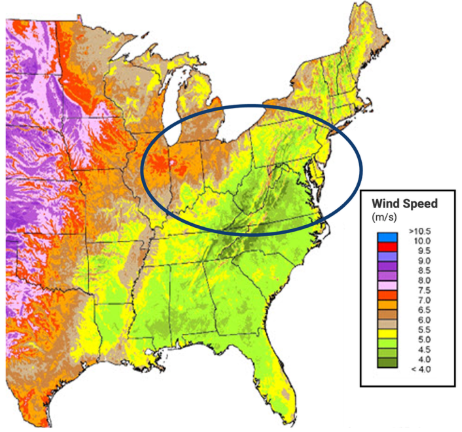
Onshore wind faces similar limitations. While northern Illinois and parts of the western PJM footprint possess relatively strong wind resources, much of eastern PJM has limited attractive wind potential, as shown in Figure 2. More expensive wind reduces buildout and provides less downward pressure on overnight power prices.
While offshore wind could provide additional clean supply, it has always been expensive and any potential project development would require contracted offtake. Additionally, federal policy uncertainty and permit revocations have made new offshore wind development almost uninvestable absent binding federal permitting reform legislation.
At the same time, the Regional Greenhouse Gas Initiative (RGGI) raises costs for covered thermal generation, contributing to electricity affordability pressure in the Eastern PJM states that participate in RGGI. However, given PJM’s relatively expensive renewable resources, carbon prices are still insufficient to make new wind and solar economic without additional contracted support.
PJM’s capacity market cost and revenue assumptions in its own modeling further complicate how best to resolve affordability concerns. For example, Ascend estimates for new gas capital costs are roughly 100% above PJM’s cost study assumptions, while Ascend’s projections for four-hour battery costs are approximately 30% lower than those used by PJM. Historical energy and ancillary service earnings can also overstate future revenues as storage suppresses ancillary service prices and renewables and efficient gas generation buildout reduce energy margins.
With the affordability backlash creating political pain, PJM stakeholders are pursuing a number of short-term solutions that fail to resolve its long-term structural market problems.
PJM’s capacity price collar, for example, reduces near-term system costs. However, it also confirms an unwillingness to pay the cost of new capacity, making merchant generation unfinanceable.
PJM’s Reliability Backstop Procurement (RBP) seeks to address the immediate shortage through a proposed targeted procurement for approximately 6.8 GW of unforced capacity (UCAP), and which would combine bilateral contracting between new loads and new resources with a central procurement auction for the remaining capacity gap. While the RBP, tentatively slated to launch in February 2027, would close the current UCAP shortfall, it does not solve the need to create ongoing incentivizes for new capacity to serve load growth.
Resolving PJM’s structural affordability problem requires a durable mechanism that supports new generation without paying the entire existing fleet the cost of new entry. Given the political pressure to contain system costs, capacity revenues for existing resources will likely move closer to the net cost of continued operations, or the revenues needed beyond energy and ancillary service earnings to keep an existing resource online. Ultimately, stakeholders should expect a long-term holistic market reform that incentivizes new generation directly and results in low capacity revenues for existing generation.
AscendMI™ (Ascend Market Intelligence) delivers proprietary power market forecasts that have been trusted in hundreds of projects and resource planning activities, supporting over $50 billion in project financing assessments. Contact us to learn more.
PJM must attract new generation to serve growing demand, but paying the entire existing fleet the price needed to finance new entry creates an affordability problem that policymakers and consumers are demonstrably unwilling to accept. Resolving that tension will require market reforms that separate revenues supporting new investment from payments needed to keep existing resources online. For developers, asset owners, and electricity buyers, the consequences of this potential bifurcation are significant, since the mechanisms used to finance new supply would substantially reduce the capacity revenues available to existing resources.
In a recent webinar previewing the latest PJM market outlook from Ascend Analytics®, Dr. Brent Nelson, Senior Managing Director of Market Intelligence, and Robert LaFaso, Director of Market Intelligence, examined PJM’s competing stakeholder priorities, rising supply costs, and proposed capacity market reforms.
As Ascend has previously pointed out, paying the Net Cost of New Entry (Net CONE) across the entire PJM supply stack increases customer costs far beyond the amount needed to finance incremental capacity, and poses a politically untenable affordability issue. And while affordability concerns have created a rare bipartisan point of unity among PJM governors and the Federal government, significant obstacles still remain when it comes to tackling the issue.
Though they share an electricity market, PJM states have substantially different priorities for the power sector. Clean energy mandates are broadly concentrated in eastern PJM, while several western states favor thermal generation. Regulatory differences provide further complications. Some regions within PJM have utilities that can rate-base new generation, while generation in other regions is subject to merchant risk, creating heterogeneity in the ability to finance new generation.
These differences create persistent governance tensions among states, generators, utilities, and consumers. Generators seeking higher revenues and customers seeking lower costs have conflicting objectives. Rapid demand growth makes resolving those conflicts more consequential because new supply must be financed before shortages can be resolved.
Renewable resources add another constraint when it comes to affordability. As shown in Figure 1, much of PJM contains relatively weak solar resources, making solar generation more expensive than in other parts of the country. Eastern states consequently face higher costs to meet clean energy goals, while expensive solar constrains buildout and provides less downward pressure on daytime power prices than in regions of the country with better solar resources.
Onshore wind faces similar limitations. While northern Illinois and parts of the western PJM footprint possess relatively strong wind resources, much of eastern PJM has limited attractive wind potential, as shown in Figure 2. More expensive wind reduces buildout and provides less downward pressure on overnight power prices.
While offshore wind could provide additional clean supply, it has always been expensive and any potential project development would require contracted offtake. Additionally, federal policy uncertainty and permit revocations have made new offshore wind development almost uninvestable absent binding federal permitting reform legislation.
At the same time, the Regional Greenhouse Gas Initiative (RGGI) raises costs for covered thermal generation, contributing to electricity affordability pressure in the Eastern PJM states that participate in RGGI. However, given PJM’s relatively expensive renewable resources, carbon prices are still insufficient to make new wind and solar economic without additional contracted support.
PJM’s capacity market cost and revenue assumptions in its own modeling further complicate how best to resolve affordability concerns. For example, Ascend estimates for new gas capital costs are roughly 100% above PJM’s cost study assumptions, while Ascend’s projections for four-hour battery costs are approximately 30% lower than those used by PJM. Historical energy and ancillary service earnings can also overstate future revenues as storage suppresses ancillary service prices and renewables and efficient gas generation buildout reduce energy margins.
With the affordability backlash creating political pain, PJM stakeholders are pursuing a number of short-term solutions that fail to resolve its long-term structural market problems.
PJM’s capacity price collar, for example, reduces near-term system costs. However, it also confirms an unwillingness to pay the cost of new capacity, making merchant generation unfinanceable.
PJM’s Reliability Backstop Procurement (RBP) seeks to address the immediate shortage through a proposed targeted procurement for approximately 6.8 GW of unforced capacity (UCAP), and which would combine bilateral contracting between new loads and new resources with a central procurement auction for the remaining capacity gap. While the RBP, tentatively slated to launch in February 2027, would close the current UCAP shortfall, it does not solve the need to create ongoing incentivizes for new capacity to serve load growth.
Resolving PJM’s structural affordability problem requires a durable mechanism that supports new generation without paying the entire existing fleet the cost of new entry. Given the political pressure to contain system costs, capacity revenues for existing resources will likely move closer to the net cost of continued operations, or the revenues needed beyond energy and ancillary service earnings to keep an existing resource online. Ultimately, stakeholders should expect a long-term holistic market reform that incentivizes new generation directly and results in low capacity revenues for existing generation.
AscendMI™ (Ascend Market Intelligence) delivers proprietary power market forecasts that have been trusted in hundreds of projects and resource planning activities, supporting over $50 billion in project financing assessments. Contact us to learn more.
Ascend Analytics is the leading provider of market intelligence and analytics solutions for the power industry.
The company’s offerings enable decision makers in power development and supply procurement to maximize the value of planning, operating, and managing risk for renewable, storage, and other assets. From real-time to 30-year horizons, their forecasts and insights are at the foundation of over $50 billion in project financing assessments.
Ascend provides energy market stakeholders with the clarity and confidence to successfully navigate the rapidly shifting energy landscape.