Let's Connect
Contact us
Thank you for reaching out, we will be in touch shortly!
Oops! Something went wrong while submitting the form.


Large-load growth, shifting energy policies, and higher financing costs are reshaping the U.S. market for renewable energy and storage power purchase agreements (PPAs), as well as for clean power mergers and acquisitions (M&A). PPA prices for renewable generation have increased as competition for resources intensifies, interconnection constraints persist, and tax credit changes affect project economics. At the same time, clean energy M&A activity has rebounded from a slow 2025, though buyers remain selective, favoring projects with secure offtake, advanced development, and near-term commercial operation dates (CODs). As market uncertainty persists, the ability to secure offtake, manage development risk, and demonstrate a credible path to commercial operation is becoming increasingly valuable.
In a recent webinar, Dr. Michael Fisher, Senior Managing Director of PowerVAL for Ascend Analytics®, Dr. Brandon Mauch, Senior Managing Director of PowerSIMM, and Rahm Orenstein, Managing Director of Ascend Energy Exchange, discussed the market conditions influencing PPA negotiations, project valuations, and M&A investment decisions heading into 2027.
The 2026 US midterm elections clarified the potential for changes to energy policy at the federal and state levels. The misalignment between a Republican president and Democratic Congress significantly diminishes the near-term prospects for restoring clean energy tax credits, and means that permitting reform remains uncertain despite bipartisan interest. State governments, however, are positioned to play a greater role in determining where and how new resources are developed.
In many states, energy affordability and local opposition to data center development remain critical bipartisan issues, and several recently elected Democratic governors ran on a platform to keep bills down. Rather than restricting data centers outright, states are likely to introduce large-load tariffs and bring-your-own-new-generation (BYONG) requirements that protect existing ratepayers from higher electricity costs. Newly elected state leaders could also strengthen clean energy mandates, particularly in Arizona, Nevada, Wisconsin, and Pennsylvania.
These shifts have the potential to reshape PPA pricing and M&A valuations. Large-load requirements could increase demand for new generation and storage without necessarily increasing merchant capacity prices. At the same time, higher Treasury yields and financing costs are making development more expensive, reinforcing the advantage of projects with predictable, contracted revenues.
Renewable PPA prices vary considerably across US markets, reflecting differences in resource quality, land costs, permitting, and competition. ERCOT and the Southwest, for instance, offer some of the country's most competitive solar economics, while higher development costs and less favorable resources contribute to elevated prices in much of the East.
Battery storage pricing is less geographically dependent, although downstate New York and ERCOT's two-hour battery market remain notable exceptions. In competitive solicitations, two-hour storage offers generally range from $7–$9/kW-month, compared with $13–$15 for four-hour storage and $23–$27 for eight-hour storage.
Across technologies, pricing pressure is coming from several directions. Data centers are competing directly with utilities for resources, while interconnection backlogs constrain near-term supply. State mandates, tariffs, and foreign entity of concern (FEOC) requirements introduce additional cost and execution risk.
For hyperscalers, speed to power often outweighs price. With peak demand projected to increase approximately 32% in ERCOT and 25% in PJM between 2026 and 2032, competition for projects capable of reaching operation quickly will remain intense. Projects with advanced interconnection positions and realistic CODs therefore carry an advantage that extends beyond their underlying generation economics.
The accelerated phaseout of wind and solar tax credits is widening the price gap between projects that qualify for federal incentives and those that cannot. Increasingly, developers are concentrating CODs around tax credit deadlines, making project timing and delivery certainty even more important in PPA negotiations. The price implications of these dynamics can be seen clearly in California, for example, where solar PPA offer prices increased approximately 25% over the past year, following an 8% increase the previous year.
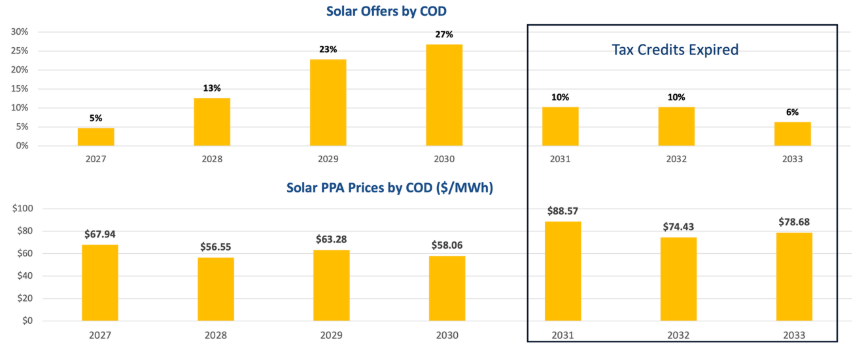
Under the One Big Beautiful Bill Act (OBBBA), projects qualifying through safe-harbor provisions generally must reach commercial operation by 2030 to retain tax credits. As shown in Figure 1, offers are concentrated before that deadline, while prices increase sharply for later CODs as developers account for lost incentives. Projects with advanced interconnection and permitting positions can offer buyers greater pricing and delivery certainty, while those facing delays risk losing tax credits and becoming less competitive.
Storage procurement is following a different trajectory. Longer-running federal tax credits provide greater pricing stability, while growing resource adequacy needs are increasing demand for longer-duration storage and firmer hybrid capacity. In California, longer-duration storage is gaining ground due to policy incentives and greater value from buyers on capacity that can support extended reliability needs: eight-hour batteries accounted for approximately 31% of storage offers in 2026, up from 7% in 2025.
Storage tolling prices have remained comparatively stable. Standalone four-hour offers have changed little, while eight-hour prices have declined modestly. Storage tax credits should support relatively stable pricing through 2033, before prices increase as incentives begin phasing out in 2034.
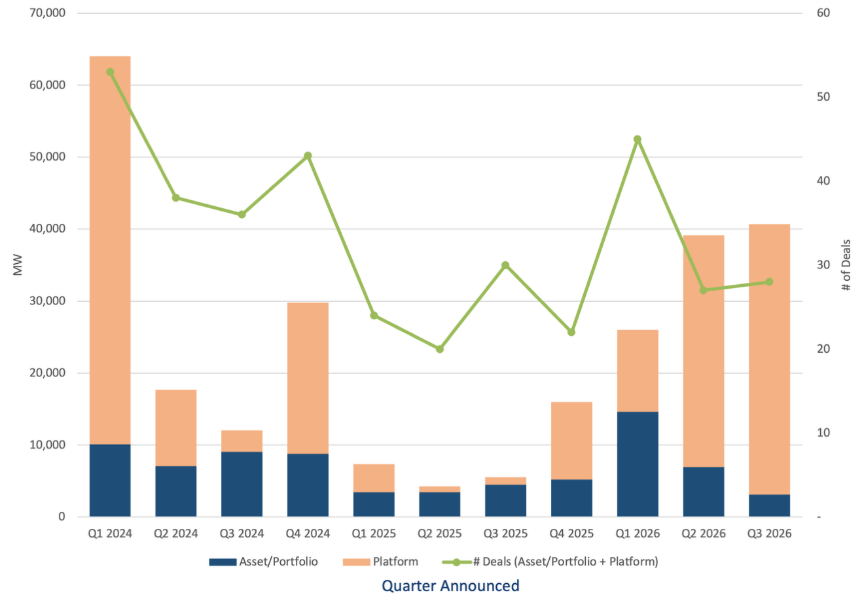
Though the clean energy M&A market experienced peaks and valleys during the first part of the 2020s, activity accelerated again beginning in late 2025, as shown in Figure 2. However, the underlying drivers have changed relative to those that drove early-decade growth, which was fueled by low interest rates, optimism around federal policy, and an influx of international capital pursuing platform and portfolio-scale deals. Now, large-load growth is attracting new capital, while existing owners are recycling investments and repositioning portfolios.
Yet higher transaction volumes have not restored the valuation levels seen in 2021–2023. The market is increasingly divided between projects offering near-term revenue certainty and those still carrying significant development risk. Operating projects, near-term CODs, and secured offtake attract strong competition. Early-stage projects without contracts face a more difficult situation, particularly where development pipelines exceed available demand.
This places greater importance on project attributes that reduce uncertainty: interconnection progress, permitting feasibility, tax credit eligibility, tariff exposure, and proximity to large loads. Buyers are also expanding their focus beyond conventional renewable projects to powered land and energy campuses with access to generation, gas infrastructure, and fiber networks.
Renewable development prospects remain moderate to strong across U.S. power markets over the next five years, supported by state policy, corporate demand, and the elevated cost of new gas generation. However, multiple factors will persistently drive green premiums to secure clean energy PPAs, including expiring renewable tax credits, higher renewable costs and potentially more competitive gas economics.
Storage has a favorable outlook across most regions, driven by its competitiveness as a capacity resource and the need to support growing electricity demand. Emerging BYONG requirements could create additional opportunities for long-term storage offtake agreements, even where clean energy mandates are limited.
Regional constraints will remain decisive for both PPA procurement and M&A activity. CAISO faces deliverability limitations, ERCOT has considerable project oversupply and offtake uncertainty, and NYISO faces procurement constraints. These differences will influence the availability of contracted projects, competition among buyers, and the premiums investors are willing to pay for development certainty.
For developers, investors, and energy buyers, securing attractive PPA terms and M&A valuations will increasingly depend on a project's ability to reach commercial operation, secure reliable offtake, and generate sustainable returns. As development risks become more fully reflected in pricing, projects that can demonstrate a higher degree of certainty will be best positioned to compete.
Ascend Power Procurement (APP™) enables utilities, community choice aggregators, and corporate energy buyers to conduct streamlined, competitive power procurement processes. APP supports the full procurement process, from RFP administration and bid collection to advanced evaluation of renewable energy, storage, and thermal offers, helping buyers identify cost-effective resources while accounting for project risks and economic value.
The Ascend Energy Exchange (AEX™) platform, an exchange for renewable and storage projects, allows buyers and sellers to maximize M&A deal values, supported by Ascend’s deep expertise in market dynamics, asset valuation, asset operations, interconnection, development risk, and commercial considerations.
Contact us to learn more.
Large-load growth, shifting energy policies, and higher financing costs are reshaping the U.S. market for renewable energy and storage power purchase agreements (PPAs), as well as for clean power mergers and acquisitions (M&A). PPA prices for renewable generation have increased as competition for resources intensifies, interconnection constraints persist, and tax credit changes affect project economics. At the same time, clean energy M&A activity has rebounded from a slow 2025, though buyers remain selective, favoring projects with secure offtake, advanced development, and near-term commercial operation dates (CODs). As market uncertainty persists, the ability to secure offtake, manage development risk, and demonstrate a credible path to commercial operation is becoming increasingly valuable.
In a recent webinar, Dr. Michael Fisher, Senior Managing Director of PowerVAL for Ascend Analytics®, Dr. Brandon Mauch, Senior Managing Director of PowerSIMM, and Rahm Orenstein, Managing Director of Ascend Energy Exchange, discussed the market conditions influencing PPA negotiations, project valuations, and M&A investment decisions heading into 2027.
The 2026 US midterm elections clarified the potential for changes to energy policy at the federal and state levels. The misalignment between a Republican president and Democratic Congress significantly diminishes the near-term prospects for restoring clean energy tax credits, and means that permitting reform remains uncertain despite bipartisan interest. State governments, however, are positioned to play a greater role in determining where and how new resources are developed.
In many states, energy affordability and local opposition to data center development remain critical bipartisan issues, and several recently elected Democratic governors ran on a platform to keep bills down. Rather than restricting data centers outright, states are likely to introduce large-load tariffs and bring-your-own-new-generation (BYONG) requirements that protect existing ratepayers from higher electricity costs. Newly elected state leaders could also strengthen clean energy mandates, particularly in Arizona, Nevada, Wisconsin, and Pennsylvania.
These shifts have the potential to reshape PPA pricing and M&A valuations. Large-load requirements could increase demand for new generation and storage without necessarily increasing merchant capacity prices. At the same time, higher Treasury yields and financing costs are making development more expensive, reinforcing the advantage of projects with predictable, contracted revenues.
Renewable PPA prices vary considerably across US markets, reflecting differences in resource quality, land costs, permitting, and competition. ERCOT and the Southwest, for instance, offer some of the country's most competitive solar economics, while higher development costs and less favorable resources contribute to elevated prices in much of the East.
Battery storage pricing is less geographically dependent, although downstate New York and ERCOT's two-hour battery market remain notable exceptions. In competitive solicitations, two-hour storage offers generally range from $7–$9/kW-month, compared with $13–$15 for four-hour storage and $23–$27 for eight-hour storage.
Across technologies, pricing pressure is coming from several directions. Data centers are competing directly with utilities for resources, while interconnection backlogs constrain near-term supply. State mandates, tariffs, and foreign entity of concern (FEOC) requirements introduce additional cost and execution risk.
For hyperscalers, speed to power often outweighs price. With peak demand projected to increase approximately 32% in ERCOT and 25% in PJM between 2026 and 2032, competition for projects capable of reaching operation quickly will remain intense. Projects with advanced interconnection positions and realistic CODs therefore carry an advantage that extends beyond their underlying generation economics.
The accelerated phaseout of wind and solar tax credits is widening the price gap between projects that qualify for federal incentives and those that cannot. Increasingly, developers are concentrating CODs around tax credit deadlines, making project timing and delivery certainty even more important in PPA negotiations. The price implications of these dynamics can be seen clearly in California, for example, where solar PPA offer prices increased approximately 25% over the past year, following an 8% increase the previous year.
Under the One Big Beautiful Bill Act (OBBBA), projects qualifying through safe-harbor provisions generally must reach commercial operation by 2030 to retain tax credits. As shown in Figure 1, offers are concentrated before that deadline, while prices increase sharply for later CODs as developers account for lost incentives. Projects with advanced interconnection and permitting positions can offer buyers greater pricing and delivery certainty, while those facing delays risk losing tax credits and becoming less competitive.
Storage procurement is following a different trajectory. Longer-running federal tax credits provide greater pricing stability, while growing resource adequacy needs are increasing demand for longer-duration storage and firmer hybrid capacity. In California, longer-duration storage is gaining ground due to policy incentives and greater value from buyers on capacity that can support extended reliability needs: eight-hour batteries accounted for approximately 31% of storage offers in 2026, up from 7% in 2025.
Storage tolling prices have remained comparatively stable. Standalone four-hour offers have changed little, while eight-hour prices have declined modestly. Storage tax credits should support relatively stable pricing through 2033, before prices increase as incentives begin phasing out in 2034.
Though the clean energy M&A market experienced peaks and valleys during the first part of the 2020s, activity accelerated again beginning in late 2025, as shown in Figure 2. However, the underlying drivers have changed relative to those that drove early-decade growth, which was fueled by low interest rates, optimism around federal policy, and an influx of international capital pursuing platform and portfolio-scale deals. Now, large-load growth is attracting new capital, while existing owners are recycling investments and repositioning portfolios.
Yet higher transaction volumes have not restored the valuation levels seen in 2021–2023. The market is increasingly divided between projects offering near-term revenue certainty and those still carrying significant development risk. Operating projects, near-term CODs, and secured offtake attract strong competition. Early-stage projects without contracts face a more difficult situation, particularly where development pipelines exceed available demand.
This places greater importance on project attributes that reduce uncertainty: interconnection progress, permitting feasibility, tax credit eligibility, tariff exposure, and proximity to large loads. Buyers are also expanding their focus beyond conventional renewable projects to powered land and energy campuses with access to generation, gas infrastructure, and fiber networks.
Renewable development prospects remain moderate to strong across U.S. power markets over the next five years, supported by state policy, corporate demand, and the elevated cost of new gas generation. However, multiple factors will persistently drive green premiums to secure clean energy PPAs, including expiring renewable tax credits, higher renewable costs and potentially more competitive gas economics.
Storage has a favorable outlook across most regions, driven by its competitiveness as a capacity resource and the need to support growing electricity demand. Emerging BYONG requirements could create additional opportunities for long-term storage offtake agreements, even where clean energy mandates are limited.
Regional constraints will remain decisive for both PPA procurement and M&A activity. CAISO faces deliverability limitations, ERCOT has considerable project oversupply and offtake uncertainty, and NYISO faces procurement constraints. These differences will influence the availability of contracted projects, competition among buyers, and the premiums investors are willing to pay for development certainty.
For developers, investors, and energy buyers, securing attractive PPA terms and M&A valuations will increasingly depend on a project's ability to reach commercial operation, secure reliable offtake, and generate sustainable returns. As development risks become more fully reflected in pricing, projects that can demonstrate a higher degree of certainty will be best positioned to compete.
Ascend Power Procurement (APP™) enables utilities, community choice aggregators, and corporate energy buyers to conduct streamlined, competitive power procurement processes. APP supports the full procurement process, from RFP administration and bid collection to advanced evaluation of renewable energy, storage, and thermal offers, helping buyers identify cost-effective resources while accounting for project risks and economic value.
The Ascend Energy Exchange (AEX™) platform, an exchange for renewable and storage projects, allows buyers and sellers to maximize M&A deal values, supported by Ascend’s deep expertise in market dynamics, asset valuation, asset operations, interconnection, development risk, and commercial considerations.
Contact us to learn more.
Ascend Analytics is the leading provider of market intelligence and analytics solutions for the power industry.
The company’s offerings enable decision makers in power development and supply procurement to maximize the value of planning, operating, and managing risk for renewable, storage, and other assets. From real-time to 30-year horizons, their forecasts and insights are at the foundation of over $50 billion in project financing assessments.
Ascend provides energy market stakeholders with the clarity and confidence to successfully navigate the rapidly shifting energy landscape.