Let's Connect
Contact us
Thank you for reaching out, we will be in touch shortly!
Oops! Something went wrong while submitting the form.


New York and New England have some of the most aggressive clean energy policies in the US, as well as substantial existing nuclear and hydropower resources. However, achieving further decarbonization will be increasingly expensive, particularly as Northeast states simultaneously pursue electrification and retire aging thermal generation. As the cost of pursuing 100% clean energy rises sharply when the low hanging fruit of decarbonization disappears, policymakers face a difficult question: is achieving a fully carbon-free power grid worth the additional expense?
In a recent webinar previewing Ascend Analytics®' latest New York Independent System Operator (NYISO) and ISO New England (ISO-NE) market outlook, Robert LaFaso, Director of Market Intelligence, and Kolby Koeck, Senior Energy Analyst, joined Dr. Michael Fisher, Senior Managing Director, to examine decarbonization economics, emerging winter-peaking demand, and policy mechanisms needed to support new generation while protecting ratepayers.
While electricity demand accelerates in nearly every US power market due principally to large-load growth, the Northeast possesses substantially different dynamics. NYISO and ISO-NE have experienced limited load growth in recent years, and both markets project relatively modest growth in the near- to medium-term future. For perspective, load from individual data centers that have been proposed in PJM, ERCOT, and MISO can exceed the Northeast's cumulative expected load growth over the next 10 years. ERCOT alone has more load currently under construction than ISO-NE anticipates adding over the next 15 years.
This stable demand creates an opportunity to make progress toward the region’s decarbonization goals without having to simultaneously accommodate significant new load. However, both NYISO and ISO-NE depend heavily for reliability on aging, inefficient gas- and oil-fired peaking plants, many of which have been slated for retirement in the near future. Replacing those facilities with new natural gas generation is essentially a non-starter, given high capital costs, supply constraints, and political opposition.
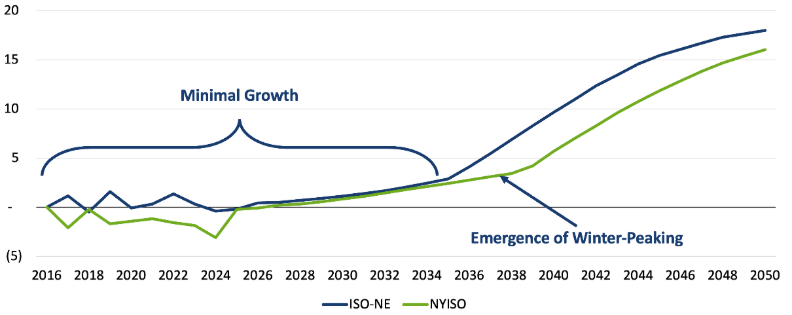
A more consequential challenge emerges over the longer term, as electrification of residential and commercial heating materially increases winter electricity demand, and eventually pushes both regions into winter-peaking systems, as illustrated in Figure 1. This transition will change both the quantity and type of capacity needed to maintain reliability, and will force near-term decisions about both delaying thermal retirements and future resource development.
Northeastern states have enacted some of the country's most aggressive emissions reduction mandates, extending beyond electricity generation to heating and other sources of carbon emissions. While decarbonization policies enjoy substantial public support within both NYISO and ISO-NE, affordably achieving those goals is increasingly difficult.
Renewable PPAs, for example, in the Northeast price at more than double an equivalent project in ERCOT. The combination of weak solar resources and higher development costs creates substantial premiums for renewable energy that ultimately affect electricity customers. At the same time, increasing carbon compliance costs under the Regional Greenhouse Gas Initiative (RGGI) add pressure: higher emissions allowance prices increase the cost of operating thermal generation, while expensive renewable PPAs raise the cost of replacing that generation.
This leaves states weighing three competing objectives: affordable and reliable electricity, full power sector decarbonization, and widespread electrification. Maintaining affordability and reliability is effectively nonnegotiable. Thus, state policymakers face a difficult choice between prioritizing full power sector decarbonization while limiting electrification-driven growth, or prioritizing electrification while accepting continued reliance on some thermal generation.
Given the difficult choice outlined above, Northeast states may have to seriously consider a future that involves a mostly, rather than fully, carbon-free electricity supply. The combination of expanding renewable generation, retaining thermal capacity, and electrifying heating offers a potentially more affordable path toward economy-wide emissions reductions.
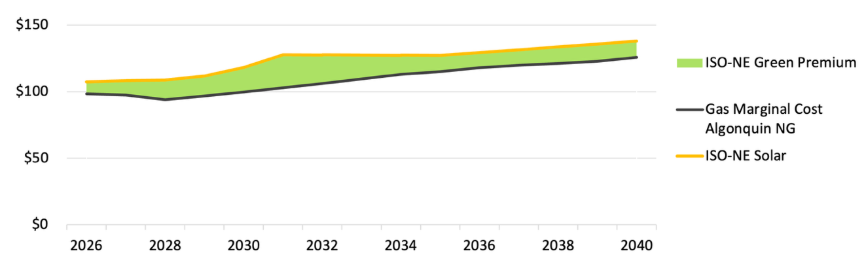
Despite the high cost of new renewable energy in the Northeast, the economics of displacing existing natural gas generation are more favorable than PPA prices alone might suggest. This is particularly true in ISO-NE, where high natural gas prices make renewable generation relatively more competitive despite the region's unfavorable solar resources. Comparing solar PPA prices with the marginal cost of gas-fired generation, including fuel, variable operating expenses, and carbon allowances, the incremental cost of clean energy in ISO-NE is approximately 15%, as shown in Figure 2. In NYISO, access to lower-cost natural gas creates a significantly different economic picture, with a comparable premium of approximately 50%.
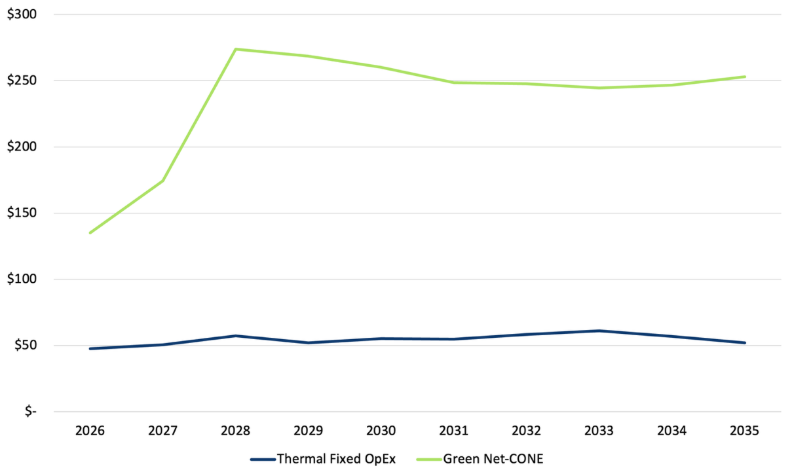
However, the economics change substantially when evaluating the cost of replacing existing thermal capacity with new clean resources. With limited near-term load growth, the Northeast's primary capacity challenge involves replacing aging thermal generation, rather than accommodating substantial new demand. As illustrated in Figure 3, retaining existing thermal capacity costs roughly five times less than developing new clean peaking resources, particularly when accounting for effective load carrying capability (ELCC). If new resources are required to recover their full costs through capacity market revenues alone, the resulting higher clearing prices would apply to the entire generation fleet, and would significantly increase costs for ratepayers.
These dynamics, then, favor retaining existing thermal generation for reliability while expanding renewable energy to reduce the output from the thermal fleet. This approach avoids the substantial cost of prematurely replacing existing capacity, while allowing the region to continue reducing power sector emissions.
Heating electrification also provides an additional opportunity to reduce emissions across the broader energy system. Replacing conventional household heating with efficient electric heat pumps can produce substantial emissions reductions even when the electricity supply retains natural gas generation.
While retaining existing thermal generation can help manage near-term capacity requirements, heating electrification in NYISO and ISO-NE will eventually create additional winter peak demand that requires new resources. With development, permitting, and interconnection timelines extending several years, both markets need to determine a preferred resource strategy well before that demand materializes. This requires policymakers to establish clear investment signals within the next few years, particularly with regard to how new generation will be compensated.
New capacity must earn sufficient revenue to recover its investment costs, generally reflected by the net cost of new entry (Net CONE). However, in capacity markets that pay a uniform clearing price to all generation, a relatively small amount of expensive new capacity can set prices for the entire existing fleet. This creates significant affordability problems, as demonstrated by recent capacity market dynamics in PJM.
A more economically efficient approach involves separating the payments needed to incentivize new generation from those required to retain existing capacity. Targeted subsidies can allow new resources to recover their investment costs without requiring market-wide capacity prices to rise to Net CONE. Both New York's Index Storage Credit (ISC) and Massachusetts' Clean Peak Standard (CPS) programs already employ subsidies to support new capacity while controlling ratepayer costs. Although their structures differ, both aim to provide sufficient long-term revenue certainty for developers to finance new projects, while encouraging competition that reduces the cost of subsidies.
However, the effectiveness of these programs depends on consistent policy support. Developers need confidence in long-term revenue opportunities prior to committing capital, securing equipment, and attempting to advance projects. Changes to procurement volumes, program structures, or financial incentives, which has already occurred with CPS, can discourage early-stage development, thus reducing the number of projects competing for contracts and potentially increasing costs.
For NYISO and ISO-NE, establishing durable procurement mechanisms within the next several years will be essential to attracting sufficient new capacity at a competitive cost before electrification materially increases winter demand. Planning for longer-duration winter peaks rather than shorter-duration summer peaks will also be necessary.
AscendMI™ (Ascend Market Intelligence) delivers proprietary power market forecasts that have been trusted in hundreds of projects and resource planning activities, supporting over $50 billion in project financing assessments. Contact us to learn more.
New York and New England have some of the most aggressive clean energy policies in the US, as well as substantial existing nuclear and hydropower resources. However, achieving further decarbonization will be increasingly expensive, particularly as Northeast states simultaneously pursue electrification and retire aging thermal generation. As the cost of pursuing 100% clean energy rises sharply when the low hanging fruit of decarbonization disappears, policymakers face a difficult question: is achieving a fully carbon-free power grid worth the additional expense?
In a recent webinar previewing Ascend Analytics®' latest New York Independent System Operator (NYISO) and ISO New England (ISO-NE) market outlook, Robert LaFaso, Director of Market Intelligence, and Kolby Koeck, Senior Energy Analyst, joined Dr. Michael Fisher, Senior Managing Director, to examine decarbonization economics, emerging winter-peaking demand, and policy mechanisms needed to support new generation while protecting ratepayers.
While electricity demand accelerates in nearly every US power market due principally to large-load growth, the Northeast possesses substantially different dynamics. NYISO and ISO-NE have experienced limited load growth in recent years, and both markets project relatively modest growth in the near- to medium-term future. For perspective, load from individual data centers that have been proposed in PJM, ERCOT, and MISO can exceed the Northeast's cumulative expected load growth over the next 10 years. ERCOT alone has more load currently under construction than ISO-NE anticipates adding over the next 15 years.
This stable demand creates an opportunity to make progress toward the region’s decarbonization goals without having to simultaneously accommodate significant new load. However, both NYISO and ISO-NE depend heavily for reliability on aging, inefficient gas- and oil-fired peaking plants, many of which have been slated for retirement in the near future. Replacing those facilities with new natural gas generation is essentially a non-starter, given high capital costs, supply constraints, and political opposition.
A more consequential challenge emerges over the longer term, as electrification of residential and commercial heating materially increases winter electricity demand, and eventually pushes both regions into winter-peaking systems, as illustrated in Figure 1. This transition will change both the quantity and type of capacity needed to maintain reliability, and will force near-term decisions about both delaying thermal retirements and future resource development.
Northeastern states have enacted some of the country's most aggressive emissions reduction mandates, extending beyond electricity generation to heating and other sources of carbon emissions. While decarbonization policies enjoy substantial public support within both NYISO and ISO-NE, affordably achieving those goals is increasingly difficult.
Renewable PPAs, for example, in the Northeast price at more than double an equivalent project in ERCOT. The combination of weak solar resources and higher development costs creates substantial premiums for renewable energy that ultimately affect electricity customers. At the same time, increasing carbon compliance costs under the Regional Greenhouse Gas Initiative (RGGI) add pressure: higher emissions allowance prices increase the cost of operating thermal generation, while expensive renewable PPAs raise the cost of replacing that generation.
This leaves states weighing three competing objectives: affordable and reliable electricity, full power sector decarbonization, and widespread electrification. Maintaining affordability and reliability is effectively nonnegotiable. Thus, state policymakers face a difficult choice between prioritizing full power sector decarbonization while limiting electrification-driven growth, or prioritizing electrification while accepting continued reliance on some thermal generation.
Given the difficult choice outlined above, Northeast states may have to seriously consider a future that involves a mostly, rather than fully, carbon-free electricity supply. The combination of expanding renewable generation, retaining thermal capacity, and electrifying heating offers a potentially more affordable path toward economy-wide emissions reductions.
Despite the high cost of new renewable energy in the Northeast, the economics of displacing existing natural gas generation are more favorable than PPA prices alone might suggest. This is particularly true in ISO-NE, where high natural gas prices make renewable generation relatively more competitive despite the region's unfavorable solar resources. Comparing solar PPA prices with the marginal cost of gas-fired generation, including fuel, variable operating expenses, and carbon allowances, the incremental cost of clean energy in ISO-NE is approximately 15%, as shown in Figure 2. In NYISO, access to lower-cost natural gas creates a significantly different economic picture, with a comparable premium of approximately 50%.
However, the economics change substantially when evaluating the cost of replacing existing thermal capacity with new clean resources. With limited near-term load growth, the Northeast's primary capacity challenge involves replacing aging thermal generation, rather than accommodating substantial new demand. As illustrated in Figure 3, retaining existing thermal capacity costs roughly five times less than developing new clean peaking resources, particularly when accounting for effective load carrying capability (ELCC). If new resources are required to recover their full costs through capacity market revenues alone, the resulting higher clearing prices would apply to the entire generation fleet, and would significantly increase costs for ratepayers.
These dynamics, then, favor retaining existing thermal generation for reliability while expanding renewable energy to reduce the output from the thermal fleet. This approach avoids the substantial cost of prematurely replacing existing capacity, while allowing the region to continue reducing power sector emissions.
Heating electrification also provides an additional opportunity to reduce emissions across the broader energy system. Replacing conventional household heating with efficient electric heat pumps can produce substantial emissions reductions even when the electricity supply retains natural gas generation.
While retaining existing thermal generation can help manage near-term capacity requirements, heating electrification in NYISO and ISO-NE will eventually create additional winter peak demand that requires new resources. With development, permitting, and interconnection timelines extending several years, both markets need to determine a preferred resource strategy well before that demand materializes. This requires policymakers to establish clear investment signals within the next few years, particularly with regard to how new generation will be compensated.
New capacity must earn sufficient revenue to recover its investment costs, generally reflected by the net cost of new entry (Net CONE). However, in capacity markets that pay a uniform clearing price to all generation, a relatively small amount of expensive new capacity can set prices for the entire existing fleet. This creates significant affordability problems, as demonstrated by recent capacity market dynamics in PJM.
A more economically efficient approach involves separating the payments needed to incentivize new generation from those required to retain existing capacity. Targeted subsidies can allow new resources to recover their investment costs without requiring market-wide capacity prices to rise to Net CONE. Both New York's Index Storage Credit (ISC) and Massachusetts' Clean Peak Standard (CPS) programs already employ subsidies to support new capacity while controlling ratepayer costs. Although their structures differ, both aim to provide sufficient long-term revenue certainty for developers to finance new projects, while encouraging competition that reduces the cost of subsidies.
However, the effectiveness of these programs depends on consistent policy support. Developers need confidence in long-term revenue opportunities prior to committing capital, securing equipment, and attempting to advance projects. Changes to procurement volumes, program structures, or financial incentives, which has already occurred with CPS, can discourage early-stage development, thus reducing the number of projects competing for contracts and potentially increasing costs.
For NYISO and ISO-NE, establishing durable procurement mechanisms within the next several years will be essential to attracting sufficient new capacity at a competitive cost before electrification materially increases winter demand. Planning for longer-duration winter peaks rather than shorter-duration summer peaks will also be necessary.
AscendMI™ (Ascend Market Intelligence) delivers proprietary power market forecasts that have been trusted in hundreds of projects and resource planning activities, supporting over $50 billion in project financing assessments. Contact us to learn more.
Ascend Analytics is the leading provider of market intelligence and analytics solutions for the power industry.
The company’s offerings enable decision makers in power development and supply procurement to maximize the value of planning, operating, and managing risk for renewable, storage, and other assets. From real-time to 30-year horizons, their forecasts and insights are at the foundation of over $50 billion in project financing assessments.
Ascend provides energy market stakeholders with the clarity and confidence to successfully navigate the rapidly shifting energy landscape.